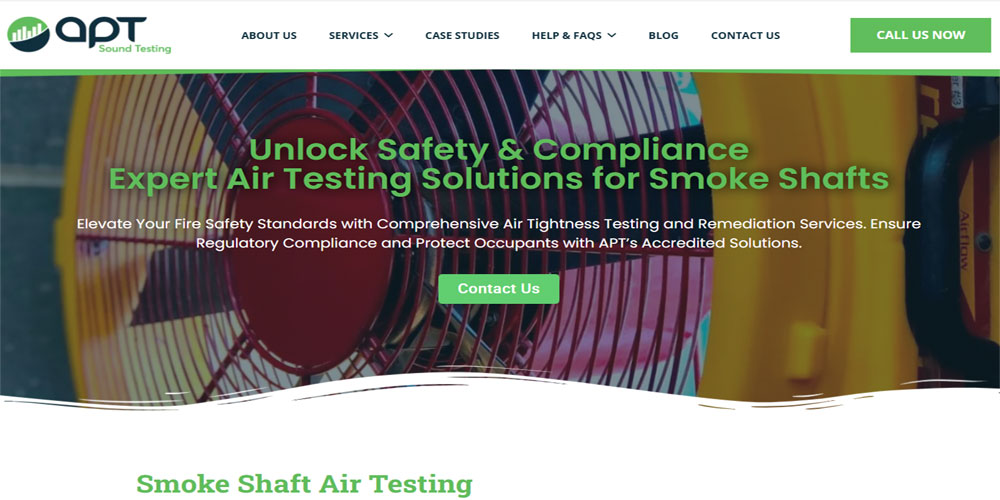
Smoke Shaft Air Testing from APT Sound Testing
Guide to Smoke Shaft Air Testing for High-Rise Developments
APT Sound Testing’s team of ATTMA Level 2 engineers carries out smoke shaft air testing using UKAS-calibrated equipment, with all testing undertaken in accordance with the latest applicable standards and guidance, including ATTMA TSL Issue 1, CIBSE TM23:2022, BS EN 13829 and BS EN 12101-2:2017.
Read our guide to the latest smoke shaft air testing regulations and standards.
How Smoke Shaft Air Testing Works
To begin the test, our engineer installs a high-powered blower door fan into an opening within the smoke shaft, typically at mid-floor level. We then temporarily seal the top and bottom of the shaft, along with other intended openings such as extract points and ventilation grilles.
Once the shaft is prepared, the fan pressurises it so its air permeability can be measured under controlled conditions.
Finding Air Leaks in Smoke Shafts
Our air testing engineer will conduct a controlled test to establish the smoke shaft’s air-pressure permeability. Smoke shafts are generally designed to achieve an air leakage rate of less than 3.8 m³/hr/m² at 50 Pa, subject to the requirements applicable to the particular project.
If the smoke shaft or AOV installation does not meet the required air permeability, our engineers can use specialist smoke-testing equipment to help locate the source of air leakage.
We use a high-powered smoke generator while the shaft is under pressure. Escaping smoke can make otherwise difficult-to-see leakage paths much easier to identify, allowing remedial works to be targeted more effectively.
Where smoke use could be problematic, our engineers can also use high-resolution thermal imaging cameras to help identify air leakage. Combining air testing with thermal imaging provides a highly effective way to investigate failed smoke shaft tests.
Smoke Shaft Air Testing Checklist
Before smoke shaft testing can take place, construction of the shaft should be substantially complete. To ensure the test can be carried out correctly and in accordance with the relevant requirements, the following points should also be addressed:
- No temporary seals should be present on the shaft envelope. Temporary seals are generally only permitted for dampers, fans and linking ductwork.
- Fire-stopping and penetrations should be fully completed throughout the shaft.
- No construction work or operatives should be present within the shaft during testing.
- The shaft should be clear of debris, tools and construction materials.
- A suitable 240V power supply should be available.
- Small blow heaters should be available in the smoke shaft, where required.
Meeting these requirements before our engineer arrives can help avoid delays and ensure the test proceeds efficiently.
Accreditation and Technical Competence
APT Sound Testing is a UKAS-accredited ISO/IEC 17025 testing laboratory, specialising in on-site (field) air tightness testing for smoke shafts in commercial and large-scale buildings.
Our UKAS accreditation demonstrates that our testing, reporting and quality management processes meet recognised technical and procedural standards.
We are also an ATTMA Level 2 registered organisation, qualified to test Large, Complicated and High-Rise (LCHR) buildings, as well as phased and zonal handover projects. In addition, our ATTMA EA accreditation enables us to perform accurate, compliant envelope area calculations for complex commercial buildings.
With more than 20 years of specialist experience, our engineers have provided testing and consultancy services on some of the UK’s most prestigious and technically challenging developments, including Battersea Power Station and the Imperial War Museum London.
This combination of accredited competence, specialist technical knowledge, and extensive industry experience lets us provide reliable, repeatable, and fully compliant smoke shaft air testing across a wide range of commercial and high-rise developments.
Contact APT Sound Testing
A failed smoke shaft air test can result in costly delays and remedial work. An experienced, appropriately accredited testing laboratory can help identify potential issues early and give your project the best chance of passing its smoke shaft air test on the first attempt.
If smoke shaft testing is required for your development, contact our smoke shaft testing specialist, APT Sound Testing, on 07775 623464 – 01525 303905 or email info@aptsoundtesting.co.uk to discuss your requirements and arrange a test.