Author: admin

UKAS Accredited Sound Testing

UKAS Accredited Sound Testing

UKAS Accredited Sound Testing

The need to carry out sound insulation testing to assess and report the acoustic performance of dividing partitions between dwellings has become increasingly important in order to demonstrate that a building’s intended performance is achieved when constructed.

Poor design detailing and/or onsite construction can have a significant impact on the overall performance of building elements and the building as a whole. Post completion sound testing provides greater certainty that designed performances are actually being achieved in compliance with Approved Document E.

Why we are a UKAS Accredited Air and Sound Testing Laboratory

Precompletion Sound Testing is now an integral part of supporting the completion certificate process throughout the UK and Ireland. In order to ensure that testing is undertaken within a robust regime which controls the reliability of test results, government guidance is in place which describes restrictions on those who should carry out sound testing and reportage.

Approved Document E states a set of sound tests should be carried out for every ten dwellings (houses, flats or rooms for residential purposes). However, if the development has several different construction types, you may need to carry out further tests for each type of construction.

For houses this usually means you are required to undertake 2 airborne wall sound tests (up to 10 houses) to the dividing walls. For flats you will be usually be required to undertake 2 airborne wall, 2 airborne floor and 2 impact floor tests (up to 10 Flats). When we undertake a fee proposal for clients, we always include a full testing schedule so it can be submitted to building control for their approval prior to the test date.  

One of the stipulations of Approved Document E is that the testing company needs to be UKAS accredited, this is covered under the Resistance to the passage of sound: Approved Document E [ADE] it goes on to state that “The person carrying out the building work should arrange for sound insulation testing to be carried out by a test body with appropriate third party accreditation” and is downloadable at: https://www.gov.uk/government/publications/resistance-to-sound-approved-document-e.

APT Sound Testing is UKAS accredited to carry out sound insulation testing and is laboratory and as a result our reports will be accepted by building control – here is a link to our UKAS Sound Testing Accreditation: https://www.ukas.com/wp-content/uploads/schedule_uploads/00002/4340Testing%20Multiple.pdf

For future note we are also UKAS accredited to carry out Air Tightness Testing – here is a link to our UKAS Air Tightness Accreditation: https://www.ukas.com/wp-content/uploads/schedule_uploads/00002/4340Testing%20Multiple.pdf

If you would like more information on our sound testing service and/or other services please contact us now at: info@aptsoundtesting.co.uk or visit our website at www.aptsoundtesting.co.uk.

Alternately, if you would like more information on how to prepare for your sound insulation testing please download our sound test checklist.

Sound Insulation Testing Terminology

Sound Insulation Testing Terminology

Sound Insulation Testing Terminology
Developers and landlords may need to improve sound insulation over a wide range of houses and flats. This may be due to the fact they have just built a new development that requires sound insulation testing under Part E or as part of a general refurbishment programme, i.e. changing houses into flats.

Often confusion can arise from the large amount of ‘terms’ used in conjunction with acoustic design and sound insulation testing. To help with this we have made a list of the following terms for clarity:

Absorption
This is the conversion of sound energy into heat, often by the use of a porous material.

Absorbent Material
This is a material that absorbs sound energy, such as acoustic mineral wool.

Airborne sound
This is sound which is propagated from a noise source through the medium of air. Examples of these are speech and sound from a television

Airborne Sound Transmission
This is direct transmission of airborne sound through walls or floors. When sound energy is created in a room, for instance by conversation, some of the energy is reflected or absorbed by room surfaces but some may set up vibrations in the walls and floor. Depending on both the amount of energy and the type of construction, this can result in sound being transmitted to adjacent parts of the building.

Air Path
This is a void in construction elements, which adversely affects the performance of sound resisting construction. Examples of air paths include incomplete mortar joints, porous building materials, gaps around pipes and shrinkage cracks – this can also effect the air tightness results.

Bonded resilient cover
This is a thin resilient floor covering normally of minimum 3-5mm thickness, which is bonded to the isolated screed surface to reduce impact sound transmission such as footfall noise, however it has a lesser effect when it comes to airborne noise.

Cavity stop
This is a proprietary product or material such as mineral wool (fibre) used to close the gap in a cavity wall.

Composite Resilient Batten
This is composed of a timber batten with a pre-bonded resilient material to provide isolation between the flooring surface layers and floor base.

Cradle/Saddle
This is an intermediate support system (with a resilient layer base, either pre-bonded or already integral) using levelling packer pieces to support a timber batten, isolating it from the floor base.

Decibel (dB)
This is the unit used for different acoustic quantities to indicate the level with respect to a reference level.

Density (kg/m3)
This is the mass per unit volume, expressed in kilograms per cubic metre (kg/m3). Blockwork is commonly referred to by industry in terms of strength (in Newtons). However, it is the density that has the important role in terms of sound insulation.

Direct transmission refers to the path of either airborne or impact sound through elements of construction.

DnT,w
This is the weighted standardized level difference. A single-number quantity (weighted) which characterises the airborne sound insulation between two rooms, in accordance with BS EN ISO 717-1:1997

Façade Testing
This Standard – ISO 140-5:1998) specifies the testing methods to evaluate the sound insulation in buildings and building elements for facades. Three rounds of a proficiency testing scheme for airborne sound insulation measurements have been performed according to the methods specified in the standard for a whole facade by using an external loudspeaker as the noise source.

Flanking element (flanking wall)
This is any building element that contributes to the airborne sound or impact transmission between rooms in a building which is not the direct separating element (i.e. not the separating wall or separating floor).

Flanking strip or edge strip
This is a resilient strip using foamed polyethylene normally 5 mm thick, which is located at the perimeter of a floor to isolate the floor boards from the walls and skirtings.

Flanking transmission
This is airborne or impact transmission between rooms that is transmitted via flanking elements and/or flanking elements in conjunction with the main separating elements. An example of a flanking element is the inner leaf of an external wall that connects to the separating ‘core’ of a wall or floor.

Flexible closer
This is a flexible cavity stop or cavity barrier which seals the air path in cavities linking adjoining dwellings.

Floating floor treatment (FFT)
This is a timber floating floor system which may use battens, cradles or platform base, all of which use a resilient layer to provide isolation from the base floor and adjacent wall elements.

Gypsum based plasterboard
This is a dry lining board applied to walls, ceilings and within floating floor treatments which has gypsum content. It may also have fibre reinforcement within the board.

Impact sound
This is sound which is propagated from a noise source through a direct medium. An example of this is footfall on a floor.

Impact sound transmission
This is sound which is spread from an impact noise source in direct contact with a building element.

Isolation
This is a strategy to limit the number and type of rigid connections between elements of construction.

L’nT,w
This is the weighted standardized impact sound pressure level. A single-number quantity (weighted) to characterise the impact sound insulation of floors, in accordance with BS EN ISO 717-2: 1997.

Mass
This is a physical quantity that expresses the amount of matter in a body. Walls and floors may be described in terms of the surface density (mass per unit area, kg/m2) of the wall face or the floor surface, which is the sum of the surface densities of each component of the construction. The density of materials is expressed as mass per unit volume, kg/m3, which can be provided via the core structure and linings such as in-situ concrete or solid dense block walls.

Mass per unit area (or surface density)
This is is expressed in terms of kilograms per square metre (kg/m2). This is often used to describe boards, panels, flooring and dry linings (see gypsum based board).

Resilience
This can reduce structural vibration transmission and still maintain material performance and overall dimensions, examples include floating floor treatments such as resilient battens or cradles, or resilient ceiling bars.

Resilient ceiling bars
This acoustic solution is generally metal based and vary in thickness from 11 mm to 30 mm. They are mounted perpendicular to the joist span direction and can increase both airborne and impact sound insulation. Care should be taken to ensure that the ceiling board fixings into the resilient bar do not come into contact with the joists and reduce the potential performance.

Resilient noggin
This is a small section of resilient ceiling bar which is used to assist in bracing non load bearing partitions.

Rw
This is a single-number quantity (weighted) which characterises the airborne sound insulation of a building element from measurements undertaken in a laboratory, in accordance with BS EN ISO 717-1: 1997

Sound Insulation Testing
Sound Insulation Testing is required near the end of a development to show that the performance of the party wall and floor partitions meet the standards as stipulated in Building Regulations Approved Document E. The testing methods for airborne and impact sound insulation is in full accordance with the suggested methods presented in BS EN ISO 140-parts 4 & 7: 1998.

Stiffness
This is can improve low frequency sound insulation, for example in floors, by reducing the potential for deflection or movement of the primary structure, therefore the correct spacing and depth of joists is important. If you have a project that requires acoustic design and/or sound insulation testing please let us know. APT Sound Testing will ensure you will have direct contact with the allocated acoustician from the start of the process, through to the successful completion of the sound insulation testing. 

If you would like more information in regards to acoustic services, please contact us at info@aptsoundtesting.co.uk or visit our website at: www.aptsoundtesting.co.uk    

Two Types of Sound Insulation Testing

Two Types of Sound Insulation Testing

Why are There two Types of Sound Insulation Testing

There are two types of sound insulation testing, Airborne and Impact. As the two types of testing are quite different here is a quick article explaining both types.

Airborne Sound Testing

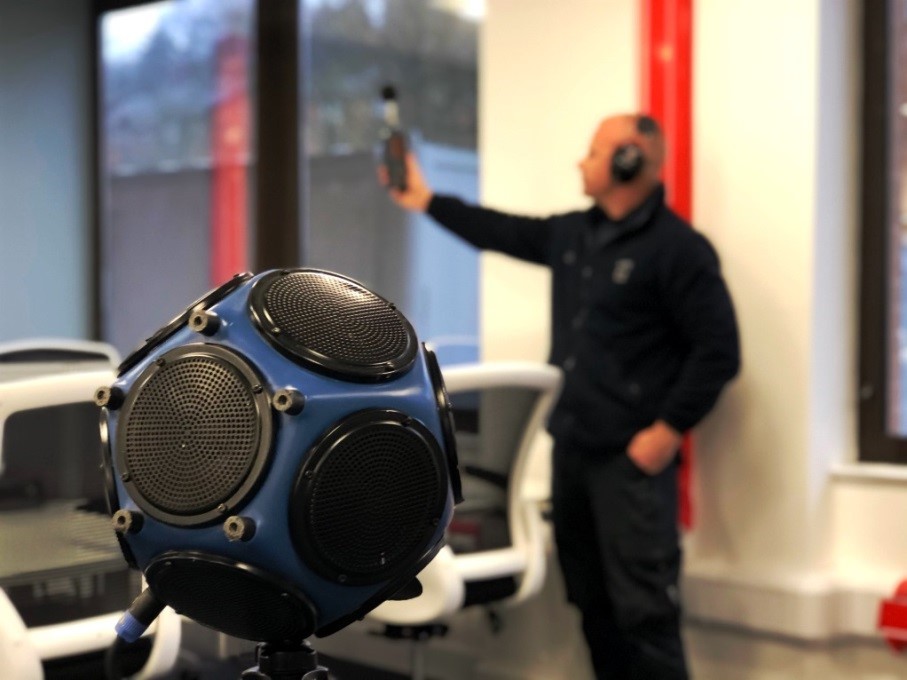
Airborne sound testing is undertaken to walls & floors. Firstly a controlled noise is generated by an amplifier and loudspeaker across a broad range of frequencies. The generated noise is very loud and is often in excess of 100dB. Initial measurements are taken using a class 1 sound level meter within the ‘source room’ followed by further measurements in the ‘receiver room’ on the other side of the wall or floor under investigation. The source room speaker position is then changed and the measurements repeated either side of the partition under test.

Two Types of Sound Insulation Testing

Thereafter background noise measurements are made using a class 1 sound level meter in the receiving room and are used to apply appropriate corrections for external sound such as traffic noise. Similarly the reverberation time (the time taken for sound to decay by 60dB) is measured within the receiving room using the sound source and a sound level meter to determine the corrections that must be applied to account for the characteristics and absorptiveness of the room.

 The difference in the two airborne noise levels (for walls and floors), corrected for background and reverberation characteristics determines the airborne sound insulation performance of the wall, or floor. A greater airborne noise difference between the source room and the receiver room determines a higher airborne sound insulation performance.

The time taken to undertake sound testing varies from project to project as no site is exactly the same. Taking into account standard site conditions a set of tests on houses -two airborne walls will take one to two hours. A six pack of tests on flats – 2 airborne wall tests will usually take between one and two hours, although this is dependent on our engineers having full free uninterrupted access between all the units/rooms under investigation.

Impact Sound Insulation Testing

Impact sound transmission testing is undertaken to floors only. This test is different; a calibrated Norsonic ‘tapping machine’ which comprises of five ‘hammers’ driven up and down by a cam and electric motor is used to “tap” the floor surface by applying a known force on the floor structure. The machine is placed in several pre-determined positions. The resulting noise is measured in the dwelling below, using a sound level meter.

Four Steps to Successful Sound Testing

Thereafter, background noise measurements are made using a class 1 sound level meter in the receiving room and are used to apply appropriate corrections for external sound such as traffic noise. Similarly the reverberation time (the time taken for sound to decay by 60dB) is measured within the receiving room using the sound source and a sound level meter to determine the corrections that must be applied to allow for the characteristics and absorptiveness of the room.

The measured noise levels in the receiving room are corrected for background and reverberation characteristics determine the impact sound insulation performance of the floor. For the impact noise the lower the measured level, the better the performance as less sound is being transmitted into the dwelling below.

The time taken to undertake sound testing varies from project to project as no site is exactly the same. Impact testing is usually undertaken as part for a 6 pack test, consisting of 2 airborne walls, 2 airborne floor and 2 impact sound tests. A standard 6 pack test will usually take between two and three hours, although this is dependent on our engineers having full free uninterrupted access between all the units/rooms under investigation.

If you require sound insulation testing, and/or acoustic design advice then please contact us now at info@aptsoundtesting.co.uk  or phone me (Darren) directly on 07775623464.

Improving Acoustics in Dwellings

Improving Acoustics in Dwellings

Improving Acoustics in Dwellings
When designing a new project containing multiple dwellings, why go further than just meeting the basic regulations. For instance, if you only manage to achieve the minimum requirements for compliance with Building Regulations Part E for sound testing, then the chance of noise complaints will usually be higher than if you better it by 5-7dB.  

Improving Acoustics in Dwellings

The World Health Organisation defines noise as ‘unwanted sound’ and such noise in buildings can have significant effects on the people (residents) who occupy them. If a person is subjected to excessive noise for long periods, it can result in physical discomfort or mental distress and in many cases noise complaints.

The WHO estimates that around 50% of the population of the European Union live in areas are exposed to noise levels that do not ensure acoustic comfort to their inhabitants and more than 30% are exposed to noise levels at night which is at a level disturbing to sleep this is simply not good enough.

Within homes, a noisy neighbour can be one of the main problems experienced in attached housing. It’s estimated that up to 4 million people in Britain have had their lives disturbed by noisy neighbours.

The best way to combat excess noise is to ensure that proper precautions are taken at the design stage of the project and thereafter during the construction of the building. Noise transmission levels should be compatible with the building’s usage with the correct acoustic climate provided in each space.

The UK has the building regulations and a number of sector-specific guidance documents covering noise, these are:

  • Approved Document E
  • Building Bulletin 93
  • Health Technical Memorandum 08-01
  • BS8233
  • BS4142

There are strong arguments for considering solutions that go above and beyond just meeting the minimum requirements in the above regulations. For instance using acoustic ceiling products and partition systems it is possible to create environments that offer greater acoustic comfort for occupants go above and beyond the standard Building Regulations requirements, which should have a positive impact on health, well-being and productivity.

Firstly, get advice on acoustic design before starting construction. The most effective way to ensure you improve the acoustics on your project and pass your sound test at the first attempt is to plan your project with sound insulation in mind. This does not need to be costly, and can save considerable time and cost at the end of the project, by reducing the chance of needing to undertake remedial works and re-testing.

The two main areas to take into consideration are usually the dividing wall and floor partitions. If you are unsure of how to build the separating wall and floor partitions and associated junctions across your project don’t panic, we can offer an acoustic design service. The degree of guidance you require can vary from site to site; however, we can cater for every eventuality by offering sample sound testing to establish the sound insulation performance of your existing wall and floors. Thereafter we can undertake more targeted design review using the information at hand.

When your project is underway, we can visit site and check the construction is being constructed as designed. Even minor alterations can have a significant impact on the effectiveness of your sound insulation measures.

Contact APT Sound Testing
If you have a new project and you need help with your acoustic design and/or sound testing then please email us at: info@aptsoundtesting.co.uk  or call us on 01525 303905. If you want more information on our full range of services please visit our website at: www.aptsoundtesting.co.uk

If you would like to download more information on how to prepare for your sound testing, please click download our sound testing checklist.

Sound Testing for New Build

Sound Testing for New Build

Sound Testing Services for New Build Dwellings
Sound Insulation Testing became mandatory in England & Wales in 2003, when Approved Document E was updated. Approved Document E requires new and converted to achieve a reasonable level of sound insulation between dwellings. The simplest way to comply with the requirements of Approved Document E; is to have on-site pre-completion sound insulation tests carried out on your project. We carry out full sound testing services in compliance with Approved Document E.

Sound Testing Services for New Build Dwellings

Sound Testing for New Build
In our experience there is usually a level of apprehension with our clients having to undertake pre-completion sound insulation tests.  This is often down to the fear of failure. It should be remembered; however, that if the acoustic design specification is closely followed, and a good standard of onsite workmanship is maintained there is very little chance of failure.

Approved Document E requires a minimum of one ‘set’ of tests for every ten units in each group and/or sub group.  Is usually broken down to the following: two airborne wall, two airborne floor and two impact sound tests. For example, if you have a block of 100 flats, all of the same construction, you would usually conduct 10 ‘sets’ of tests. If you have a development of 25 houses, with five different sub-groups (5 units in each) then you would usually conduct 5 ‘sets’ of tests. 

As previously stated a set of tests usually consists of two airborne tests of separating walls and two airborne tests and two impact tests on separating floors; however, if no separating floors are available, i.e. in semi-detached or terraced houses, one set of tests would consist of two airborne tests of separating walls only.

To test the airborne sound insulation properties of a floor or wall, a sound source which consists of an amplifier and loud speaker is set up on one side of the wall or floor partition that is to be tested. We then turn the setting to turn on Pink noise. Pink noise sounds like the static that can be heard on a radio that is off station or the old TV test card noise. This type of noise is used because it is made up of a wall of sound that has a wide spectrum of frequencies.

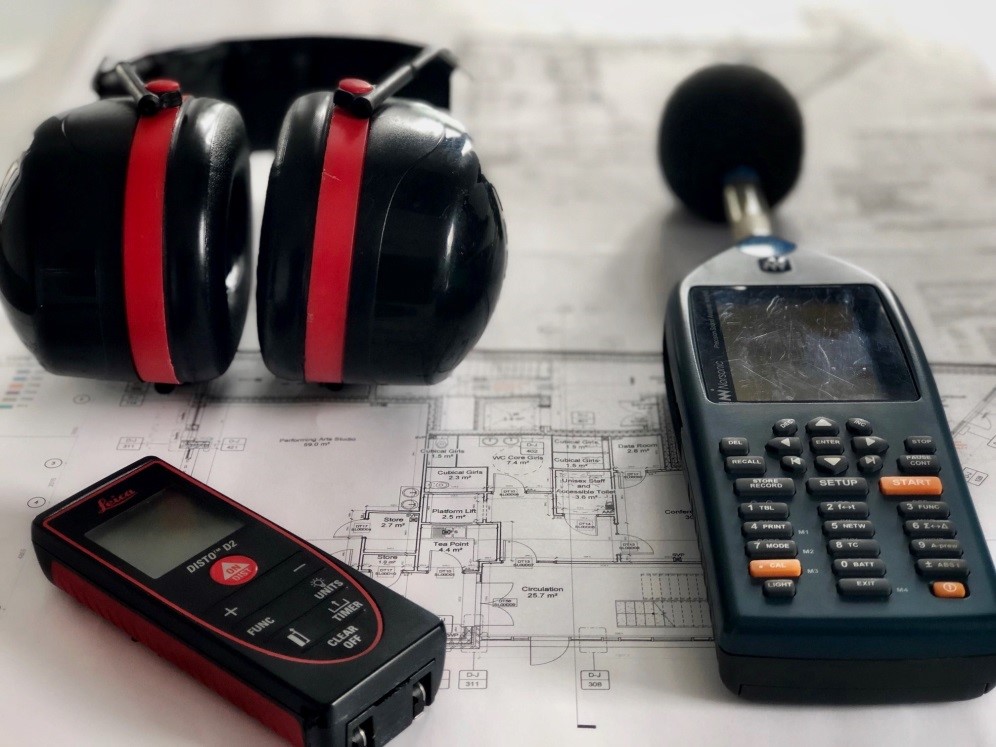
This provides an indication of sound insulation performance for a wide range of sounds that may be experienced within a dwelling from speech to a kettle boiling. The pink noise is measured in the room which contains the speaker or sound source using a Class 1 Norsonic sound level meter; thereafter the noise is measured on the other side of the wall or floor partition that is being tested. In layman’s terms the difference between these two levels is the amount of sound that is stopped by the sound insulating qualities if the wall or floor partition/s.

The result is then corrected and adjusted depending on the echo or reverberation time within the receiving room, and any background noise such as builders work noise etc. to give the airborne sound insulation result (DnT,w). The results of these tests are then compared to the performance criteria of Approved Document E – 45dB new build & 62dB for conversions) and a pass or fail sound test certificate is produced

To test the impact sound insulation performance of a floor, a Norsonic tapping machine which consists of five small hammers that are dropped onto the floor to simulate foot fall, is placed on the floor. The resultant noise in the room below is measured with a Norsonic Class 1 sound level meter and the amount of noise that passes through the floor is the impact sound transmission level and is expressed as a single number.

This result is then corrected and adjusted depending on the reverberation time of the rooms as well as any background noise to give the impact sound transmission result (LnT,w). The results of these tests are then compared to the performance criteria of Approved Document E – 62dB new build & 64dB conversions) and a pass or fail sound testing certificate is produced.

If pre-completion test results do not satisfy the performance criteria of Approved Document E, then our test engineer will attempt to determine the possible causes of failure. This may be to do with construction detailing around services or at junctions, or simply, poor acoustic design. Once the results have been finalised along with the associated graphs, our acoustician (with the aid of the information from the sound test engineer, we should be able to determine the specific cause of failure. Once a specific reason for failure has been determined, we can then advise the client on remedial actions that can be undertaken.

Contact APT Sound Testing Services
If you have a project that’s needs acoustic design advice or needs pre-completion sound testing then please visit our website at aptsoundtesting.co.uk or call us directly on 07775 623464 and we should be able to offer you an acoustic solution to help your project achieve practical completion.

Thermal Imaging Surveys

Thermal Imaging Surveys

Thermal Imaging Surveys
APT Sound Testing provide UKAS accredited sound testing & Thermal Imaging Surveys for London and the whole of the UK as required by Approved Document E of the Building Regulations. We undertake projects on all types of residential buildings and commercial buildings. We also undertake sound testing on schools and buildings containing rooms for residential purposes.

Thermal Imaging Surveys in London

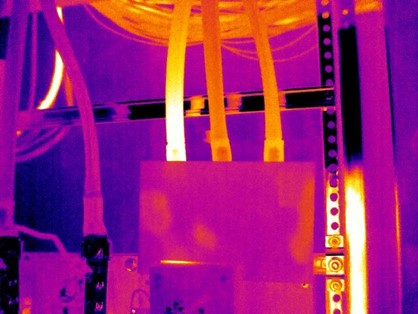
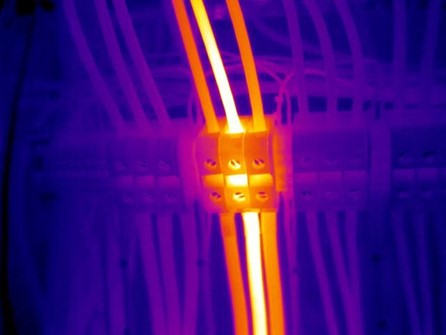
A thermal Imaging survey is a completely non-invasive method of investigating many aspects of a building that are virtually impossible by any other method.

Thermal Imaging Process

A thermal Imaging survey is an extraordinary method of investigating many aspects of a building that is completely non-invasive.

Thermal Imaging Inspections use IR Thermography to identify a wide range of issues such as:

• Incorrectly applied or inadequate insulation within the building envelope

• Locating air leakage paths into/out of your building

• Moisture infiltration

• Poor moisture barriers

There is no other low impact and accurate way to assess the unseen performance of insulation or the building fabric.

A thermal Imaging Survey can is also ideal for identifying water penetration through roofs or other parts of a building structure, alleviating the need for time consuming water dye tests which are not always accurate.

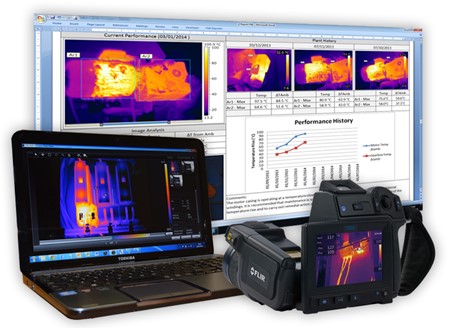
APT Sound Testing uses the latest Flir Thermal Imaging Cameras for our thermography report generation and as well as utilising the latest software for accurate reportage and trend analysis.

This means or thermal imaging reports can be issued within hours of the survey being completed with recommendations to help our clients deal with every eventuality.

How we Prepare for a Thermographic Survey

What is also important is that there must be no direct or residual solar loading from the sun in the building.

Many companies have their thermal imaging surveys undertaken an hour or so after sunset and this is usually flawed and may lead to inaccurate results. Whilst there may be rate exceptions to this, as a rule, there will be solar load in the building for many hours after sunset.

Therefore, we have learnt to undertake more accurate reportage the thermal imaging surveys should generally be conducted in the early hours of a cold morning, approx.

Two hours before the sun can fall on the building. It is more difficult to undertake conduct these types of heat loss survey during summer months when the ground temperatures and surrounding buildings are at high temperatures for months on end; however, this can be overcome by ramping up internal temperatures within the building and using the latest and more advanced thermal imaging cameras.

In all cases APT Sound Testing will check each project in isolation to ensure the correct site conditions are in place prior to undertaking the thermal imaging survey in compliance with the requirements with BS EN 13187. Building Regulations Part L and this link both offer lots of useful information in regards to Thermography Surveys.

We have years of experience working with a wide range of clients that span both the public and private sectors. We have clients ranging from self-builders through to the largest housing developers. We also work with the health authority and the banking sector on their cleanroom testing. Our clients have benefited from our wealth of knowledge and friendly, proactive service that we provide.

If you need more information on how to prepare your building for a Thermal Imaging Survey please download our air tightness testing checklist. If you would like more information in regards to our, please visit our website or call us Direct on 07775 623464.

Preparing for Sound Testing

Preparing for Sound Testing

Preparing for Sound Testing
For APT to undertake accurate sound testing we require that certain guidelines are followed, i.e. keeping site noise levels to be kept to a minimum etc. To record accurate test measurements, relatively quiet conditions are required on-site throughout the testing. Any site operatives working in the testing area will have to leave temporarily and any noisy works in the vicinity of the test areas including external site activity such as groundworks, drilling and banging will need to be halted, otherwise, it may result in a sound test failure.  We always provide a full sound testing checklist within our quotation which identifies what actions need to be undertaken prior to the sound insulation test.

The condition the buildings/dwelling is very important, as they can influence the results of the test. The following stages for sound testing will help preparation and also assess the point at which completed buildings can be tested. Generally before the test the parts of the building/rooms either side of the separating wall or separating floor should be complete.

Particular attention should be paid to the following:

1.    All separating floors and walls and all flanking walls and floors should be complete.

2.    All wall and floor junctions should be complete – to include flanking strips etc.

3.    All wall finishes should be complete, this should include skirting’s being in place. This does not include decorative finishes such as paint.

4.    Floors must be bare and no carpets should be laid – where a concrete floor with bonded resilient cover is to be fitted with wood based flooring. In this case, the test sample resilient floor cover should be tested with a wood based floor covering laid over the test sample area.

5.    Windows should be installed with all glass fitted.

6.    Trickle vents should be in place and closed.

7.    All doors should be fully fitted and closed. This includes internal doors and external doors fully fitted with doors seals.

8.    Services should be complete and any voids around ducts finished.

9.    Electrical sockets should be fitted.

10.   A 240V electricity supply should be available to all the test plots.

11.   There should be no noise during the test other than from the testing equipment.

12.   The test plots and adjacent areas within the building should be quiet for the duration of the test.

13.   No work should be carried out or noise made in the building at the time of the test.

14.   Site workers should not enter the building or be in the parts of the building undergoing a test.

After the sound insulation test a report or certificate should be provided in compliance with Building Regulations Part E.

This normally provides the following information:

1.    The company name and/or testers name and address that carried out the test and the accreditation held by the membership organisation.

2.    The client/applicant name.

3.    Site address.

4.    Plots tested

5.    If it was a wall or floor test.

6.    List of equipment used (including details on calibrated equipment) and testing technique.

7.    Confirmation that the test was in accordance with BS EN ISO 140 Part 4 (airborne) and Part 7 (impact).

8.    Measurement procedure.

9.    The results should be calculated in accordance with BS EN ISO 717-1 and 717-2 1997. Detailed test results giving a declaration of a pass or fail.

10.   Date of test. The test results or certificates will be submitted to the verifier during the completion certificate process.

The test duration depends on the amount of tests required on the project. Taking into account standard site conditions a set of tests on houses -two airborne walls will take one to two hours. A six pack of tests on flats, consisting of two airborne walls, two airborne floor and two impact tests will take between two to three hours. Throughout the sound testing we will require full free uninterrupted access to the units/rooms in all test areas.

We offer an acoustic design service to review the construction detailing. We also offer a sample testing service along with site inspections which provides a ‘one stop acoustic solution’. We visit site during the build process to check for any workmanship issues that may cause problems during the final pre-completion sound testing.

If you would like APT Sound Testing to review your site’s acoustic construction, then please speak to us about our acoustic design service. Call us today on 01525 303905 or alternatively visit the APT Sound Testing website for more information.

Sound Testing for Approved Document E

Sound Testing for Approved Document E

What Types of Sound Testing are required for Approved Document E?

Sound insulation testing must be carried out on new build and conversion dwellings. The dwellings will either require Airborne and/or impact sound testing depending on the type of dwelling. For houses airborne wall tests are usually required; however, for flats you usually need to carry out airborne wall, airborne floor and impact sound testing.

Airborne-sound-testing-on-flats

Here is a brief explanation on the two types of sound insulation tests:

Airborne Sound Tests – Airborne tests are carried out on party walls and floors/ceilings between dwellings. Airborne sound testing measures levels of sound transmitted through the air. We use a Norsonic loudspeaker that produces white noise on one side of the partition, and measure with a decibel meter on the other side how much sound is lost through the partition.

Examples of airborne noise that you usually expect to find in dwellings are people talking, radios and televisions.

Impact Sound Tests – These are only carried out on separating floor/ceiling divides between dwellings – usually on flats. An impact test measures the levels of noise transmitted directly through a separating construction as a result of impact noise, which emulates footfall noise from above. To produce footfall noise we use a tapping machine, which drops metal hammers onto the floor to create impact noise. We then measure the amount of sound that passes through the partition with a decibel meter in the room below the floor partition.

All testing should be carried our between ‘habitable’ rooms. Habitable rooms can be lounges, bedrooms, studies, living rooms and kitchens. Test findings are fed into an Approved Document E complaint report that will be then sent to the client to pass on to the tasked building control body. This sound test report should always be acceptable to Building Control and will help you to get your development signed off.

We provide a turnkey acoustic solution for consultants, project managers and developers from the design stage of developments, right through to the final precompletion testing, ensuring our clients have peace of mind when it comes to the acoustics on their projects.

APT Sound Testing is UKAS accredited to undertake Sound Insulation Testing under ISO/IEC 17025:2017. As a UKAS accredited laboratory we are required to attain the highest standards at all times.

For further information, please see our frequently asked questions section, or to prepare for your sound testing please download our sound test checklist.

For more information please contact us at info@aptsoundtesting.co.uk or call us on 07775623464. Alternately, for more information please visit our website at www.aptsoundtesting.co.uk

Sound Insulation Testing Information

Sound Insulation Testing Information

Sound Insulation Testing Information for Clients

Sound insulation testing or pre-completion sound testing must be carried out on new build dwellings as well as on converted dwellings. The dwellings will either require an Airborne sound test or an Airborne and Impact sound test. Airborne tests are carried out on separating walls between habitable rooms of dwellings such as houses or flats. Airborne and Impact sound tests are carried out on the separating partition floors between habitable rooms of flats. All sound insulation testing must comply with Approved Document E of Building Regulations.

All of our sound insulation tests are carried out in accordance with ISO 140-4 and ISO 140-7 and we are a UKAS accredited test laboratory, so you can be safe in the knowledge that all our sound testing is carried out to the highest standards in compliance with ISO 17025/2017.

Sound Insulation Testing Information

New build properties need to meet the requirements of DnTw+Ctr ≥45dB (more than) and LnTw  ≤62dB (less than).  Conversion properties need to meet the requirements of DnTw+Ctr ≥43dB (more than) and LnTw ≤64dB (less than).

APT Sound Testing test engineers have over 15 years of experience in sound insulation testing throughout London and the South East. We are experts in acoustic consultancy as well as the testing, having completed hundreds of acoustic design projects jobs throughout the UK. We take pride in offering all of our clients a personal and comprehensive acoustic service which is reflected in our positive google reviews and testimonials.  (See our positive customer testimonials here)

We provide a turnkey acoustic solution for consultants, project managers and developers from the design stage of developments, right through to the final precompletion testing, ensuring our clients have peace of mind when it comes to the acoustics on their projects.

What Is Sound Insulation Testing for Approved Document E?

As we have explained, Sound insulation testing must be carried out on new build dwellings as well as on converted dwellings. The dwellings will either require an Airborne sound test or an Impact sound test depending on the dwelling type.

Here is a brief explanation on the two types of sound tests:

Airborne Sound Tests – Airborne tests are carried out on party walls and floors/ceilings between dwellings. Airborne sound testing measures levels of sound transmitted through the air. We use a Norsonic loudspeaker that produces white noise on one side of the partition, and measure with a decibel meter on the other side how much sound is lost through the partition.

Examples of airborne noise that you usually expect to find in dwellings are people talking, radios and televisions.

Impact Sound Tests – These are only carried out on separating floor/ceiling divides between dwellings – usually on flats. An impact test measures the levels of noise transmitted directly through a separating construction as a result of impact noise, which emulates footfall noise from above. To produce footfall noise we use a tapping machine, which drops metal hammers onto the floor to create impact noise. We then measure the amount of sound that passes through the partition with a decibel meter in the room below the floor partition.

All testing should be carried our between ‘habitable’ rooms. Habitable rooms can be lounges, bedrooms, studies, living rooms and kitchens. Test findings are fed into an Approved Document E complaint report that will be then sent to the client to pass on to the tasked building control body. This sound test report should always be acceptable to Building Control and will help you to get your development signed off.

For further information, please see our frequently asked questions section, or to prepare for your sound testing please download our sound test checklist.

APT Sound Testing is UKAS accredited to undertake Sound Insulation Testing under ISO/IEC 17025:2017. As a UKAS accredited laboratory we are required to attain the highest standards at all times.

It is common knowledge that the assessment criteria used by UKAS are internationally recognised as being the best indicators of accurate, impartial and consistent performance. UKAS accreditation demonstrates an organisation’s competence, impartiality and performance capability against internationally recognised standards.

For more information on our Acoustic Design services and Sound Testing services in London, please give me a call direct on 07775 623464  or email us at info@aptsoundtesting.co.uk

Sound Testing Explained

Sound Testing Explained

Want to Know More About Sound Testing?

Airborne and Impact Sound is transmitted through most walls and floors by setting the entire structure into vibration. This vibration generates new sound waves of reduced intensity on the other side. The passage of sound into one room of a building from a source located in another room or outside the building is termed ”sound transmission”. 

Sound transmission loss or Sound Reduction Index, R dB, is a measure of the effectiveness of a wall, floor, door or other barrier in restricting the passage of sound. The sound transmission loss varies with frequency and the loss is usually greater at higher frequencies. The unit of measure of sound transmission loss is the decibel (dB). The higher the transmission loss of a wall, the better it functions as a barrier to the passage of unwanted noise across the dividing (acoustic) partitions.

Sound Testing Explained

Sound Testing Explained

Approved Document E stipulates that there are two types of sound insulation in buildings: airborne and impact. Airborne sound insulation is used when sound produced directly into the air is insulated and it is determined by using the sound reduction index. Impact sound insulation is used for floating floors and it is determined by the sound pressure level in the adjacent room below.

A sound insulation test of a separating partition will be considered as a pass if the airborne sound insulation is equal to or greater than the DnT,w + Ctr value shown for the appropriate dwelling in the table, for airborne testing in new builds properties a figure of 45dB or greater is required and for Impact testing 62dB and below. For conversion properties a figure of 43dB or greater is required and for Impact testing 64dB and below.

What is DnT,w

DnT,w is an in-situ measured performance parameter which demonstrates the level of resistance to sound transmission between two adjacent spaces, such as flats or houses. The measurement will include both direct sound transmission and flanking sound transmission of the construction. Flanking transmission is the effect of sound travelling through the building and may be particularly evident where beams and joists bridge a common partition or along poorly isolated lightweight wall constructions.

The DnT,w of a separating wall or floor will typically be of the order 5 to 7 dB lower than the manufacturers specified Rw (single figure quantity of sound insulation) for the single element, due principally to the contribution from flanking sound transmission around the element when it is built on site – this should always be accounted for in the initial acoustic design.

What is Ctr

Ctr is the spectrum adaption term. It is a correction attributed to the sound insulation quantity to account for urban traffic noise.

What is L’nT,w

L’nT,w is an in-situ measured performance parameter which demonstrates the level of resistance to impact sound transmission between floors. The impact measurement includes both direct sound transmission and flanking sound transmission.

Weighted Sound Reduction Index Rw

When specifying the acoustic performance of an acoustic partition in a more general manner, it can be useful to describe the sound insulation by a single number. The weighted sound reduction index, Rw , is a rating method given in EN ISO 717-1. This standard fits a standard reference curve to the measured sound reduction index curve.

Within the EN ISO 717-1 standard, a rating method is also given where the Rw value is completed by two C-terms which are applied to two models of the noise spectra for various types of noise. These two terms, Rw + C and Rw + Ctr, also include the frequency range 100 – 3150 Hz but can be extended to 50 – 5000 Hz. As industrial and traffic noise often have high sound levels which are also below 100 Hz, it is recommended that the extended frequency area is used.

The summary value, Rw + C, gives the reduction value in dBA for a spectrum with a level which is equally high in all third-octave bands. This can be used for:

•             Highway road traffic travelling at speeds in excess of 80 km/h

•             Factories emitting mainly medium and high frequency noise

•             Living activities (talking, music, radio, TV)

•             Railway traffic at medium and high speed

•             Jet aircraft at a short distance

The summary value Rw + Ctr also gives the reduction value in dBA, spectrum with low-frequency dominance such as:

•             Disco music

•             Urban road traffic

•             Railway traffic at low speeds

•             Factories emitting mainly low and medium frequency noise

Both the impact and airborne insulation performance of floors and walls should be carefully considered from the start of the project to ensure that the minimum performance requirements for new and converted developments are met inline with Approved Document E

If you would like more information in regards to our sound testing and/or noise survey services, please contact us now at info@aptsoundtesting.co.uk.