Author: admin

UKAS Accredited Sound Testing

UKAS Accredited Sound Testing

UKAS Accredited Sound Testing

The need to carry out sound insulation testing to assess and report the acoustic performance of dividing partitions between dwellings has become increasingly important in order to demonstrate that a building’s intended performance is achieved when constructed.

Poor design detailing and/or onsite construction can have a significant impact on the overall performance of building elements and the building as a whole. Post completion sound testing provides greater certainty that designed performances are actually being achieved in compliance with Approved Document E.
UKAS Accredited Sound Testing

Pre-completion Sound Testing is now an integral part of supporting the completion certificate process throughout the UK and Ireland. In order to ensure that testing is undertaken within a robust regime which controls the reliability of test results, government guidance is in place which describes restrictions on those who should carry out sound testing and reportage.

Approved Document E states a set of sound tests should be carried out for every ten dwellings (houses, flats or rooms for residential purposes). However, if the development has several different construction types, you may need to carry out further tests for each type of construction.

For houses this usually means you are required to undertake 2 airborne wall sound tests (up to 10 houses) to the dividing walls. For flats you will be usually be required to undertake 2 airborne wall, 2 airborne floor and 2 impact floor tests (up to 10 Flats). When we undertake a fee proposal for clients, we always include a full testing schedule so it can be submitted to building control for their approval prior to the test date.  

One of the stipulations of Approved Document E is that the testing company needs to be UKAS accredited, this is covered under the Resistance to the passage of sound: Approved Document E [ADE] it goes on to state that “The person carrying out the building work should arrange for sound insulation testing to be carried out by a test body with appropriate third party accreditation” and is downloadable at: https://www.gov.uk/government/publications/resistance-to-sound-approved-document-e.

APT Sound Testing is UKAS accredited to carry out sound insulation testing and is laboratory and as a result our reports will be accepted by building control – here is a link to our UKAS Sound Testing Accreditation: https://www.ukas.com/wp-content/uploads/schedule_uploads/00002/4340Testing%20Multiple.pdf

For future note we are also UKAS accredited to carry out Air Tightness Testing – here is a link to our UKAS Air Tightness Accreditation: https://www.ukas.com/wp-content/uploads/schedule_uploads/00002/4340Testing%20Multiple.pdf

If you would like more information on our sound testing service and/or other services please contact us now at: info@aptsoundtesting.co.uk or visit our website at www.aptsoundtesting.co.uk.
Airborne & Impact Sound Testing in London

Airborne & Impact Sound Testing in London

Airborne & Impact Sound Testing in London

Sound Testing usually needs to be carried out between pairs of rooms separated by party walls and/or floors. Most sound tests are carried out between living rooms and bedrooms as these are classed as the two main habitable rooms; however, other rooms can be used if this is not possible such as studies, kitchens and dining rooms.

Our Sound insulation testing procedure is fairly simple and straightforward. Essentially, for party walls there is only one type of sound insulation test which is airborne sound test; however for party floors there is a requirement for two types of sound insulation testing – airborne & impact sound testing. Here is a brief description for each type:

Airborne Sound Testing in London

Airborne Sound Testing is carried out by means of a loudspeaker emitting a steady source of noise on one side of the partition (wall or floor) to be measured. The corresponding sound level is measured on the other side of the partition. Impact sound insulation tests are carried out by means of a tapping machine placed on the floor sample to be measured and the noise measured in the room or space below. Calculations are done based on these measurement and the above mentioned parameters are calculated and compared to the Building Regulations Part E sound insulation requirements for the given type of the building. It is important that the building to be sound tested is completely finished and sealed with no sound leakage through doors and windows.  Please see our check list for sound testing for more information.

Airborne & Impact Sound Testing in London

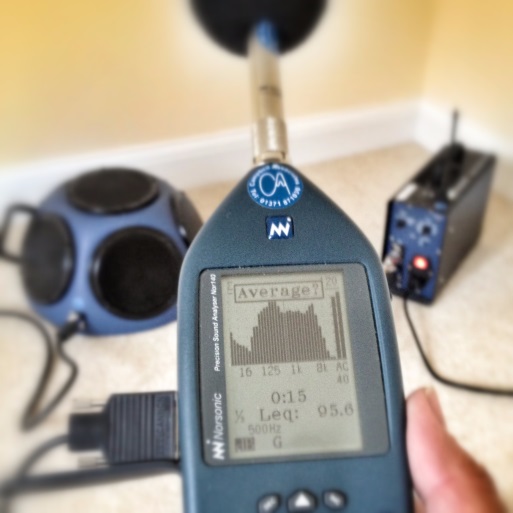
Airborne sound insulation testing is undertaken to walls & floors. Firstly a controlled noise is generated by an amplifier and loudspeaker across a broad range of frequencies. The generated noise is very loud and is often in excess of 100dB. Initial measurements are taken using a class 1 sound level meter within the ‘source room’ followed by further measurements in the ‘receiver room’ on the other side of the wall or floor under investigation.

The source room speaker position is then changed and the measurements repeated either side of the partition under test. Thereafter background noise measurements are made using a class 1 sound level meter in the receiving room and are used to apply appropriate corrections for external sound such as traffic noise. Similarly the reverberation time (the time taken for sound to decay by 60dB) is measured within the receiving room using the sound source and a sound level meter to determine the corrections that must be applied to account for the characteristics and absorptiveness of the room. The difference in the two airborne noise levels (for walls and floors), corrected for background and reverberation characteristics determines the airborne sound insulation performance of the wall, or floor. A greater airborne noise difference between the source room and the receiver room determines a higher airborne sound insulation performance.

The time taken to undertake sound testing varies from project to project as no site is exactly the same. Taking into account standard site conditions a set of tests on houses -two airborne walls will take one to two hours. A six pack of tests on flats – 2 airborne wall tests will usually take between one and two hours, although this is dependent on our engineers having full free uninterrupted access between all the units/rooms under investigation.

Impact Sound Testing in London

Impact sound testing is undertaken to floors only. This test is different; a calibrated Norsonic ‘tapping machine’ which comprises of five ‘hammers’ driven up and down by a cam and electric motor is used to “tap” the floor surface by applying a known force on the floor structure. The machine is placed in several pre-determined positions. The resulting noise is measured in the dwelling below, using a sound level meter. Thereafter, background noise measurements are made using a class 1 sound level meter in the receiving room and are used to apply appropriate corrections for external sound such as traffic noise. Similarly the reverberation time (the time taken for sound to decay by 60dB) is measured within the receiving room using the sound source and a sound level meter to determine the corrections that must be applied to allow for the characteristics and absorptiveness of the room.

The time undertaken to test each project varies from project to project as no building/development is exactly the same. Taking into account standard site conditions a set of tests on houses which consists of two airborne walls will take approx. 1-2 hours. A six pack of tests on flats consisting of 2 airborne wall, 2 airborne floor and 2 impact floor tests will usually take approx. 2-3 hours, although this is dependent on our engineers having full free uninterrupted access between all the units/rooms under investigation.

If you require sound testing, and/or acoustic design advice then please contact us now at info@aptsoundtesting.co.uk or phone Darren) direct on 07775623464.