Category: Sound Testing Services

Sound Testing Services in London

Sound Testing Services in London

Sound Testing Services on London Developments
London is a huge city containing over 8 million people. In this crowded environment it is essential that noise transference between properties in kept to a minimum between new and existing buildings for the occupant’s wellbeing.

To help control noise issues APT Sound Testing undertakes UKAS accredited Part E sound throughout London and the South East. When there are problems with noise transference between dwellings, and the building’s design is called into question we can offer advice on how to upgrade the wall and/or wall partition.

We has extensive knowledge regarding the way different materials and construction methods can influence the results of a sound test, this helps to ensure to ensure your company achieves compliance with the Sound Testing for Part E of Building Regulations.

Sound Testing Services in London
Pre completion sound testing in London has been a mandatory requirement since July 2003. All new build properties and conversions which were built after this date require 10% of each party wall/floor construction type to be tested. Sound insulation testing is to be carried out between pairs of rooms separated by party walls and/or floors. In is usual to test between living rooms and bedrooms, which are classed as the two main habitable rooms; however, other rooms can be used if this is not possible.

We are also experiencing a rise in the amount of sound testing that’s required to existing London buildings. We have carried out a large amount of sound tests in council/housing association blocks, where the residents are experiencing excess noise between the dividing wall and floor partitions. We also undertake sound testing to existing flats where the lease stipulates that wooden floors should not be used instead of carpets and as a result the noise levels have increased through the floors. In all these instances we can undertake sound testing to highlight the existing noise levels so acoustic upgrades – if required) can be targeted and implemented.

Our test procedure involves setting up a noise source in a room on one side of the party wall or floor and measuring the noise on both sides of the partition. Airborne sound testing may also be required between horizontally and vertically separated pairs of rooms.

The sound insulation testing is undertaken by using a sound source, amplifier and loudspeaker to generate a high noise level in one room (the source room). Noise measurements are then taken in both the source and receiver rooms using a prescribed number of source and microphone positions. The background levels in the receiver room are measured and the reverberation time in the receiver room is also measured. From the results, the airborne sound insulation (DnT,w + Ctr) is calculated and compared to the requirements of Approved Document E of Building Regulations.

For vertically separated rooms, Impact sound testing may also be required. This sound test is undertaken using a tapping machine which drops a series of weights onto the floor of the upper room. The noise level in the lower (receiver) room is measured for a prescribed number of source and microphone locations. The background levels in the receiver room are measured and the reverberation time in the receiver room is also measured. From the results, the impact sound insulation results (LnT,w) is calculated and compared to the requirements of Approved Document E of Building Regulations.

APT Sound Testing Services
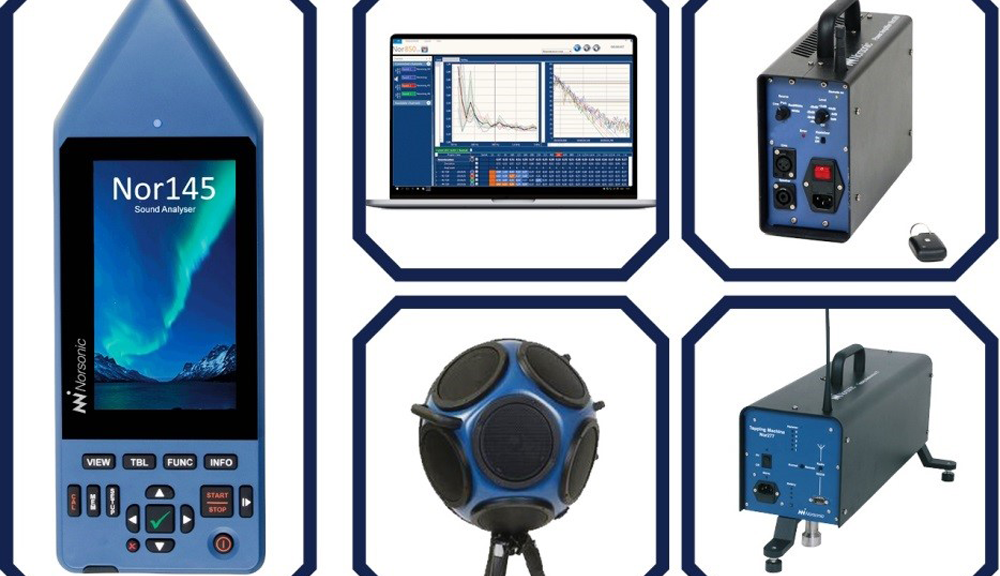
Our sound test engineers carry all the latest Norsonic equipment, which are class one rating and all of our sound insulation testing, is completed to a strict quality controlled standard. We provide full UKAS Accredited sound insulation testing and air testing.

If you would like advice on your acoustic design or sound testing in London, please contact APT Sound Testing now on 01525 303905 or visit our Acoustic & Sound Testing Services website.

APT Sound Testing Services in London

APT Sound Testing Services in London

Searching for APT Sound Testing in London

At APT Sound Testing, we carry out professional sound testing on all types of residential and commercial buildings across London and throughout the UK. Our services also cover schools and buildings that include rooms for residential use. As a UKAS-accredited provider, all of our testing meets the requirements of Approved Document E of the Building Regulations.

A Friendly, Proactive Approach to Acoustic Compliance

We pride ourselves on offering a friendly, forward-thinking service that covers everything from acoustic design and consultancy to full pre-completion testing and certification. With many years of experience supporting clients in both the public and private sectors, we work with everyone—from self-builders and small developers to major national house builders. We also support specialist sectors, including healthcare and banking, particularly for cleanroom testing.

Our clients value not only our deep technical knowledge but also our approachable, proactive way of working. This commitment to service is one of the reasons we enjoy one of the highest return-client rates of any pre-completion testing consultancy in the UK.

Local Expertise with National Reach

Unlike many providers, we never subcontract our work. All testing is completed by our in-house engineers, ensuring consistency, quality, and reliability across every project.

With an office located in central London, we’re ideally positioned to respond quickly to urgent survey and testing requirements. We also have the capacity to carry out last-minute appointments and weekend testing, a service used frequently by clients in fast-paced sectors such as banking.

Qualified Engineers, UKAS Accreditation, and Modern Equipment

Our highly trained engineers deliver an efficient, customer-focused service from the initial design phase through to project completion. Thanks to decades of accumulated acoustic design experience, we understand the unique needs of each project and can tailor our advice accordingly.

As a multi-UKAS accredited laboratory operating to strict ISO standards, we guarantee a high level of quality and professionalism. We invest heavily in state-of-the-art acoustic testing and survey equipment, all calibrated to UKAS standards, enabling us to deliver accurate and dependable results.

Integrated Acoustic and Air Tightness Services

To make compliance as smooth as possible, we also offer in-house UKAS-accredited air tightness testing, allowing clients to combine both services in a single, seamless package—reducing costs and avoiding coordination headaches.

Get in Touch

If you need advice or want to book a sound test, we’re here to help. Contact us through our online form or call 01525 303905 to discuss your project with one of our friendly and knowledgeable acoustic or air-tightness consultants.

Sound Testing Roadmap for Leaseholders

Sound Testing Roadmap for Leaseholders

Sound Testing Roadmap for Leaseholders

This guide is designed specifically for leaseholders who are upgrading their floor finishes from carpet to wood. It explains why sound testing is required, what the tests measure, and how to ensure compliance with lease conditions and Building Regulations.


🔎 Why Leaseholders Require Sound Testing to Floors

Many residential leases include covenants that:

  • Require carpets to remain in place, or
  • Demand proof that any new hard floor finish (such as wood or laminate) achieves equivalent sound insulation performance to the original construction.

Why?

  • Carpets naturally reduce impact noise (footsteps, moving furniture).
  • They also help limit airborne noise.
  • Replacing carpet with wood often increases both impact and perceived noise in the flat below unless acoustic upgrades are installed.

Freeholders and management companies typically request acoustic evidence to prevent disputes and ensure compliance with lease terms or Building Regulations Part E.


📊 Pre‑Works and Post‑Works Sound Testing

  • Pre‑works sound testing: Baseline measurements are taken with the existing carpet finish to record current airborne and impact insulation performance. These results set the target values for the new floor system.
  • Acoustic upgrades: Specialist acoustic companies can recommend tailored upgrades (e.g., underlays, insulation, resilient ceiling systems) to maximise the chance of passing post‑works testing.
  • Post‑works sound testing: Conducted after installation and upgrades, using the same methods to provide a direct comparison with baseline results.
  • Test standards and measurements: Reports follow recognised methods for airborne and impact sound reduction. Results are compared against lease requirements, Building Regulations Part E, or the pre‑works baseline.

👉 Tip: Always confirm test protocol, locations, and pass criteria with your management company before starting work. This ensures results are accepted without dispute.


📐 How to Compare and Complete Sound Test Results

  1. Match test conditions: Post‑works sound tests must replicate pre‑works setup (same receiver positions, furniture state, doors/windows closed).
  2. Compare metrics:
    • Airborne noise: Higher sound reduction (dB) = better. Post‑works values should equal or exceed baseline.
    • Impact noise: Lower sound pressure level (Lp) = better. Post‑works values should be equal to or lower than baseline.
  3. Produce a compliance report: Include:
    • Accredited test certificates
    • A clear table comparing pre‑ and post‑works values
    • Photographic evidence of acoustic measures
    • A signed statement confirming the tested configuration represents the finished floor system
  4. If results fail: Document remedial measures and re‑test. Common fixes include adding or improving acoustic layers above/below joists.

Accurate records and clear reporting help secure freeholder sign‑off or a formal Licence to Alter.


Summary

Converting from carpet to wood in a leasehold flat almost always requires both pre‑works and post‑works sound testing. The best chance of compliance comes from:

  • Baseline testing
  • Targeted acoustic upgrades (underlays, cavity insulation, resilient ceilings, specialist panels)
  • Post‑works verification

This combined approach ensures no loss of acoustic performance compared with the original carpet finish.


📞 Contact Us Today

Our expertise, comprehensive services, and commitment to quality make us the trusted choice for sound insulation testing. We use the latest UKAS calibrated sound test equipment so you can be sure you are in safe hands.

  • 📧 Email: info@aptsoundtesting.co.uk
  • 📱 Call Darren direct: 07775 623464

Contact us today to schedule a sound test or learn more about our acoustic design services.

Guide to Sound Testing in London

Guide to Sound Testing in London

Introduction to Sound Testing in London

When constructing or converting residential buildings in London, one crucial but often overlooked aspect is sound insulation. Ensuring your property meets the necessary acoustic standards isn’t just a courtesy to future occupants—it’s a legal requirement.

Under Building Regulations Approved Document Part E, developers are required to demonstrate that separating walls and floors between dwellings provide adequate resistance to the passage of sound. Whether you’re constructing a new apartment block, converting a house into flats, or repurposing a commercial space into residential use, sound testing plays a vital role in ensuring compliance and creating comfortable living environments.

So, what does sound testing involve, and what types should you expect during your project in London? Let’s dive into the details.


Why Is Sound Testing Important?

Sound testing is designed to assess the effectiveness of acoustic insulation between dwellings. The goal is to ensure a reasonable level of sound separation—so that people can enjoy peace and privacy in their own homes without being disturbed by their neighbours.

In London, with its dense housing stock and increasing number of mixed-use developments, proper sound insulation is more important than ever. This is especially critical in buildings where different households share walls or floors.

When Is Sound Testing Required?

If your project involves:

  • A new-build dwelling
  • A conversion into self-contained flats
  • A material change of use (e.g., turning an office into residential units)

…and the dwellings are attached via a shared wall or floor that is not used exclusively by the same occupants, then sound testing is mandatory before completion.

According to the regulations, at least 10% of each type of separating wall or floor construction must be tested.


The Two Main Types of Sound Testing

Sound testing typically falls into two categories: Airborne Sound Testing and Impact Sound Testing. Depending on your building’s layout and construction, both may be required.

1. Airborne Sound Testing

Airborne sound testing measures how well walls or floors prevent sound from traveling through the air—such as talking, TV noise, or music.

This test is commonly carried out between adjacent rooms in separate dwellings—like bedrooms or living rooms—both horizontally (side by side) and vertically (floor to ceiling).

How It Works:

A loudspeaker is placed in the “source” room and generates high sound levels. The sound levels are then measured in both the source and adjoining “receiver” room using a calibrated microphone. Background noise levels and the reverberation time (how long sound lingers) are also recorded to ensure accuracy.

What’s the Requirement?

  • New build: Minimum of 45 dB airborne sound insulation
  • Conversions: Minimum of 43 dB

The higher the decibel value, the better the sound insulation.

2. Impact Sound Testing

Impact sound testing is relevant for vertically-separated dwellings—for example, between an upstairs flat and a downstairs unit. This test assesses the level of noise generated by impacts (think footsteps, dropped items) on the floor.

How It Works:

A tapping machine is placed on the floor in the upper room. This device drops small hammers in a controlled sequence to simulate footfall. Sound levels are then measured in the room below. Like with airborne testing, reverberation and background levels are also taken into account.

What’s the Requirement?

  • New build: No more than 62 dB
  • Conversions: No more than 64 dB

In this case, the lower the decibel value, the better the insulation performance.


Sample Sound Testing During Conversions

If you’re converting an existing building—such as turning an old office into flats—it’s wise to carry out sample sound testing before you start construction.

Why? Because many older buildings weren’t designed with acoustic separation in mind. You might find:

  • Insufficient mass in the separating structure
  • Poor isolation between walls/floors
  • Unintended sound paths (known as flanking transmission)

Common Flanking Paths

One of the most frequent culprits is the inner leaf of an external cavity wall—particularly if it’s built using lightweight blocks like Thermalite. Sound can travel along these paths and reduce overall insulation performance, even if the separating wall or floor is well-built.

By doing a pre-construction sample test, you’ll get an accurate picture of the current sound insulation and can plan a targeted acoustic upgrade—potentially saving time and costly remedial works later on.


Sound Testing of External Facades

Another area of acoustic performance often overlooked is the external facade. This is particularly relevant for properties located in noisy areas—like those near busy roads, railways, or flight paths.

How It Works:

  • A loudspeaker is placed approximately 5 meters outside the building at a 45-degree angle.
  • Sound pressure levels are measured 2 meters in front of the facade and 1.5 meters above ground.
  • The results help evaluate how much environmental noise enters through the external envelope of the building.

This type of testing is essential for developers targeting high-performance builds or for residential units located in designated noise-sensitive zones.


Professional, Accredited Testing Services

Sound testing must be performed by qualified professionals using high-precision equipment. At APT Sound Testing, our engineers use Class 1 Norsonic instruments — the gold standard in acoustic testing.

We carry out testing to UKAS-accredited and ISO-compliant standards, ensuring results you (and your building inspector) can trust. Whether you need testing for a small conversion or a large residential scheme, our team has the experience to guide you through every step.


Get in Touch

If you’re working on a building project in London and need sound testing to comply with Part E of the Building Regulations, we’re here to help. From pre-construction advice to final handover testing, APT Sound Testing provides a complete acoustic consultancy service.

📞 Call us on 01525 303905
🌐 Visit: APT Sound Testing Services

Sound Testing in London

Sound Testing in London


Types of Sound Testing in London

Building Regulations Part E require that builders demonstrate the sound insulation performance of separating walls/floors in new-build dwellings and/or converted dwellings or rooms for residential purposes (as well as those newly formed by a material change of use). This applies when separate dwellings are attached via a common partition not exclusively used by the same occupants. The only way to satisfy the relevant compliance with building regulations is to undertake sound testing in London.

The regulations set minimum performance requirements for sound insulation between spaces, as to provide reasonable conditions for living. Performance can be demonstrated either by sound testing a sample of as-built constructions/properties.

Sound Testing in London

Sound Insulation Testing needs to be carried out between pairs of rooms separated by party walls or floors. In most cases the rooms to be sound tested will be the two main habitable rooms – living rooms and bedrooms. The sound testing procedure involves setting up a noise source in a room on one side of the party wall or floor and measuring the noise on both sides of the partition.

Sound Testing for Part E of Building Regulations has been a mandatory requirement since July 2003. All new build dwellings and conversions which were built after this date require 10% of each party wall/floor construction type to be tested.

There are two mains types of Sound Testing in London that need to be carried out prior to the building handover, they are:

Airborne Sound Testing
Airborne sound tests are usually required between horizontally and vertically separated pairs of rooms. The sound tests are undertaken by using a sound source, amplifier and loudspeaker to generate a high noise level in one room (the source room). Noise measurements are then taken in both the source and receiver rooms using a prescribed number of source and microphone positions. The background levels in the receiver room are measured and the reverberation time in the receiver room is also measured.

From the results, the airborne sound insulation (DnT,w + Ctr) is calculated and compared to the requirements of Approved Document E. For new build projects you are required to achieve 45dB for airborne sound testing through walls and floors and 62dB for Impact sound testing for floors. For refurbishment projects this changes to 43dB for airborne and 64dB for impact.

Impact Sound Testing
For vertically separated rooms, an Impact sound test may also be required. This sound test is undertaken using a “tapping machine”, (as above) which drops a series of weights onto the floor of the upper room. The noise level in the lower (receiver) room is measured for a prescribed number of source and microphone locations. The background levels in the receiver room are measured and the reverberation time in the receiver room is also measured. From the results, the impact sound insulation (L’nT,w) is calculated and compared to the requirements of Approved Document E.

Sample Sound Tests
If you are undertaking a conversion project, i.e. subdividing a commercial office building into flats, it is important to ascertain the performance of your existing floor and wall partition. In our experience there is often noise travels directly through the separating partition due to lack of mass or isolation; or, it may be coming along another indirect route – called a flanking path. One of the most common flanking paths is the inner leaf of an external cavity wall, especially if it’s been constructed out of a lightweight weight material such as thermalite blockwork.

To offer our clients peace of mind we can visit site before any construction works have taken place and undertake a series of sample sound tests to check the acoustic performance of the existing partitions. This allows our clients to undertake a targeted acoustic design, saving time and money.

Sound Testing of Building Facades
For the sound testing of external facades we place the loudspeaker outside  the  building  at a distance of 5m from the facade with  the  angle  of  sound incidence  equal  to  45° ± 5°  and  such  that  the  real  traffic  noise  impact  is simulated  the  best  possible  way.  The speaker and amplifier are used to generate a steady random noise signal via the loudspeaker source. The sound pressure levels are then measured at 2m in front of the facade plane and 1.5m above the ground.

Contact APT Sound Testing
All APT’s test engineers carry the latest Norsonic sound testing equipment, which are class one rating. All of our sound testing is completed to a strict quality controlled standard. We provide full ISO & UKAS complaint sound testing. If you would like more information in regards to sound testing in London, please contact us on 01525 303905 or visit our website APT Sound Testing Services website.

Sound Testing for Dwellings

Sound Testing for Dwellings

Sound Testing for Dwellings: Ensuring Compliance

Since July 2003, pre-completion sound testing has been a mandatory requirement under Part E of the Building Regulations. As a UKAS-accredited sound insulation testing laboratory, we offer a proactive and reliable sound testing service to help our clients achieve building control sign-off with ease.

If you’re involved in the construction or renovation of dwellings, it’s crucial to understand the importance of sound testing. Here’s what you need to know about the process and why it’s essential for your project.

What is Sound Testing for Dwellings?

A common question we receive from clients is: “What exactly is sound testing?” In simple terms, sound insulation testing assesses whether a building meets the required acoustic standards. It is a necessary process for new builds and conversions, ensuring compliance with building regulations.

To ensure accurate results, sound testing must be carried out by a qualified professional with third-party accreditation, such as a UKAS-accredited sound testing company. This guarantees that the testing process adheres to strict quality standards and provides reliable results for regulatory compliance.

Types of Sound Testing

There are two primary types of sound insulation testing:

1. Airborne Sound Insulation Testing

Airborne sound refers to noise that travels through the air and penetrates separating structures between rooms. In the case of a lightweight floor, airborne sound could pass through elements such as the plasterboard ceiling, the floor void, and the floorboards, ultimately reaching the adjacent room.

2. Impact Sound Insulation Testing

Impact sound measures the noise level in a room when a direct impact is made on the floor above. This test is particularly important in multi-story buildings, where sound transmission between floors needs to be minimized to ensure comfortable living conditions for occupants.

Regulatory Requirements and Compliance

The specific acoustic performance standards for new builds and conversions are outlined in Approved Document E: Resistance to the Passage of Sound. These regulations set the minimum requirements for sound insulation, ensuring that buildings provide adequate protection against noise transmission.

For refurbishments, the standards are slightly more lenient than for new constructions, as it is generally more challenging to retrofit effective soundproofing solutions into existing structures. However, compliance is still required to meet building control approval.

When is Sound Testing Required?

All new-build properties and conversions completed after July 2003 must undergo sound testing. A minimum of 10% of each party wall and floor construction type must be tested to ensure compliance with regulations. Testing is conducted between pairs of rooms that are separated by party walls or floors, helping to verify that noise levels remain within acceptable limits.

Why Choose APT Sound Testing?

At APT Sound Testing, we bring years of acoustic design experience to every project, ensuring a seamless process from initial design consultation to final pre-completion testing. Our team of expert acoustic engineers provides:

  • Comprehensive Sound Testing Services – Covering both airborne and impact sound insulation testing.
  • UKAS-Accredited Testing – Ensuring compliance with regulatory standards.
  • Fast and Reliable Service – With site visits typically available within one week.
  • Expert Acoustic Design Advice – Helping you implement effective soundproofing solutions.
  • Competitive Pricing – Offering cost-effective sound testing without compromising on quality.

Our goal is to make sound insulation testing as straightforward as possible for our clients. Whether you’re a builder, architect, or developer, we’ll guide you through the process to ensure full compliance with Building Regulations.

Book Your Sound Test Today

Don’t let sound insulation testing be an afterthought — ensure compliance early to avoid delays in your project completion. Contact APT Sound Testing today to schedule a sound test or to learn more about our additional services, including acoustic design detailing.

📧 Email: info@aptsoundtesting.co.uk
📞 Call: 01525 303 905 or 07775 623464

We look forward to working with you and helping you achieve a successful building control sign-off!

Introducing APT Sound Testing

Introducing APT Sound Testing

APT Sound Testing & Acoustic Design Services

At APT Sound Testing, we pride ourselves on offering a friendly, proactive, and expert service in sound testing, acoustic design, and compliance certification. Our team of experienced sound test engineers is dedicated to ensuring our clients achieve the necessary acoustic results to pass sound testing and attain building completion. With our in-depth knowledge and commitment to quality, we provide tailored acoustic design advice and UKAS-accredited services, ensuring seamless compliance with all regulatory requirements.

Comprehensive Sound Testing Services

We conduct sound testing for a wide range of buildings, including residential and commercial properties, schools, and other facilities containing rooms for residential purposes. Our UKAS-accredited sound testing services cover London and the entire UK, ensuring compliance with Approved Document E of the Building Regulations.

By choosing APT Sound Testing, you gain access to a team that understands the intricacies of acoustic performance. Our expertise ensures that buildings meet the required standards, reducing the risk of costly delays in the construction and certification process.

Why Choose APT for Your Thermal Imaging Survey?

Our thermal imaging services stand out due to our extensive experience and technical expertise. We have been at the forefront of infrared inspections for years, serving the engineering, construction, maintenance, and management industries across the UK. Our professional thermographers are qualified in accordance with BS EN 13187, surpassing the requirements of BREEAM. Whether it’s detecting thermal bridging, identifying insulation defects, or ensuring airtightness, our advanced imaging techniques provide invaluable insights for your project.

Smoke Shaft Testing for Multi-Storey Developments

Automatic Opening Ventilation (AOV) systems play a crucial role in fire safety for high-rise buildings. Ensuring that smoke shafts are sufficiently airtight is vital for the effective transport of clean air and smoke extraction. Our smoke shaft testing service helps to confirm compliance with national air permeability standards, reducing the risk of smoke inhalation and enhancing occupant safety. By verifying that these systems function correctly, we contribute to the overall fire strategy of multi-storey developments.

Premium Last-Minute Thermal Imaging Service

Building maintenance and diagnostics often require quick and precise action. Our premium last-minute thermal imaging service is designed for urgent situations where immediate analysis is needed. Whether it’s detecting roof leaks, identifying electrical faults, or ensuring the integrity of the building envelope, our Level 3 thermographers use state-of-the-art FLIR thermal imaging cameras to deliver accurate and reliable results. When time is of the essence, APT Sound Testing provides the highest level of professionalism and efficiency.

Experienced Sound Testing Engineers

Our sound testing engineers are not only highly qualified but also dedicated to delivering the best service possible. We provide expert acoustic design advice to help clients meet regulatory requirements and successfully pass sound testing. Additionally, we offer UKAS-accredited air tightness testing as part of a comprehensive package, reducing costs and simplifying coordination.

Who We Work With

APT Sound Testing has years of experience working with a diverse range of clients across both the public and private sectors. From self-builders to major housing developers, as well as health authorities and financial institutions requiring cleanroom testing, we cater to a wide spectrum of needs. Our commitment to excellence has resulted in one of the highest client retention rates in the UK’s pre-completion testing and consultancy sector.

We take pride in our ability to provide a unique, proactive service. Unlike many other companies, we do not subcontract our work—all testing and consultancy services are carried out in-house. This ensures consistent quality and accountability across all our projects.

Convenient & Responsive Service

With an office located in central London, we are strategically positioned to respond quickly and efficiently to client requests. Our resources allow us to accommodate last-minute testing and weekend work, which is particularly valuable for clients in the banking sector and other industries with tight schedules.

Our highly trained engineers prioritize customer satisfaction, ensuring a quick and efficient service. By leveraging years of acoustic design experience, we have built an extensive knowledge base that enables us to understand and meet the specific requirements of each project. As a multi-UKAS accredited laboratory working to strict ISO standards, we guarantee a high-quality service from initial consultation to project completion.

Our Commitment to Quality & Practical Solutions

At APT Sound Testing, we listen carefully to our clients’ needs and provide practical, cost-effective solutions tailored to their projects. Our approach considers buildability and compliance in a holistic manner, offering a seamless acoustic consultancy service that includes both acoustic design and pre-completion testing.

We invest heavily in state-of-the-art acoustic testing and survey equipment, all of which is UKAS-calibrated to the highest standards. By continually enhancing our personnel and technology, we can offer an efficient and accurate service that meets and exceeds industry expectations.

Contact APT Sound Testing Today

APT Sound Testing is dedicated to providing top-tier acoustic design, sound testing, and compliance solutions. Our team is always ready to assist with your project, offering expert advice and reliable service to ensure your building meets the required standards.

Get in touch with us today to discuss your latest project. Call us at 01525 303 905 or visit our website to learn more about our comprehensive services.