Floor Plenum Testing Services
Floor Plenum Testing: What You Need to Know
BG 65/2016 Floor Plenum Testing Guidance sets out the methodology for testing floor plenum airtightness, and it’s a standard that APT Sound Testing follows closely on every project.
But what exactly is a floor plenum, and why does airtightness matter so much?
What Is a Floor Plenum?
A floor plenum is the void between a building’s structural floor and a raised access floor. This space is commonly used to distribute conditioned air throughout a building.
For the system to work efficiently, that air must flow into the occupied space, not escape into cavities, risers, stairwells, or other adjacent areas. When a plenum is properly sealed, diffusers and grilles can deliver air at the correct flow rate, ensuring comfort and performance.
What Is Floor Plenum Testing?
If your building includes floor or ceiling plenums, airtightness testing is essential. Surprisingly, around 70–75% of plenums fail their first air test.
With extensive experience in raised access floor testing, APT Sound Testing helps clients avoid that outcome. By getting involved early, testing can be carried out as soon as the floor is installed, identifying issues before they become costly problems.
What the process involves:
- Initial air pressure testing
- Smoke surveys to detect leakage paths
- A detailed report highlighting problem areas
- Guidance for sealing contractors to resolve issues
This proactive approach significantly improves the chances of passing the test first time.
Why Do So Many Plenums Fail?
There isn’t just one reason, failures usually come down to a combination of factors.
One of the biggest issues is a lack of awareness around how airtight a plenum actually needs to be. While systems may perform well in laboratory conditions, real-world construction introduces complications.
Multiple trades often need to run cables, pipes, and services through the plenum. Every penetration is a potential leakage point, and without proper sealing, performance drops quickly.
Key Considerations During Construction
Achieving airtightness starts long before testing. Here are some of the most important factors to consider:
1. Raised Access Floor and Finishes
Carpet tiles are often installed over raised floors. If their joints don’t align with the floor panels, and especially if they’re glued, they can help reduce leakage.
However, finishes should never be relied on as the primary airtightness solution, as they can degrade over time.
2. Service Boxes and Penetrations
Electrical and data floor boxes can significantly contribute to air leakage if not properly specified and sealed.
Any penetration — whether for cabling or fixtures — must include a designed airtight sealing solution.
3. Perimeter Sealing
The junction between the raised floor and surrounding walls is a common weak point.
Improving this area may involve:
- Installing metal angle supports
- Using closed-cell insulation or neoprene strips
- Ensuring continuous sealing along the perimeter
4. Wall Construction
Plenum walls are particularly vulnerable to leakage.
- Plasterboard systems must have all joints sealed
- Fire-rated boards should meet airtightness standards
- Materials should offer long-term durability (e.g. 25+ years lifespan)
5. Floor Structure
Different floor types behave differently:
- In-situ concrete: generally airtight
- Precast planks: require sealing at joints and penetrations
- Beam and block: should be covered with a screed layer
How Floor Plenum Air Testing Works
The floor plenum testing process is straightforward but highly controlled:
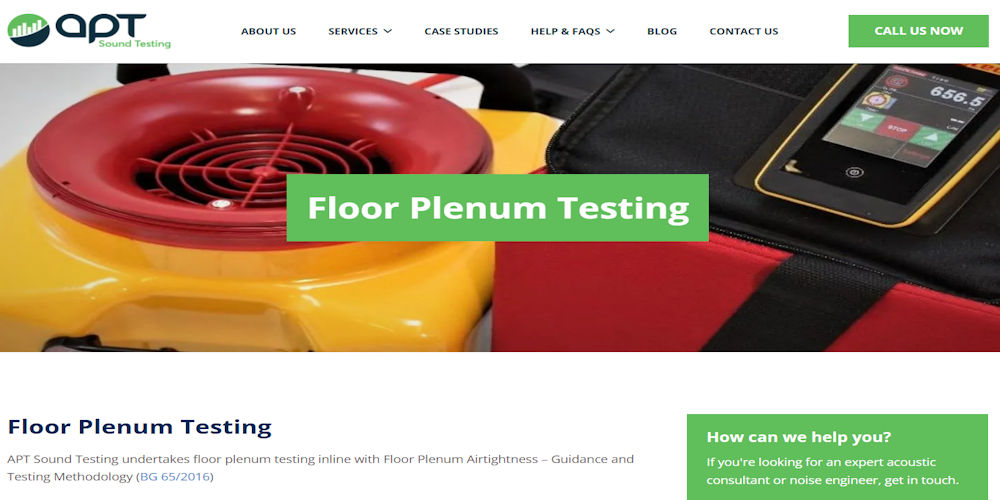
- A floor tile is removed and replaced with a sealed fan unit
- All ductwork in the test zone is isolated and sealed
- Pressure tubes are installed via a secondary tile
- A calibrated fan is used to pressurise the plenum
- Pressure readings are recorded and compared against specifications
If the plenum fails, a smoke survey is carried out to visually identify leakage paths, making it easier to target remedial work.
Why Early Testing Matters
Testing early in the construction process allows issues to be identified and resolved before completion. This reduces delays, avoids rework, and improves overall system performance.
APT Sound Testing works closely with project teams to recommend appropriate specifications, carry out testing, and support successful outcomes.
Get Expert Support
If you’re planning a project involving raised access floors, getting expert advice early can make all the difference.
APT Sound Testing offers:
- Site visits and tailored recommendations
- Full airtightness testing services
- Detailed reporting and practical guidance
To learn more, get in touch with APT Sound Testing or their team by calling 01525 303905 or email: info@aptsoundtesting.co.uk to discuss your requirements.