BS8233 Noise Assessments: A Technical Guide
BS8233 Noise Assessments – A Complete Technical Guide for Planning & Building Compliance
- Introduction to BS8233
BS 8233:2014 is one of the most widely used acoustic standards in UK planning and building design. It provides detailed guidance on noise control in and around buildings, including external noise intrusion, internal sound insulation, building services noise and general acoustic design principles. For any development located near transport routes, commercial premises or industrial activity, a BS8233 noise assessment is typically required by the local planning authority.
The standard emphasises that noise control should be approached on an objective and quantifiable basis, stating:
“Noise control in and around buildings is discussed… on an objective and quantifiable basis as far as is currently possible.”(BS8233:2014, Introduction)
This article provides a complete technical breakdown of BS8233 noise assessments, how they are carried out, what they must include, and how APT Sound Testing ensures full compliance for planning and building control.
2. What Is a BS8233 Noise Assessment?
A BS8233 noise assessment evaluates external noise levels at a development site and determines the acoustic measures required to achieve the recommended internal noise criteria set out in BS 8233:2014. These criteria apply to:
- Living rooms
- Bedrooms
- Dining rooms
- Home offices
- Hotel rooms
- Healthcare spaces
- Education buildings
The standard provides recommended internal noise levels for dwellings (Table 4), including:
- Living rooms: 35 dB LAeq,16hr
- Bedrooms: 30 dB LAeq,8hr
- Dining rooms: 40 dB LAeq,16hr
These values form the backbone of most planning conditions relating to noise.
For a deeper dive, see BS8233 noise assessments.
3. When Is a BS8233 Noise Assessment Required?
Local authorities typically request a BS8233 noise assessment when:
- A development is near a busy road
- The site is close to a railway line
- Aircraft noise is present
- There are industrial or commercial noise sources nearby
- A change of use introduces noise‑sensitive rooms
- A planning condition explicitly requires a BS8233 noise report
APT provides nationwide noise surveys:https://aptsoundtesting.co.uk/noise-surveys/
4. The Structure of BS 8233:2014
BS 8233 is divided into several key sections relevant to noise assessments:
- Clause 5: Planning and design
- Clause 6: External noise sources
- Clause 7: Indoor ambient noise criteria
- Clause 8: Sound insulation in buildings
- Clause 9: Noise from building services
- Annexes A–H: Calculations, NR curves, insulation indices, legislative context, worked examples
The standard is intended for use by non‑specialist designers, but in practice, most assessments require an experienced acoustic consultant due to the technical modelling involved.
5. What a BS8233 Noise Assessment Includes
A compliant BS8233 noise assessment typically contains the following components:
5.1 Baseline Noise Survey
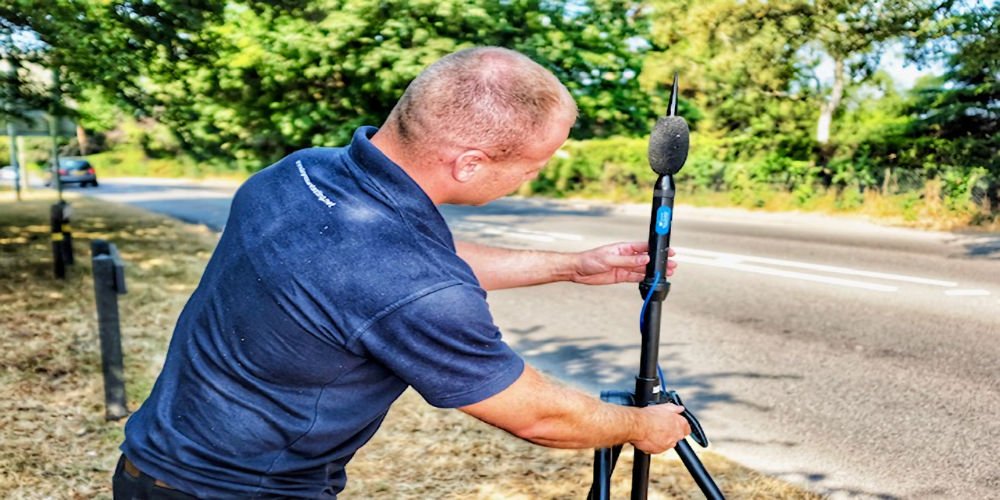
A detailed noise survey is carried out at the development site, usually over a 24‑hour period. Measurements include:
- LAeq,T
- LAmax
- LA10 / LA90
- Diurnal variations
- Façade vs free‑field corrections
BS 8233 notes: “Facade level measurements… are typically 1 dB to 2 dB higher than corresponding free‑field measurements.”
(BS8233:2014, 3.1.10)
This correction is essential when designing façade performance.
5.2 Façade Noise Modelling
Using measured data, we calculate the required performance of:
- External walls
- Glazing systems
- Ventilation strategy
- Building orientation
- Acoustic trickle vents or MVHR systems
This modelling ensures internal noise levels meet BS8233 criteria with windows closed, as required by planning authorities.
APT’s façade and ventilation design service: https://aptsoundtesting.co.uk/acoustic-design-service/
5.3 Ventilation Strategy Review
BS 8233 requires internal noise levels to be met without relying on open windows. Therefore, the ventilation system must provide:
- Background ventilation
- Overheating mitigation
- Compliance with Approved Document F
- Acceptable internal noise levels
This is often the most challenging part of the assessment, especially on noisy sites.
5.4 Internal Layout Review
We assess room placement to minimise noise exposure:
- Bedrooms placed away from noise sources
- Non‑habitable rooms used as acoustic buffers
- Optimised building massing
- Courtyard layouts to reduce façade exposure
This aligns with BS8233 Clause 5.2 on assessing the building or site.
5.5 Compliance Statement
The final report confirms whether the development meets BS8233 criteria and details any required mitigation, such as:
- Enhanced glazing
- Acoustic vents
- Mechanical ventilation
- Acoustic barriers
- Upgraded façade construction
APT specialises in designing cost‑effective, buildable solutions that satisfy planning without unnecessary overspecification.
6. External Noise Sources (Clause 6)
BS 8233 provides guidance on assessing noise from:
- Road traffic
- Aircraft
- Railways
- Industrial sources
- Construction sites
- Wind farms
It also highlights the importance of meteorological effects, façade reflections, and free‑field corrections.
APT’s external noise surveys: https://aptsoundtesting.co.uk/noise-surveys/
7. Indoor Ambient Noise Criteria (Clause 7)
BS 8233 provides recommended internal noise levels for:
- Dwellings
- Offices
- Schools
- Healthcare
- Hotels
- Commercial spaces
These values are used to determine the required façade performance and ventilation strategy.
APT’s BS8233 service page: https://aptsoundtesting.co.uk/noise-surveys/bs8233-noise-assessments/
8. Sound Insulation & Flanking (Clause 8)
BS 8233 discusses:
- Airborne sound insulation
- Impact sound insulation
- Flanking transmission
- Sound insulation testing
- Performance of common building elements
It reinforces the importance of flanking control:
“Flanking transmission can significantly reduce the overall sound insulation performance.” (BS8233:2014, 8.2)
APT provides full acoustic detailing and Part E sound testing:
https://aptsoundtesting.co.uk/sound-testing/
9. Noise from Building Services (Clause 9)
BS 8233 covers noise from:
- Mechanical ventilation
- Air‑conditioning
- Pumps
- Lifts
- Boilers
- Ductwork noise
- Fan noise
- Vibration‑induced noise
Good design and installation are essential to avoid noise complaints.
APT provides building services noise assessments: https://aptsoundtesting.co.uk/noise-surveys/
10. Why BS8233 Noise Assessments Matter
A BS8233 noise assessment ensures:
- Planning approval is achieved
- Residents experience acceptable internal noise levels
- Complaints and future disputes are avoided
- The development complies with national guidance
- Façade and ventilation systems are correctly specified
- Internal layouts are optimised for acoustic comfort
APT integrates BS8233 into all noise surveys, acoustic design reports and sound insulation strategies.
11. Why Choose APT Sound Testing?
- UKAS‑accredited company
- 22+ years’ experience
- Nationwide coverage
- Fast reporting
- Detailed acoustic design
- Contractor‑friendly guidance
- Full support for BS8233, BS4142, Part E, BB93 & HTM 08‑01
APT’s dedicated BS8233 page: https://aptsoundtesting.co.uk/noise-surveys/bs8233-noise-assessments/
About APT Sound Testing
APT Sound Testing is a UKAS‑accredited acoustic consultancy with over 22 years’ specialist experience in building acoustics, environmental noise assessment, BS8233 Residential Noise Assessments, BS4142 industrial noise surveys, sound insulation testing and Part E compliance. We support residential, commercial and industrial developments across the UK, providing fast, accurate and fully compliant acoustic testing and reporting.
Our team combines deep technical expertise with practical, contractor‑friendly guidance to help clients achieve full compliance with Approved Document E, BS8233, BS4142, BB93, HTM 08‑01 and wider planning and building control requirements. Whether you need pre‑completion sound testing, noise impact assessments, acoustic design advice or troubleshooting for difficult sites, we deliver reliable results with a rapid turnaround.
Contact Us Now
APT Sound Testing
T: 07775 623464
E: info@aptsoundtesting.co.uk
W: https://aptsoundtesting.co.uk