Part E Sound Insulation Testing
Part E Sound Testing: A Guide to Building Regulations Sound Insulation Testing
If you’re building new homes, converting an office into flats, or developing residential accommodation, Part E sound testing is likely to be an important part of your project.
For many residential developments, Building Control requires sound insulation testing before signing off the work. Leaving it until the last minute can cause unnecessary delays, particularly if a test highlights an issue that needs remedial work.
At APT Sound Testing, our UKAS-accredited engineers carry out sound insulation testing across the UK. We work with house-builders, developers, contractors, housing associations, and private clients to help ensure their projects meet Building Regulations Part E requirements.
GET A FAST PART E SOUND TESTING QUOTE
UKAS Accredited • Nationwide Coverage • Full Coverage
Part E Sound Testing being undertaken in London, UK by APT Sound Testing Acoustic Engineers
What is Part E Sound Testing?
Part E of the Building Regulations covers the Resistance to the Passage of Sound. Its purpose is to ensure people in adjoining homes are adequately protected from noise travelling through separating walls and floors.
Approved Document E sets out the official requirements.
Part E sound testing, also known as sound insulation testing, acoustic testing, or pre-completion sound testing, demonstrates that the separating walls and floors within a development provide the required level of sound insulation.
There are two main types of sound insulation measurement.
Airborne Sound Insulation
Airborne testing looks at how effectively a wall or floor prevents airborne noise from passing between adjoining rooms or properties.
This includes everyday sounds such as:
- Speech
- Television
- Music
- General household noise
Impact Sound Insulation
Impact testing primarily assesses floors and measures how much impact noise travels between properties.
Typical examples include:
- Footsteps
- Objects being dropped
- Furniture being moved
Depending on the development type, both airborne and impact testing may be required.
When is Part E Sound Testing Required?
The exact testing requirements depend on the project type and the applicable Building Regulations. However, sound insulation testing is commonly required for many residential developments.
New Build Flats and Apartments
New-build apartment developments generally require sound insulation testing between adjoining dwellings before completion.
Testing helps demonstrate that the separating walls and floors have achieved the required acoustic performance.
Building Conversions
Converting an existing building into residential accommodation can also trigger Part E requirements.
This can include:
- Office-to-residential conversions
- Commercial-to-residential conversions
- Barn conversions
- Factory or industrial building conversions
- Mixed-use developments
Each project’s construction and circumstances differ, so it is worth confirming the testing requirements with Building Control early.
HMOs
Some Houses in Multiple Occupation (HMOs) may also require sound testing, depending on the accommodation type and Building Control requirements.
Student Accommodation
Purpose-built student accommodation and other residential developments with multiple adjoining rooms or units may also require acoustic testing as part of the building compliance process.
Why is Part E Sound Testing Important?
Sound testing is not simply a box-ticking exercise. Poor acoustic performance can significantly affect the people who eventually live in a building.
From a construction perspective, a failed test can also create problems at the worst possible time — when a project is approaching completion.
Potential consequences include:
- Delays to Building Control sign-off
- Additional remedial acoustic work
- Increased project costs
- Delayed occupation
- Delayed property sales or handovers
- Frustration for contractors, developers and future occupants
This is why arranging testing at the right stage of the build is so important.
If possible, consider acoustic requirements during design and construction rather than waiting until the development is ready for handover.
Part E Sound Test Pass by APT Sound Testing Ltd
How is Part E Sound Testing Carried Out?
Part E testing is carried out by suitably qualified and experienced acoustic engineers using calibrated acoustic equipment.
The exact procedure depends on whether the test assesses airborne or impact sound insulation.
Airborne Sound Testing
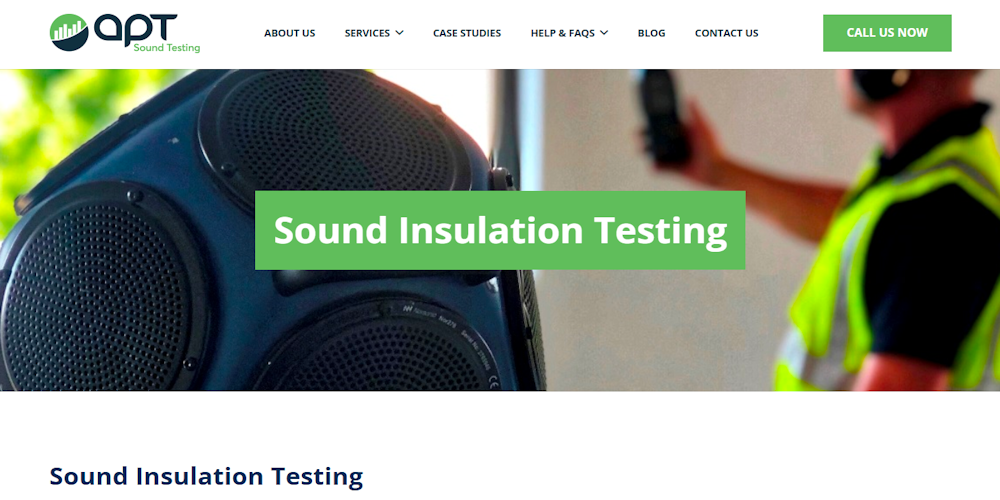
For an airborne sound test, a loudspeaker is positioned in the source room and produces a controlled broadband noise signal.
The engineer then takes sound level measurements in both the source and receiving rooms.
The engineer will also measure factors such as:
- Sound levels in the source room
- Sound levels in the receiving room
- Background noise
- Reverberation time
The results are then analysed to establish the sound insulation performance of the separating construction.
Impact Sound Testing
Impact testing is generally carried out on separating floors.
A calibrated tapping machine is placed on the floor above and creates a series of controlled impacts designed to simulate everyday footfall.
The engineer measures sound levels in the room below to assess the floor’s impact sound insulation performance.
The results are compared against the relevant Part E requirements.
Common Reasons for Part E Sound Test Failures
Several reasons can cause a separating wall or floor to fail a sound insulation test. In many cases, the problem isn’t the main construction but small details overlooked during installation.
Based on our experience conducting sound insulation testing, common issues include the following.
Poor Acoustic Detailing
Small gaps and unsealed penetrations can surprisingly affect acoustic performance.
Potential problem areas include:
- Pipe penetrations
- Electrical sockets
- Service risers
- Ceiling penetrations
- Gaps around building services
Sound can travel through surprisingly small openings, so careful detailing and sealing are essential.
Poor Installation
A wall or floor system may be designed to meet the required acoustic performance, but that doesn’t guarantee the finished construction will perform the same way.
Incorrect installation, missing insulation, poorly fitted boards or inadequate sealing can all affect the final result.
Flanking Transmission
Not all sound travels directly through the separating wall or floor.
Noise can also travel through adjoining elements of the building — known as flanking transmission. This can include connections between walls, floors, ceilings and other structural elements.
Changes During Construction
Changes made to a wall or floor construction during the build can also affect acoustic performance.
Replacing specified materials, changing service routes or altering details without considering the acoustic implications can introduce weaknesses into the construction.
Getting acoustic design advice early can help identify and avoid these problems.
How Can You Improve Your Chances of Passing on the First Try?
Good preparation can make a significant difference.
Before your sound testing engineer arrives, make sure the areas being tested are genuinely ready.
Complete the Necessary Finishes
Where applicable, make sure:
- Plasterboard installation is complete
- Sealant and acoustic sealing works are finished
- Flooring has been installed
- Doors are fitted
- Relevant construction details are complete
Check for Gaps
Look carefully around service penetrations, sockets, pipework and other openings. Seal any gaps appropriately before testing.
Follow the Specified Construction
The finished wall or floor should match the approved acoustic specification.
If you’ve made changes during construction, check their potential acoustic impact before arranging the final test.
Get Advice Before Testing
If you’re unsure whether a construction is likely to meet the required standard, getting advice before the test can be far more cost-effective than discovering a problem after completion.
Early acoustic input can help identify potential weaknesses while you still have time to correct them.
Sound insulation testing of walls in houses by APT Sound Testing Ltd
Why Choose APT Sound Testing?
APT Sound Testing is a UKAS-accredited testing laboratory providing specialist building compliance testing across the UK.
We work with a wide range of clients, including:
- House-builders
- Property developers
- Principal contractors
- Housing providers
- Architects
- Building Control professionals
- Private clients
Our clients choose APT Sound Testing for:
- UKAS-accredited testing
- Nationwide coverage
- Fast turnaround times
- Competitive fees
- Experienced acoustic engineers
- Building Regulations expertise
- Comprehensive test reports
We also understand that sound testing can be a critical part of a construction programme. A failed test or a test arranged too late can delay other stages of a project, so we aim to make the process as straightforward as possible.
Plan Your Part E Sound Testing Early
Part E sound testing is an important consideration for many new-build and residential conversion projects. The earlier you consider acoustic requirements, the easier it is to spot potential problems and address them before they become expensive issues.
If your project is approaching completion and you need Part E sound insulation testing, APT Sound Testing can help.