Category: Sound Insulation Testing

Improving Sound Insulation on London Property Developments

Improving Sound Insulation on London Property Developments

Improving Sound Insulation on London Property Developments
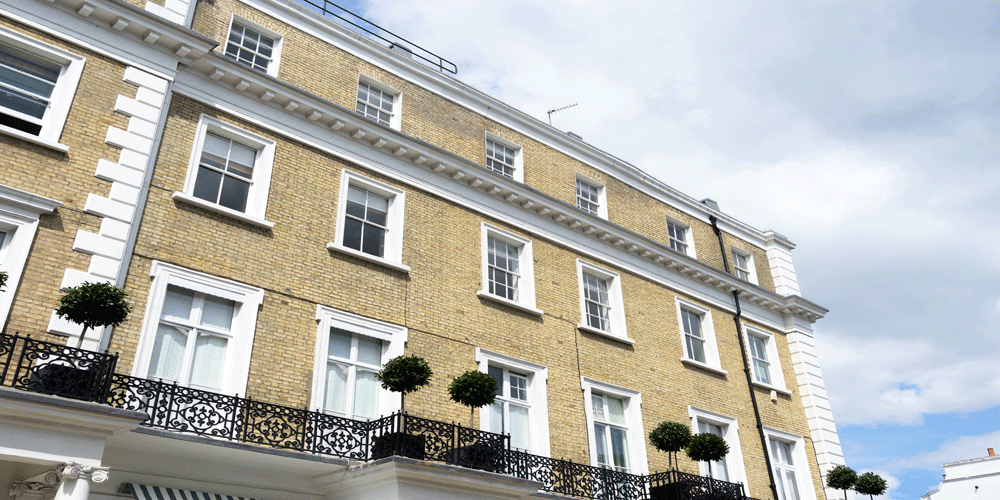
Many of the dwellings in London consist of flats converted from large Victorian houses.. Unfortunately at the time of the building conversion, designing for sound insulation was not a high priority and so many of the dwellings suffer from adverse noise transference between the floor and wall partitions. This can be extremely stressful to the occupant’s well being is a major cause for concern.

Sound Testing Services

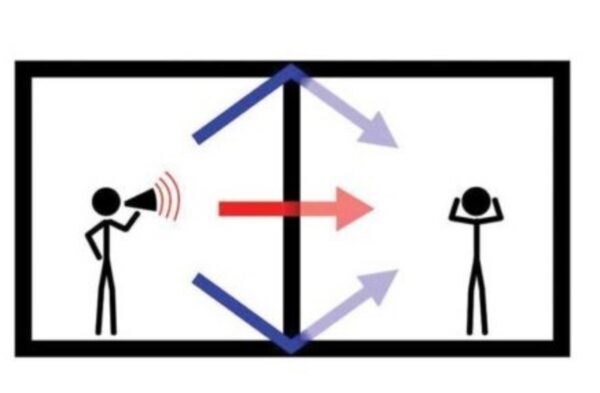
There are ways to improve the airborne and impact performance by improving the wall/floor partitions ability to reduce the amount of sound transmission from one side of a construction element to the other. By isolating the different materials may not be enough its own and you may need to improve the mass of the partition as well.

Improving Existing Floor Partitions
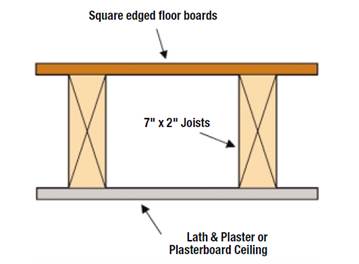
In our experience of undertaking hundreds of sound insulation tests in London, refurbishment projects usually achieve 30-35dB for airborne sound and 70dB for Impact Sound, if the existing construction has not been acoustically upgraded. These figures do not meet the required 43dB & 64dB as stipulated in Part E of Building Regulations. As sound double every 10dB this is a massive failure and acoustic improvements must be made. Many existing construction consist of a similar construction as shown in as detail 1 below.

Acoustic Improvements to Existing Floor Partitions
To reduce airborne and impact sound transmission this usually means adding density and isolation to the floor construction. This can be as simple as adding a drop ceiling consisting of 125mm timber frame. The top of the frame must be a minimum of 25mm below the existing ceiling finish – such as lathe and plaster. Then, to the inside of the timber frame add 100mm of Acoustic Wool and two layers of sound-board tacked to the bottom of the timber frame – all boards to be lapped.

This should improve your sound test results by approx. 10-15dB depending on the existing site conditions and quality of the installation. Detail 2 shows this in more detail.

Improving Existing Wall Partitions
The standard onsite construction for existing internal walls may be a mixture of 100mm masonry with render applied to either side; or, 100mm timber partition with lathe and plaster to either side. Unfortunately neither of these existing wall constructions will have the acoustic properties to pass Part E in their existing state due to lack of mass and poor isolation values.

Improving Wall Partitions
One way to quick and simple way improve the acoustic performance of a the dividing wall partition, is to install a 70mm metsec partition in front of the existing wall – its usually best to install this in the largest room. Leave approx. 25mm gap between the back of the metsec and the wall. Then install 50mm acoustic wool to the inside of the metsec and add two layers of soundboard to the outside of the metsec frame, ensuring all boards are properly lapped and the perimeter joints are filled with acoustic mastic.

Taking the above into account is it essential that the acoustic design is addressed right from the start of the refurbishment project, so it prevents delays in handover, i.e. to prevent the dwelling failing the sound testing at building control signoff stage.– a common problem.

We can also offer acoustic design advice and UKAS sound testing on existing flats to ensure that the building handover is not delayed due to noncompliance with Part E. We can also undertake sample sound testing on projects where clients are worried about existing ‘hybrid’ construction/s to help highlight the existing noise levels so acoustic upgrades – if required) can be quickly targeted and implemented.

If you would like advice on your acoustic design or require sound insulation testing in London, please contact us now on 01525 303905 or contact us at info@aptsoundtesting.co.uk.

Sound Insulation on London Properties

Sound Insulation on London Properties

Improving Sound Insulation on London Properties

Many of the dwellings in London consist of flats converted from large Victorian houses. Unfortunately at the time of the building conversion, designing for sound insulation was not a high priority and so many of the dwellings suffer from adverse noise transference between the floor and wall partitions. This can be extremely stressful to the occupant’s wellbeing is a major cause for concern.

There are ways to improve the airborne and impact performance by improving the wall/floor partitions ability to reduce the amount of sound transmission from one side of a construction element to the other. By isolating the different materials may not be enough its own and you may need to improve the mass of the partition as well.

Improving Existing Floor Partitions

In our experience of undertaking hundreds of sound tests in London, refurbishment projects usually achieve 30-35dB for airborne sound and 70dB for Impact Sound, if the existing construction has not been acoustically upgraded. These figures do not meet the required 43dB & 64dB as stipulated in Part E of Building Regulations. As sound double every 10dB this is a massive failure and acoustic improvements must be made. Many existing construction consist of a similar construction as shown in as detail 1 below.

Detail 1: Existing Floor Partitions Rated At Approx. 30dB

Acoustic Improvements to Existing Floor Partitions

To reduce airborne and impact sound transmission this usually means adding density and isolation to the floor construction. This can be as simple as adding a drop ceiling consisting of 125mm timber frame. The top of the frame must be a minimum of 25mm below the existing ceiling finish – such as lathe and plaster. Then, to the inside of the timber frame add 100mm of Acoustic Wool and two layers of sound-board tacked to the bottom of the timber frame – all boards to be lapped. This should improve your sound test results by approx. 10-15dB depending on the existing site conditions and quality of the installation.

Improving Existing Wall Partitions

The standard onsite construction for existing internal walls may be a mixture of 100mm masonry with render applied to either side; or, 100mm timber partition with lathe and plaster to either side. Unfortunately neither of these existing wall constructions will have the acoustic properties to pass Part E in their existing state due to lack of mass and poor isolation values.  

Improving Wall Partitions

One way to quick and simple way improve the acoustic performance of a the dividing wall partition, is to install a 70mm metsec partition in front of the existing wall – its usually best to install this in the largest room. Leave approx. 25mm gap between the back of the metsec and the wall. Then install 50mm acoustic wool to the inside of the metsec and add two layers of soundboard to the outside of the metsec frame, ensuring all boards are properly lapped and the perimeter joints are filled with acoustic mastic.

Taking the above into account is it essential that the acoustic design is addressed right from the start of the refurbishment project, so it prevents delays in handover, i.e. to prevent the dwelling failing the sound testing at building control signoff stage – a common problem.

We can also offer acoustic design advice and UKAS sound testing on existing flats to ensure that the building handover is not delayed due to noncompliance with Part E. We can also undertake sample sound testing on projects where clients are worried about existing ‘hybrid’ construction/s to help highlight the existing noise levels so acoustic upgrades – if required) can be quickly targeted and implemented.

If you would like advice on your acoustic design or require sound insulation testing in London, please contact us now on 07775 623464 or contact us at info@aptsoundtesting.co.uk.

Sound Insulation Testing

Sound Insulation Testing

Sound Insulation Testing: What You Need to Know

Since July 2003, pre-completion sound insulation testing has been a legal requirement under Part E of the Building Regulations. At APT Sound Testing, we are a UKAS-accredited sound insulation testing laboratory offering expert guidance, fast testing, and reliable reports to help you meet building control sign-off requirements.

What Is Sound Insulation Testing?

Sound insulation testing measures how effectively walls, floors, and ceilings reduce the transmission of airborne and impact noise between adjoining rooms or dwellings. It is required for:

  • New-build residential properties
  • Conversions (e.g., commercial-to-residential)

The goal of Approved Document E (England, Wales, and Northern Ireland) is to limit noise disturbance between homes, protecting residents’ quality of life.

When Is Sound Testing Required?

All developments built after July 2003 must undergo sound insulation testing. Typically, 10% of each type of separating wall and floor construction must be tested. Tests are carried out between adjoining rooms across party walls or floors.

How to Prepare for a Sound Insulation Test

Proper preparation increases the likelihood of passing the test on the first attempt. When you book with us, we provide a detailed checklist to guide you. Here are some essential steps:

  1. Minimize site noise – Avoid use of radios, power tools, or alarms.
  2. Complete all internal constructions – Walls, floors, ceilings must be finished.
  3. Fit windows and doors – Fully installed, glazed, and closed.
  4. Install and close ventilation systems
  5. Hang and close internal doors
  6. Install skirting boards, sockets, and light switches
  7. Do not lay final floor finishes – Bare structural floors are needed for impact testing.
  8. Keep test rooms empty and accessible
  9. Ensure no workers are on-site during testing
  10. Provide access to both sides of separating walls/floors
  11. Ensure 240v (50Hz) power is available

How Many Tests Are Required?

The number of tests depends on your development size and construction types. For example:

  • Small to medium projects (up to 10 units): Often require one “6-pack” (2 airborne wall tests, 2 airborne floor tests, and 2 impact floor tests).
  • Semi-detached houses: Typically only need 2 airborne wall tests.

We’ll assess your project and confirm the exact testing requirement when you request a quote.

What If My Building Fails the Test?

Don’t worry, failures can be rectified. If your development doesn’t meet the required standards, our experienced acoustic consultants will suggest targeted acoustic upgrades to help you pass on retest and achieve compliance.


Why Choose APT Sound Testing?

  • UKAS-accredited for peace of mind
  • Nationwide coverage across the UK, including London
  • Expert support from design stage through to final testing
  • Fast turnaround and clear reporting
  • Experience with residential, commercial, educational, and care buildings

Need help with your project?
Call us today at 01525 303905 or fill out our online contact form. One of our friendly acoustic and air tightness consultants will be in touch to guide you through the process.

Sound Insulation Testing – Q&A

Sound Insulation Testing – Q&A

Sound Insulation Testing – Questions & Answers

APT sound testing often get asked a similar bunch of questions in regards to sound insulation testing. Over the last couple of years we have collated these questions and answers and to help our valued clients we have shown these below.

What is sound testing for Part E
Sound Insulation Testing is a method of quantifying the sound insulation performance of  walls and/or floors. Sound testing can be carried out on party walls, party floors or facades of any building.

What is sound insulation?
Sound insulation is the property of a wall and /or dividing partition to resist the passage of noise.

Why do I need sound testing on my Project/Property?
The largest single reason for disputes between neighbours is noise complaints. Approved Document Part E – Resistance to the passage of sound describes minimum standards to be achieved by newly built domestic dwellings.

What building regulation do we work to?

Approved Document Part E, sets out minimum standards for sound insulation performance to be achieved by party wall and party floors. Building contractors may show compliance with Part E of the Building Regulations by two methods. One method is to register plots to be built with Robust Standard Details Limited and the other is to show as-built performance by Pre-Completion Sound Testing to Part E of Building Regulations.

When are Pre-Completion Sound Tests carried out?
Pre completion Sound testing is carried out when the construction of party walls and floors are largely complete. Windows should be in place with any vents closable. Internal and external doors should be in place, along with skirting, cornicing and plug sockets in place. Sound testing on floors must be carried out before any soft coverings are in place.

 Do detached properties require sound testing for Part E of Building Regulations?

No, only attached properties require sound tests, detached properties share no common partitions with any other properties.

Are internal walls/floor between rooms within a single dwelling sound tested?
No, Laboratory test based performance standards (Rw) exist for certain internal walls and floors, but they are not intended to be verified as-built by on site measurement and therefore sound insulation testing is not a requirement.

How many sound tests are needed on my Project?

Approved Document E states that one set of sound tests is required for every 10 units in a group or sub-group. A group or sub-group is defined where significant differences in construction or layout occur, for instance:

  • For a pair of semi-detached Houses – a set of tests would usually comprise two airborne sound insulation tests of a separating wall.
  • For Flats (up to 10 units) – a six pack would normally be required, this comprises of: two airborne wall tests, two airborne floor tests and two impact floor sound tests. The easiest way to work out the number of tests required is to multiply 1 x 6 packs for every 10 flats, i.e. if you have 22 flats you will require 3 x 6 packs which equals 18 sound tests in total.
  • For Rooms for Residential Purposes (student accommodation, hotel rooms, care homes etc.) – a set of tests would usually comprise: one airborne sound insulation tests of a separating wall; one airborne sound insulation test of a separating floor; one impact sound transmission test of a separating floor.

How are plots selected for Sound Insulation Testing?
We will usually specify the sound insulation tests that are required. We first look at the plans then work a testing schedule taking into account testing through both the projects lounges & bedrooms where possible. We will also try and undertake testing across walls and floors in different areas of the building.

The building control officer, warranty provider or other concerned parties may require you to carry out sound testing in specific areas or plots. However where this has not been stipulated we can advise accordingly. When we have specified the sound testing schedule it should always be checked by building control and/or the client to seek their approval before the commencement of testing.

How do I Preparing my Site for Sound Insulation Testing?

APT always send out a checklist with our fee proposals to help you prepare for the sound testing, as we always want our clients to be fully prepared so they can pass their sound testing at the first attempt.

Will the sound insulation testing disrupt work on site? 
There should be minimal site disruption during the sound insulation testing. However, although high levels of noise are generated but in order to make accurate test measurements, relatively quiet conditions are needed to take accurate measurements. This means that anyone working in the testing area will have to leave temporarily and any noisy works in the vicinity of the test rooms will need to be halted i.e. using power tools.

How long will the Sound Insulation Testing take?

The time taken for London sound testing varies with site conditions, but generally a ‘6 pack’ set of tests on houses and flats takes about one to two hours. Obviously this depends on the site being fully prepared in line with our sound testing checklist.

How do I know if I’m ready for a sound insulation test?
The plots should be at least at second fix stage – for further details please refer to our checklist.

Do I need all internal and external doors and windows installed?
Yes, all internal and external doors must be fitted and operable prior to the sound testing. Trickle vents must also be installed where required.

 What if I only have 110 volt on site?

Unfortunately we cannot undertake the testing; we will need 240V to undertake the sound insulation testing.

Should I inform my neighbours of the impending sound testing?
If the building is attached in any way to occupied properties then you will need to inform the neighbours. To comply with Part E we need to gain access to the neighbouring properties to undertake the sound test. You will need to ensure that access is provided to the neighbouring properties throughout the sound testing.

Can you offer advice to help me to pass my sound insulation testing?
We offer an acoustic design service to help you design your buildings partitions to pass Part E sound testing. If you send through the relevant drawings such as sections and plans during the design stages of the project, we can check the design to see if there are any junctions or details where ‘noise flanking’ may occur. You can then change your design to lower the chance of a sound test failure.

Do you have a check-list to help us prepare for the sound testing?
Yes, we have an informative checklist to help prepare for the testing, please visit our website at www.aptsoundtesting.co.uk to download the checklist.

Is it easy to upgrade the sound insulation in my Existing Home?.

Yes of course. If excess noise is causing you stress and anxiety, in comparison upgrading the walls/floors to your existing property can be a worthwhile process. its normally quite easy to upgrade walls and floors/ceilings to lower sound transmission. Sometimes it can be as easy as installing an acoustically (insulated) backed board against the offending partition. In all instances it is important not only that the right products are used to cause minimal disruption but they are also fitted correctly in-line with manufacturer’s guidelines. .

Rest Assured

We believe in working with our clients whether they are existing home owners suffering acoustic problems or large developers requiring a more expansive service to achieve sound testing compliance. We believe that by being involved at the beginning of a project we can often save our clients expensive and difficult remedial works at the completion stage of a project.

If you would like more information on our full range of services, including Sound Insulation Testing, please contact us now at info@aptsoundtesting.co.uk or call us on 01525 303905.