Author: admin

The Importance of Airtightness Testing

The Importance of Airtightness Testing

The Importance of Airtightness Testing.
Approved document L suggests that air permeability is the physical property used to measure the airtightness of the building fabric.  The test measurement is defined as air leakage rate per hour per square metre of envelope (m3/hr/m2) area at a test reference pressure differential across the building envelope of 50 Pascal (50 N/m2). The design air permeability is the target value set at the design stage and is tied in to the design stage SAP assessment – in many cases the air leakage figure set of the air tightness test is 5m3/hr/m2.

Wherever air infiltration occurs, there is a corresponding exfiltration somewhere else in the building. During the summer, infiltration can bring humid, outdoor air into buildings. In winter, exfiltration can result in moist indoor air moving into cold wall cavities and may result in condensation and ultimately mould and/or rot which could result in serious damage to the property.

The ATTMA – Air Tightness Testing and Measurement Association governing body for air tightness testing and  the defines ‘air leakage’ as the uncontrolled flow of air through gaps and cracks in the fabric of a building. The general public recognise it as draughts. In most cases the main air leakage paths are:

Services Penetrations

  • Service penetration’s around boilers pipes.
  • Service penetration’s around under floor heating.
  • Service penetrations in the kitchen and utility room.
  • Service penetrations in the toilets, bathroom and en-suite.
  • Pipework penetrations behind the radiators.
  • Service penetrations in the bathrooms and en-suite.
  • Around electrical fuse box.
  • Around extract fans.

General Air Leakage Paths

  • Gaps between skirting board and floor on each floor level.
  • Behind kitchen units.
  • Behind Utility Cupboards
  • Around poorly fitted trickle vents.
  • Around Patio doors.
  • Gaps around the stairs.
  • Around loft hatch.
  • Gaps around the bath panel and the shower tray.

Importance of Airtightness Testing.
Also, to incorrect sequencing of work the air sealing may not be undertaken properly. One such example is the late addition of mechanical and electrical pipework & cables that should have been installed earlier in the project; however, due to insufficient information i.e. missing details on drawings, the M&E is often added at a later stage, thus requiring additional penetrations through the newly completed building fabric. Unfortunately once newly formed penetrations are in the envelope, nobody wants to take ownership for the new penetrations and the resealing of the areas, so the air leakage paths are left to the end of the project. 

In many instances, operatives are rushed to install new installations resulting in much larger access holes than is strictly necessary for the service pipework/cables, this often happens in kitchens, utility rooms, bathrooms, toilets, and service cupboards. In these rooms, service penetrations are often hidden behind Kitchen cupboards, behind toilets, sinks, bath panels, and under the shower. Other areas are around services in airing and boiler cupboards. Once cupboards and boilers etc. are installed, it makes it almost impossible to seal the air leakage paths especially if it’s close to the air seal line. Unfortunately, if service penetrations are not properly sealed it often results in air tightness testing failure.

In many cases a lack of understanding by building contractors can lead to multiple ongoing air test failures.  One common problem is the client putting cosmetic appearance above general airtightness; however, with careful air sealing both can be achieved.  Unfortunately, with the airtightness target being halved from the old standard of 10m3/hr/m2 to 5m3/hr/m2 it is essential that the all air leakage paths are sealed prior to the air tightness test.

In our experience, another reason for airtightness testing failures is down to a general lack of understanding where the air seal line within the building.  Some of the issues that may need to be addressed to overcome this would include adequate training, quality control, and building design.

If you employ our services from the start of the project, we will send out our air tightness checklist to help you prepare for the air testing. If each item is actioned in-line with the checklist then our clients usually pass first time. We can also visit site a few weeks prior to the air test date to undertake a site inspection, we can then highlight any potential air leakage paths so they can be sealed prior to the air tightness test.

If you would like more information in regards to preparing for your air tightness test in London, please contact us at: info@airpressuretesting.net or phone us on  01525 303905

Sound Testing for New Build Dwellings

Sound Testing for New Build Dwellings

Sound Testing Services for New Build Dwellings
Sound Insulation Testing became mandatory in England & Wales in 2003, when Approved Document E was updated. Approved Document E requires new and converted to achieve a reasonable level of sound insulation between dwellings. The simplest way to comply with the requirements of Approved Document E; is to have on-site pre-completion sound insulation tests carried out on your project. We carry out full sound testing services in compliance with Approved Document E.

In our experience there is usually a level of apprehension with our clients having to undertake pre-completion sound insulation tests.  This is often down to the fear of failure. It should be remembered; however, that if the acoustic design specification is closely followed, and a good standard of onsite workmanship is maintained there is very little chance of failure.

Sound Testing for New Build Dwellings


Sound Testing New Build

Approved Document E requires a minimum of one ‘set’ of tests for every ten units in each group and/or sub group.  Is usually broken down to the following: two airborne wall, two airborne floor and two impact sound tests. For example, if you have a block of 100 flats, all of the same construction, you would usually conduct 10 ‘sets’ of tests. If you have a development of 25 houses, with five different sub-groups (5 units in each) then you would usually conduct 5 ‘sets’ of tests.  As previously stated a set of tests usually consists of two airborne tests of separating walls and two airborne tests and two impact tests on separating floors; however, if no separating floors are available, i.e. in semi-detached or terraced houses, one set of tests would consist of two airborne tests of separating walls only.

To test the airborne sound insulation properties of a floor or wall, a sound source which consists of an amplifier and loud speaker is set up on one side of the wall or floor partition that is to be tested. We then turn the setting to turn on Pink noise. Pink noise sounds like the static that can be heard on a radio that is off station or the old TV test card noise.

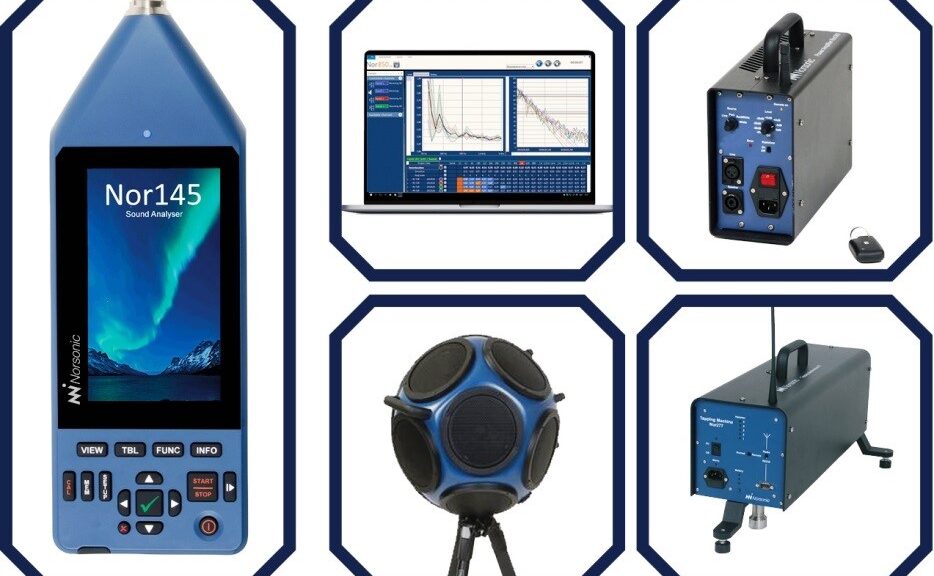
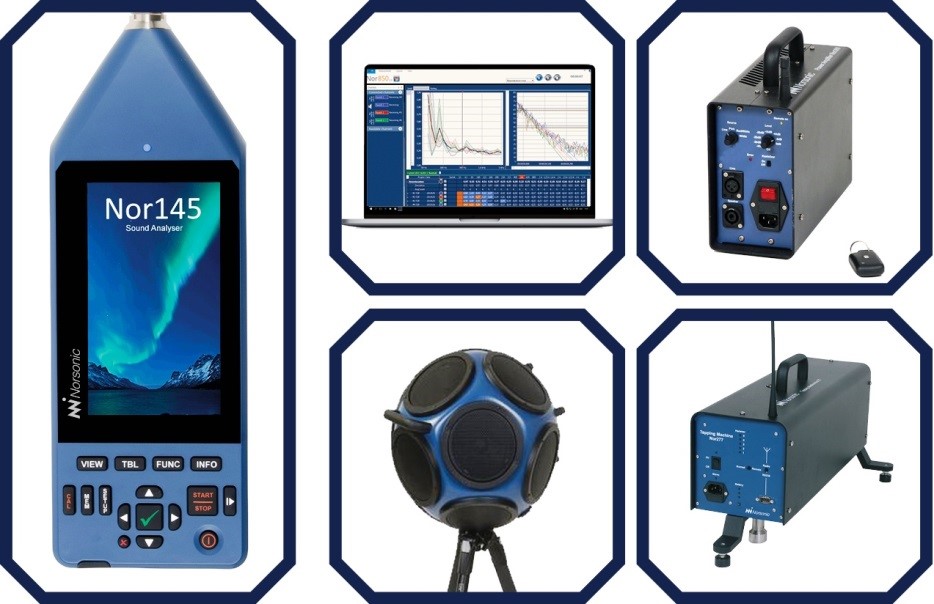
This type of noise is used because it is made up of a wall of sound that has a wide spectrum of frequencies. This provides an indication of sound insulation performance for a wide range of sounds that may be experienced within a dwelling from speech to a kettle boiling. The pink noise is measured in the room which contains the speaker or sound source using a Class 1 Norsonic sound level meter; thereafter the noise is measured on the other side of the wall or floor partition that is being tested. In layman’s terms the difference between these two levels is the amount of sound that is stopped by the sound insulating qualities if the wall or floor partition/s.

The result is then corrected and adjusted depending on the echo or reverberation time within the receiving room, and any background noise such as builders work noise etc. to give the airborne sound insulation result (DnT,w). The results of these tests are then compared to the performance criteria of Approved Document E – 45dB new build & 62dB for conversions) and a pass or fail sound test certificate is produced

Testing Impact Sound Insulation Performance
To test the impact sound insulation performance of a floor, a Norsonic tapping machine which consists of five small hammers that are dropped onto the floor to simulate foot fall, is placed on the floor. The resultant noise in the room below is measured with a Norsonic Class 1 sound level meter and the amount of noise that passes through the floor is the impact sound transmission level and is expressed as a single number. This result is then corrected and adjusted depending on the reverberation time of the rooms as well as any background noise to give the impact sound transmission result (LnT,w). The results of these tests are then compared to the performance criteria of Approved Document E – 62dB new build & 64dB conversions) and a pass or fail sound testing certificate is produced.

If pre-completion test results do not satisfy the performance criteria of Approved Document E, then our test engineer will attempt to determine the possible causes of failure. This may be to do with construction detailing around services or at junctions, or simply, poor acoustic design. Once the results have been finalised along with the associated graphs, our acoustician (with the aid of the information from the sound test engineer, we should be able to determine the specific cause of failure. Once a specific reason for failure has been determined, we can then advise the client on remedial actions that can be undertaken. Contact APT Sound Testing

If you have a project that’s needs acoustic design advice or needs pre-completion sound testing then please contact us by visiting the  APT Sound Testing Website and we should be able to offer you an acoustic solution to help your project achieve practical completion.

Steps for a Planning Noise Assessment

Steps for a Planning Noise Assessment

The 5 Simple Steps for a Planning Noise Assessment

1st Step – Baseline situation

It will usually be necessary to have a full understanding of the existing noise levels in the vicinity of the receptor. This can be achieved by carrying out a planning noise survey of background or ambient noise levels over the period when the noise source will be operational.

The baseline noise levels will usually be determined by measuring the LA90 or the LAeq, however in practice both will usually be measured simultaneously.

The term ‘LA90’ is the ‘A’ weighted noise level exceeded for 90% of the measurement period. Typically this is called the background noise level if it relates to a period when the noise source is not operational.

The ‘A’ weighting is a correction applied within a sound level meter to adjust the response of the Class A noise meter to match the response of human hearing at different frequencies. This is used to exclude short-term noises, such as a vehicle passing from the measurement value, leaving only the underlying or background noise.

The terms ‘LAeq’ is as an average noise level over the measurement period, although it relates to the average noise energy. It is a popular and universally used measure which correlates well with human annoyance.

Step 2 – Noise sources and times of operation

A detailed knowledge of the noise source (or in the case of a proposed development, the likely noise source) is also essential. This is because noise levels are of less importance than the amount by which they exceed the baseline noise and the times or days of operation.

Step 3 – Manufacturer Data for Proposed Equipment

If the proposed development will create a source of noise, the noise consultant may need the manufacturer’s data for proposed equipment, times of operation and working practices.

Step 4 – Determining the impact

Noise impact is determined using a variety of methods, all of which will rely on comparing noise levels at a receptor against absolute noise level criteria or against existing baseline noise levels. Generally one of three approaches is used:

  1. Where the proposal is for a development which will introduce an industrial type noise source, or where a receptor in a new development may be affected by this type of source, it is usual to assess impact by comparing the noise level, after making corrections for certain attributes of the noise, against background noise levels at the receptor (existing or proposed). The council expects that, at the receptor, noise from the source is a certain amount below existing background levels. Typical cases include new equipment in a business, an air conditioning unit or an extract and fan serving a restaurant. This is known as the BS4142 methodology.
  2. In some cases the impact does not depend on a comparison between source levels and baseline levels. For example, a proposed housing development is close to an existing road, where generally the impact is determined by establishing whether the absolute levels due to the source are acceptable.
  3. Applications for certain developments may require a more specialist approach. For example, the method for assessing a new nightclub combines both elements. Existing levels of noise in low frequency bands are measured and compared against levels in those same frequencies with music playing. The council may then require that the music does not cause any increase above existing levels.

Step 5 – Noise mitigation measures

Development proposals which are inherently noisy may include mitigation measures in the original scheme. However, the need for further mitigation may be necessary when the impact assessment indicates that the acceptability criteria are exceeded. Either way noise mitigation, or reduction measures, should be considered in the assessment in demonstrating how the acceptability criteria will be achieved.

The most effective measures will be those which reduce levels at source, rather than in transmission or at the receptor. However, in situations such as where the proposal is for new housing near existing sources of noise, it will not be possible to reduce source noise levels. Where the proposal will introduce a new noise source it is good practice to reduce levels at source as far as possible, before considering other mitigation measures, some of these may be:

  1. Reduction of noise at source – Using equipment or systems with lower sound power levels is highly effective and can avoid the need for other more costly and intrusive mitigation options. Noise impact can be lessened by reducing total running times or by shifting operations to less sensitive times of the day. The use of acoustic silencers and enclosures around the source may also be effective at reducing the need for other mitigation methods.
  • Reduction of noise in transmission – The simplest way to reduce noise once emitted is by increasing the distance to receptors. For example, siting of plant and equipment within an industrial site as far away from sensitive receptors as possible and/or the new housing development may be designed so that properties are set back from a noise source. In many cases, a properly calculated buffer zone between source and receptor will represent the most cost effective solution.
  • Reduction of noise at a receptor –  if the development is located in a busy urban area, this may be the only option to reduce the noise impact, also where the applicant has no access to land for the construction of a barrier. The way a development is designed can be an effective mitigation tool if the building faces away from the main noise source. Also, if noise sensitive rooms are located on the sheltered side of the building, the impact will be reduced at the most sensitive areas.
  • Acoustic Improvements to the building façade – Where no other options are available, improving the sound insulation of a building facade can be effective in reducing internal noise levels. However, often it will be necessary to provide acoustic treated mechanical ventilation to avoid the need to open windows in warm or humid weather, this is often the solution next to busy elevated railway lines.

If you would like more information in regards to our noise surveys for planning and acoustic design for your development, please visit the APT Sound Testing website or call us today on: 07775 623464.

Thermal Imaging Surveys in Houses

Thermal Imaging Surveys in Houses

Thermal Imaging Surveys in Houses to Reduce Heat Loss.

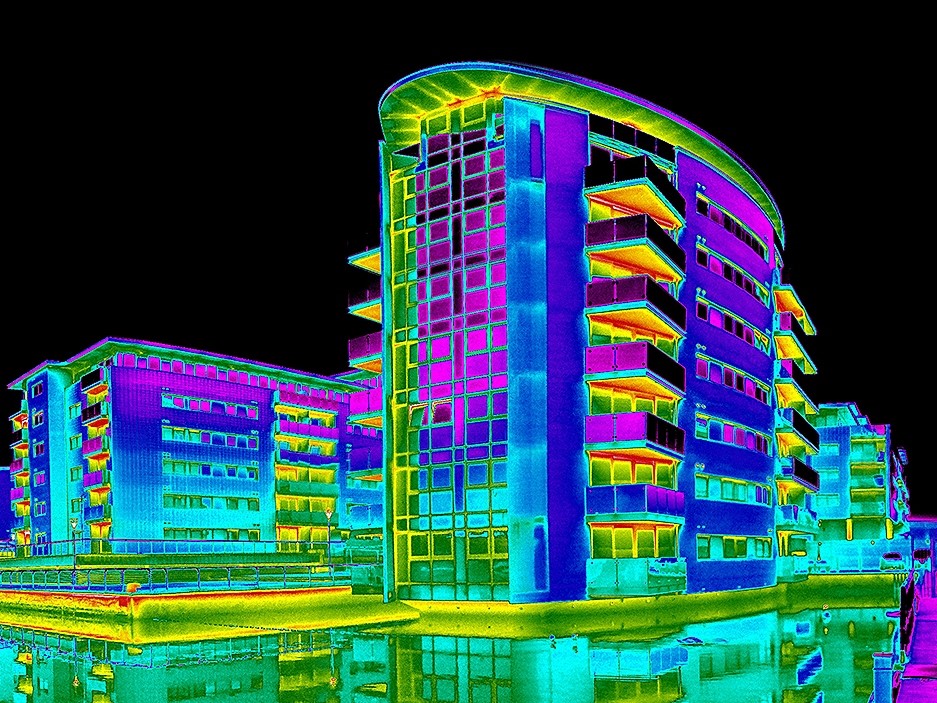
Our thermal imaging surveys can provide extremely useful information about the thermal performance of your property.

We arrange thermal imaging survey on your home, or commercial buildings throughout England and Wales and we always strive to provide a fast and friendly cost-effective thermal inspection service.

A thermal camera survey can be undertaken to establish more than just heat loss, it can also be utilised for:

  1. Energy efficiency – a heat loss thermal survey is essential as it identified where the biggest energy cost-savings can be made.
  2. Damp walls and ceilings and floors – water ingress, sources of dampness, leaks in flat roofs or via chimneys.
  3. Water leaks – leaks in under-floor heating systems or behind concealed pipework in walls, ceilings and floors.
  4. Thermal bridging areas – missing or ineffective insulation at door and window reveals
  5. Missing or damaged insulation – areas where poor workmanship leading to missing or damaged insulation causing cold spots.
  6. Air infiltration – cold draughts into the building through the building envelope that can excess draughts leading to an unpleasant environment.
  7. Air leakage paths – warm air escaping through the building envelope that wastes valuable energy.
Thermal Imaging Surveys in Houses to Reduce Heat Loss

At APT we understand that every customer has different reasons for commissioning a thermographic survey, whether it is for their home, or commercial building we have the technical expertise to help you. Here is another interesting article explaining 10 reasons for carrying out thermal imaging surveys.

Thermal imaging can identify insulation problems.

To reduce heating and/or air conditioning bills having continuous high spec insulation throughout the entire home is important.  One little area of insulation missing can cost you extra money on each monthly bill. We can look for temperature differentials or colour differentials with our high spec thermal imaging cameras to see if insulation is missing in your building envelope. Having this information, you can add /upgrade insulation to targeted areas.

Thermal Imaging Shows Water Leaks and Moisture Intrusion

Do you have a water leaks and/or stains on the ceiling?  Unfortanly the naked eye may be able to see the water stain, but the thermal image may give the technician insight into what is going on.  This is identified due to the evaporating water highlighting cooler temperatures rather than normal surface temperatures. If it shows up as blue or purple, there may be a leak.  Thermal imaging is one of the best non evasive inspections as it can be done without intruding on the homeowner’s daily activities or tearing apart areas that are not needed to be touched.

Thermal Imaging can highlight electrical issues.

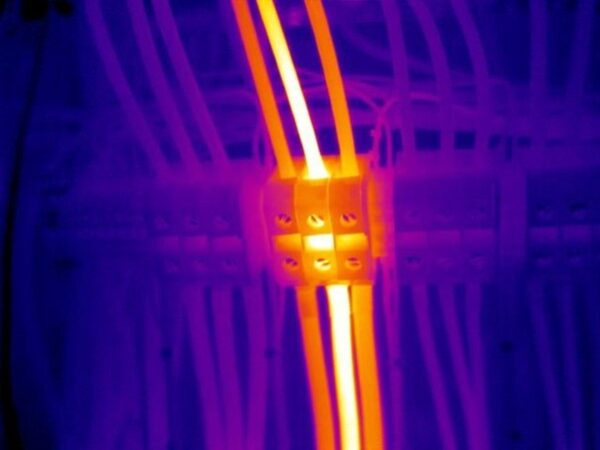
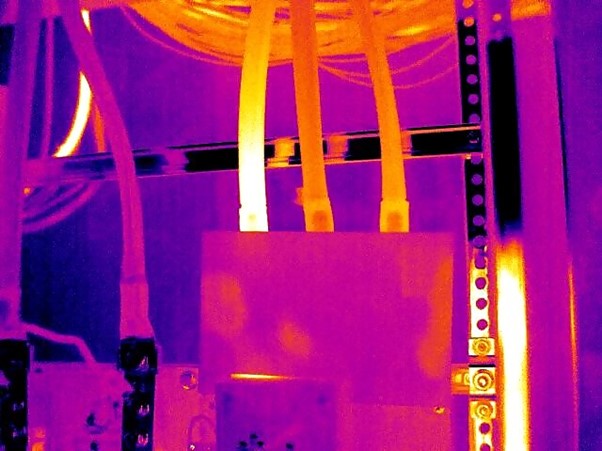
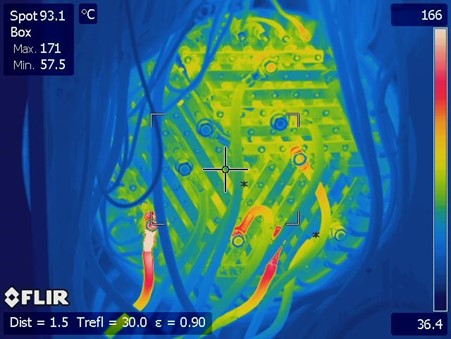
Often, we cannot see the electrical issues in the home.  We don’t have a way to know if an electrical panel is functioning properly, or if it damaged and about to malfunction. Out thermal imaging camera can pick up these issues.  Surveying an electrical box will tell us the temperatures are within the correct parameters or it isn’t not working correctly.

What is the duration of the thermal imaging house survey?

We suggest you allow a minimum of 1 to 2 hours for our engineer to undertake the thermal survey. For large commercial buildings please allow up to 3 to 4 hours.

Do you need an Internal or External Thermal Inspection?

Elements such as wind and outside temperature can make an internal thermal inspection the better choice.  The internal thermal inspection is also is more likely to catch the flow of the air because of how it radiates off an object.  In addition, heat and air do not escape straight out of a home and often go through an inside wall and this might not be picked up from the outside.  We often use our high-powered blower door systems on depressurise in conjunction with thermal imaging to highlight air leakage paths through building envelopes.

Internal or External Thermal Inspection

When can we expect our thermal Imaging report.
We usually, supply the thermal survey report within 1 to 2 days. You will receive your thermal imaging report in PDF format, including copies of the images recorded, and our interpretation of what they are indicating. Most over companies take 1-2 weeks to supply the completed reports.

Why pick APT to undertake your thermal imaging survey?
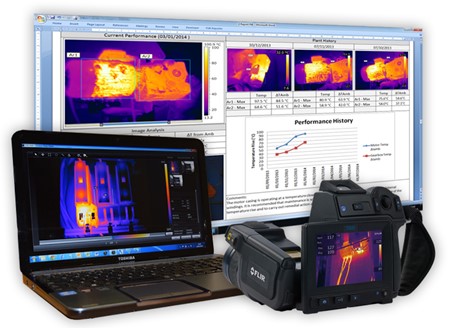
Please note that our engineers are trained to level 3, which is the highest level you can achieve as a thermographic engineer. We also use large format thermal imaging cameras; this provides you with the absolute best chance of solving any potential issues by utilising thermographic technology.

Our thermal specification includes:

  1. Level 3 thermographic certification
  2. Level 3 qualified thermographers
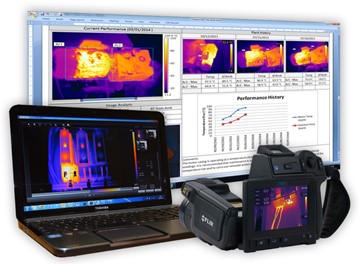
  3. Large format FLIR cameras with 45-degree lenses

We will discuss your project and fully understand your plans and concerns and provide you with the maximum value and reliability from your infrared thermal imaging survey.

The importance of using a  Level 3 trained thermographers cannot be overstated as they are trained to be write predictive maintenance and inspection practices and to develop test procedures and ascertain severity criteria. To try and help clients prepare for the thermal imaging survey to their building, we have written the following article: How we carry our thermal Surveys on commercial buildings.

To try and help facility managers with their electrical and mechanical surveys, we have written the following article: thermal imaging inspections for facilities management. Also, throughout the UK BREEAM projects are becoming more common place. BREEAM provides extra points to projects that have a BREEAM Thermal survey undertaken. As not many clients are aware of BREEAM thermal surveys, we have included more information in our ‘What is a BREEAM thermal Imaging Survey’ article. Also to try and help clients prepare for their survey please download our Thermal Imaging Checklist or check our our article a technical explanation of thermal imaging surveys

Please contact us for more information

If you would like to contact us for more information on our thermal imaging house surveys, please contact us on 01525 303905 or email us at: info@aptsoundtesting.co.uk

Alternatively if you would like more information on how to prepare for your thermal imaging survey, please visit our website here or download our thermal imaging checklist  

Extra Costs Associated with Sound Test Failure

Extra Costs Associated with Sound Test Failure

Extra Costs Associated with Sound Test Failure

If you have a new and/or conversion residential project you are usually required to undertake Sound Testing, this demonstrates that the performance of the party wall and floor partitions meet the standards as stipulated in Building Regulations Approved Document E.

Unfortunately, many developers and builders often have to undertake expensive remedial treatments by underestimating the requirements of Building Regulations Document E which results in Sound Test failures

Extra Costs Associated with Sound Test Failure

Preparing for Sound Testing

There are two key considerations when designing separating walls and floors to achieve the requirements of Approved Document E and avoid costly Sound Test failures.

  1. Direct Sound Transmission – This is sound that travels directly through the separating wall and/or floor from one room to another.
  2. Flanking Sound Transmission – This is sound that bypasses the separating wall and/or floor, via a weak junction element such as external wall, floor or ceiling detail. It is worth noting that sound flanking can lead to sound test failure even if you have a robust separating wall and/or floor specification.

Three Ways to Increase the performance of separating walls and floors

  1. Mass – The greater the mass per unit area of the wall or floor, the less it will vibrate in response to sound waves thus less sound energy is radiated.
  2. Absorbing Porous Materials – materials such as acoustic rock wool are used within cavities in separating wall and floor structures to reduce mid to high frequency sound energy.
  3. Vibration Isolation – This is the reduction of structure-borne sound and vibration by the use of resilient materials such as acoustic membrane to separate materials and form independent structures. For instance the introduction of a floating floor would isolate the floor surface from the rest of the structure and reduce the vibration transfer of footfall noise.

How we can help you avoid sound test failures

During early design and construction process, we visit site to conduct a comprehensive acoustic design survey and review, we also take this opportunity to meet; where possible, the site/project manager, architects etc. The first stage of the acoustic design is to send through the design drawings – to include sections etc. We then review the design to check that the construction details proposed are capable of passing the sound tests. This usually takes place straight after planning has been approved as increased cost savings can be realised at the earliest stage, we will evaluate the construction methods and materials specified to ensure that they are capable of meeting the acoustic requirements of Approved document E. The typical areas we check are:

  1. There are no flanking points, where isolated partitions are wrongly mechanically fixed together to caused noise bridging.
  2. The walls and floors design are acoustically robust, to comply with Building Regulations Part E.
  3. The acoustic treatments for Soil Pipes, Stair Cases Steel Beams etc. to ensure they are acoustically fit for purpose, as these are some of the areas that get usually missed.
  4. Acoustic floor treatments are compatible with the proposed floor finishes i.e. Carpets, Laminates, Floor Tiles and under floor heating systems.

Also provide on-going design support service, so you will have direct contact with the allocated acoustician from the start of the process through to the successful completion of the project.

Avoiding Sound Test Failure
One of the most important services is the going site survey visits which allow our clients to feel confident about the outcome of testing at the end of the build.If you have a new project and you need help with your acoustic design and/or sound testing then please email us at: info@aptsoundtesting.co.uk or call us on 01525 303905. If you want more information on our full range of services please visit our website at: www.aptsoundtesting.co.uk

Thermal Imaging Surveys to Commercial Buildings

Thermal Imaging Surveys to Commercial Buildings


T
hermal Imaging Surveys to Commercial Buildings
Thermographic surveys are one of the best diagnostic tools for demonstrating where heat is being lost in your commercial building in London and the South East.   Most of our customers are incredibly surprised at the amount of the sources of heat loss that we uncover on their buildings during a thermal imaging survey. There can be a multitude of problems we can uncover such as cold draughts emanating through air leakage paths/cracks in the building envelope as well as missing insulation from whole sections of walls and/or floors or roof, which have been missed out by the insulation installation companies.

Thermal Imaging Surveys to Commercial Buildings

How do we carry out a thermal survey on commercial buildings?

We will try and book in a convenient time to visit your commercial building, naturally this will depend on the time of year (usually November-April) and forecast weather conditions.  Note that we may suggest rearranging for another date if the conditions turn out to be unsuitable such as heavy rain and/or high ambient air temperatures throughout the day and night.

When our thermal engineer arrives on site, we’ll discuss in some detail the problems you have encountered with heat loss/draughts and any objectives you have.

Unlike our competitors, we will always carry out a full internal and external survey as standard (see below for more information).

How long does a Thermal Survey take?

This depends to an extent on the size of your commercial building, but also on how involved you want to be.  We strongly encourage you or your site representative follows our engineer around during the survey – we will both learn more in the process, which will ultimately help us to help you.  We suggest you allow a minimum of 1 hour, and up to 2 hours if you have a lot of questions and/or a large dwelling. For large commercial buildings please allow up to 3-4 hours.

Thermographic surveys

When will you receive the thermal imaging survey report?
Usually within 1-2 days you will receive your thermal imaging report in PDF format, including copies of the images recorded, and our interpretation of what they are indicating. Most over companies take 1-2 weeks to supply the completed reports.

Why pick us to undertake your thermal survey?
Please note that our engineers are trained to level 3, which is the highest level you can achieve as a thermographic engineer. We also use large format thermal imaging cameras; this provides you with the absolute best chance of solving any potential issues by utilising thermographic technology.

Our specification includes:

  1. Level 3 thermographic certification
  2. Level 3 qualified thermographers
  3. Large format FLIR cameras with 45-degree lenses
your thermal survey?

What type of buildings require thermal imaging surveys?

There are many different types of buildings that require thermal imaging surveys, here are just a few:

  1. Commercial Buildings
  2. Office Blocks
  3. Schools and Colleges
  4. Warehouses & Storage
  5. Military Infrastructure
  6. Flats, Houses & Residential Tower Blocks
  7. Housing Stock (Councils & Property Managers)
  8. Flat Roofing

What types of building defects are identified during thermal imaging survey’s?

Thermal imaging can pick up hundreds of different building defects. Here are a few of the most common items identified during previous thermal surveys.

  1. Poor Construction
  2. Missing or Damaged Insulation
  3. Thermal / Cold Bridging
  4. Air Leakage & Unintentional Openings
  5. Moisture & Water Ingress
  6. Poor Thermal Comfort
  7. Damp & Mould

Please contact us for more information

If you would like to contact us for more information on our thermal imaging services, please contact us on 01525 303905 or email us at info@aptsoundtesting.co.uk

Alternatively if you would like more information on how to prepare for your thermal imaging survey, please visit our website here or download our thermal imaging checklist   

BS8233 NOISE ASSESSMENT GUIDANCE FOR DEVELOPERS

BS8233 NOISE ASSESSMENT GUIDANCE FOR DEVELOPERS

BS8233 Noise Assessment Guidance
One of the planning conditions for your new development states that you need to undertake a BS8233 noise survey; however, what is a noise assessment and how do I undertake one?  

Understanding your planning requirements when planning a residential project or development can be confusing. With various permissions and assessments available, knowing which you need and what they all mean is often a struggle.

A BS8233 noise assessment is a common assessment that you might come across while planning your development. It relates to noise levels on development projects and is often required for obtaining planning permission. If you are undergoing a residential development near to noise sources in London and the South East and/or the United Kingdom, then please read our expert guide on BS8233 noise assessments.

BS8233 Noise Assessment Guide for Developers

A BS8233 noise assessment refers to ‘guidance on sound insulation and noise reduction for buildings. It is used to handle the noise levels from outside the building, noise from a plant and services within it, the impact on occupiers and even how sound varies in individual room acoustics. The assessment will suggest appropriate criteria and limits for various situations within a development project to bring the internal/external noise levels down to the acceptable levels in line with BS8233.

BS8233 NOISE ASSESSMENT GUIDANCE FOR DEVELOPERS

The following table below shows the required indoor ambient noise levels to comply with BS8233.

indoor ambient noise levels

BS8233 sets out appropriate noise levels for both internal and external projects for daytime and night time. It provides some guidance on the design of sound insulation in buildings as well as various methods of achieving noise reduction in new build projects and refurbishments.

When you choose APT Sound Testing for a BS8233 noise assessment we will arrange for our acoustic engineers to complete the report on your behalf. A noise survey will be carried out at the development site, and the sound environment will be evaluated. The survey helps us to determine any potential noise impact, and we will consider all aspects of BS8233.

Why is a BS8233 Noise Assessment Required on my Project?

Any development such as commercial projects, such as offices, schools or residential houses and flats, that is located near a transport noise source such as a railways line or main road are likely to require a BS8233 noise impact assessment; which most likely requires the assessment to consider the guidance contained in the British Standard 8233:2014. Developments near roads or railways often need this assessment as part of the planning permission to check that appropriate external and internal noise levels can be achieved. This is necessary to protect any future occupants of the site from excessive noise, as well as to protect other people nearby to the development.

A local planning authority will request a noise impact assessment should support the planning or preferably be provided at the pre-application stage of planning application for a new project. The information provided in the noise impact assessment which considers BS8233, provides the authorities the necessary information to assess the level of noise on the development and surround areas. This can then be used to ensure that appropriate noise reduction measures are put in place if required, such as acoustic upgrades to the building façade etc.  if you undertake a BS8233 noise survey you increase the chance of planning consent being awarded for your new residential or commercial development.

The key reason for a BS8233 noise assessment is to make sure that a development is compliant with the Noise Policy Statement for England and the National Planning and Policy Framework.

BS8233 NOISE ASSESSMENT GUIDANCE FOR DEVELOPERS

What Does A BS8233 Noise Assessment Involve?

APT Sound Testing will arrange for our acoustic engineers to visit site to undertake a BS8233 noise assessment and the sound environment will be calculated. Measurements are usually undertaken over a minimum 24 hour period to the nearest building façade facing the main noise source. If there are multiple noise sources extra survey locations may need to be carried out. We will then carry produce the noise assessment report. The survey helps us to determine any potential noise impact, and we will consider all aspects of BS8233.

After the survey, we will be able to recommend solutions (if required) to make sure your development meets all the local regulations. This will all be used to create your BS8233 noise assessment report which can then be used for planning permission applications and compliance with your relevant planning condition/s.

We have undertaken hundreds of noise surveys throughout London and the South East, if you need any further information on our BS8233 noise assessments service to comply with your planning conditions, or you would you like to contact us to discuss your noise survey requirements then please contact us at info@aptsoundtesting.co.uk or call us on 01525 303905.

Alternately, for more information, please visit our BS8233 noise survey page, or please visit our noise survey guidance page. You can also download our BS8233 noise assessment checklist here.

Party Floor Sound Testing in London

Party Floor Sound Testing in London

Party Floor Sound Testing in London
APT sound testing has undertaken hundreds of sound insulation tests on party floors on new build and converted properties throughout London and Greater London.

In many cases the existing floor construction is similar to the image shown below, this type of existing floor construction usually achieves 30-35dB for airborne sound and 66-74dB for Impact Sound. Obviously, these figures fall well short of the minimum requirements of Approved Document E, which requires 43dB & 64dB, so to pass the precompletion sound testing major improvements must be made to the acoustic element of the floor partition.

Alt Text – A picture of an existing floor partition rated at Approx. 30dB, which will fail the sound insulation test through a party floor in London.

A picture of an existing floor partition rated at Approx. 30dB, which will fail the sound insulation test through a party floor in London

Our Acoustic Design Service for Party Floors in London

We have helped many architect and developers with their acoustic design and sound testing requirements on projects containing hundreds of units, through to a pair of semi-detached dwellings. Using our experience and knowledge, we always try to provide the best solution considering material costs and on-site buildability.

If it is a conversion project and you are unsure of the existing floor construction and sound insulation performance, we often recommend our ‘sample sound testing service. Firstly, we visit site and undertake sample sound testing to at least one floor partition – this usually consists of at least one airborne and impact test to party floor. Once the airborne floor sound test results are established, we can then offer a targeted acoustic design solution to achieve compliance with Approved Document E.

After the sample sound testing has been undertaken and the sound insulation levels realised, we can then undertake the 2nd part of our acoustic service – the acoustic design review. Using the acoustic data collected during the sample sound testing, we can undertake a targeted acoustic review. We always try to provide a targeted acoustic solution that considers material cost and onsite buildability. Where possible we try to provide an off the peg solution, which helps to minimise delays due to material deliveries.

During the onsite construction, we can visit site to check that the construction team is installing the acoustic materials in-line with manufacturer’s guidelines, this is the third element of our acoustic service.  In our experience a sound test failure is often caused by poor workmanship rather than the actual acoustic design. The site survey helps to further reduce the chance of a test failure.

The fourth and last part of our acoustic service is the final pre-completion sound testing. We visit site and undertake the post-completion sound testing to demonstrate compliance with Approved Document E. We then forward our sound test report, which should be forwarded to Building Control by the client to attain building control signoff.

Alt Text – A picture of the equipment required to undertake acoustic design and sound testing through a party floors in London.

A picture of the equipment required to undertake acoustic design and sound testing through a party floors in London.

The problem with noise flanking in London

In many cases there are more technical issues such as noise flanking which may require more detailed diagnosis and invasive investigation. This can mean having to remove some of the wall and floor partitions. Often noise flanking is causes by the use of lightweight blocks in the construction of the walls in an apartment development. This can allow sound to travel along the walls both horizontally and vertically from dwelling to dwelling. In many cases a wall and/or floor partition may have a very robust acoustic construction; however, the floor partition will still fail due to the sound travelling up and down the walls via the noise flanking pathway.

Common reasons for party floor failure in London

The are many reasons for party floor failure, here are some of the most common issues:

  1. Where lightweight blocks used in the inner envelope construction. This allows sound to travel along the lightweight blocks both vertically and horizontally from dwelling to dwelling.
  2. Bridging an acoustic floor system with skirting, or via screwing down the floor system to the joists.
  1. Resilient bars missing or fitted incorrectly to the underside of the floor joists.
  2. Excess recessed lights have been fitted into an acoustic ceiling.
  3. The dividing floor has a lack of mass or acoustic insulation has not been installed correctly, and/or or direct fixing of plasterboard and/or floorboards to joists without using a resilient ceiling construction and/or floating floor.
  4. Through Windows if they are not double-glazed units and/or have secondary glazing as a minimum – this is often a problem if there is a continuous curtain wall running through the dwellings.
  5. Along structural joints along the perimeter wall and floor joint. These areas should be filled with acoustic mastic)
  6. Structural steels that run through one property to the other without material isolation, i.e. plasterboard is screwed directly to the steel offering little or no noise isolation.

Acoustic upgrades for party floors in London Flats  

One of the easiest solutions to improve the acoustic performance of party floors between flats, is to retain the existing joists and between the joists install a 100mm RW45 acoustic insulation. Above the joists install 22mm T&G boarding, above the boarding install a layer of 6mm acoustic resilient membrane, this must be bonded to the T&G boarding. This can then be finished with engineered flooring and/or carpet. Below the joists install resilient bars and below the bars install 1x15mm & 1×12.5mm layers of soundboard. All boards must be properly lapped, and the perimeter joints filled with acoustic mastic. This acoustic solution is usually robust enough to achieve the requirements of Approved Document E; however, as every project is slightly different it is always best to undertake a site-specific design review for each project.  

Alt Text A picture of a sound test engineer undertaking party floor sound insulation testing in London.

A picture of a sound test engineer undertaking party floor sound insulation testing in London.

How we can help 

It can be very time-consuming trying to identify the cause of a failed sound test and undertake the remedial works to achieve Building Control signoff. To reduce the risk of acoustic issues on your site is always best to hire an experienced consultant. We are also a UKAS accredited company, so you can be sure of a friendly and professional service providing a ‘one stop’ solution for all your acoustic requirements.

We can advise on all types of acoustic design solutions, to help you pass your sound testing to party floors to new and conversion projects at the first attempt. Whatever the problem we can usually find an acoustic solution that will help you achieve Building Regulation compliance. For more information, please visit our new sound test blog.

We cover the following areas throughout London and Greater London, including the boroughs of City of London, Barking and Dagenham, Barnet, Bexley, Brent, Bromley, Camden, Croydon, Ealing, Enfield, Greenwich, Hackney, Hammersmith and Fulham, Haringey, Harrow, Havering, Hillingdon, Hounslow, Islington, Kensington and Chelsea, Kingston upon Thames, Lambeth, Lewisham, Merton, Newham, Redbridge, Richmond upon Thames, Southwark, Sutton, Tower Hamlets, Waltham Forest, Wandsworth, Westminster to help you achieve the requirements of Approved Document E and attain building control signoff.

If you would like more information in regards to sound testing service and/or acoustic design services in London, please contact us on 01525 303905 or info@aptsoundtesting.co.uk, for more information please visit our website at www.aptsoundtesting.co.uk or download our sound test checklist.

Party Wall Sound Testing in London

Party Wall Sound Testing in London

Party Wall Sound Testing in London
We often get asked by our clients throughout London, how they can improve the sound insulation to pass the Party Wall sound insulation testing.  To try and simplify this we have written the following article explaining the main acoustic design considerations for undertaking and improving the acoustic characteristics of party walls to pass the Sound Insulation Testing in compliance with Approved Document E of Building Regulations.   

As a starting point, you need to consider the following five basic acoustic design considerations, they are:

  1. Adding Mass – such as adding dense finishing boards such as ply, OSB, drywall or plasterboard.
  2. Providing Isolation – such as constructing independent linings, or introducing acoustic brackets, acoustic hangers or resilient channels, which will help to decouple drywall from the rest of the building’s structure.
  3. Adding Absorption – such as open cell woven types of material such as RW45 Acoustic Wool Cavity Insulation, which provides a soaking up or absorption of the acoustic energy entering it.
  4. Providing Resilience – There are quite a few ‘acoustic membranes’ on the marketplace, most membranes are 3-6mm in thicknesses and is commonly installed within walls, ceilings and floors to mitigate airborne and impact sound.
  5. Adding Stiffness – adding extra noggins between wall frames and/or floor joists can add stiffness to the overall construction of the party walls/floors.
A picture of APT Sound Testing engineer undertaking a precompletion sound test pass through a party wall in London.

Reasons for party walls failing the sound testing  

The are many reasons why party walls may fail the pre-completion sound testing, the main reasons are as follows:

  1. Shared Structural Building Components – Floorboards, Floor Joists, Continuous Drywall Partitions, Continuous Concrete Floors, and Cement Block Walls.
  2. Through Structural Steel – Structural steel beams are often a major cause of noise transmission as plasterboard is often fixed directly to the steel without sound breaks.
  3. Plumbing Chases – Junctures between the Walls & Floor Slab Above or at the Exterior Wall Juncture (this should be filed with mortar etc. to add mass to these weakened areas.
  4. Through Windows – if they have single glazing, with no double glazing or secondary glazing as a minimum and the windows are in close proximity either side of the party wall.
  5. Fixtures & Outlets – Light Switches, Telephone Outlets, and Recessed Lighting Fixtures (if penetrations have been cut back to back with the opposite dwelling under test)
  6. Structural Joints – Perimeter Joints at Wall & Floor, Through Wall & Ceiling Junctures (these should be filled with acoustic mastic.
  7. Around the End of the Partition Through the Adjacent Wall (acoustic mastic should be used to seal this junction)

A simple way to improve noise through party walls in London

One quick and simple way to improve the acoustic performance of a dividing wall partition, is to install a 70mm met-sec partition in front of the existing wall – it is usually best to install this in the largest room. Leave approx. 25mm gap between the back of the met-sec and the wall. Then install 50mm acoustic wool (min 45kg/m3) to the inside of the met-sec frame, then add 1 x 15mm & 1 x 12.5mm layers of soundboard to the outside of the met-sec frame. Ensure all boards are fully lapped and the perimeter joints are filled with acoustic mastic.

How many airborne party wall sound tests do I need?

Essentially, for sound testing party walls, you only need to carry out airborne sound testing. If your development is 10 units or less, you are required to carry out 2 airborne wall sound tests – if there are different types of wall construction, you will need to undertake sound testing to each wall type.

Preparing your development for sound testing in London

There are quite a few items to consider when preparing your London development for completion sound testing. Basically, if you action the following items, it should help you pass the sound testing at the first attempt:

  1. Download our APT sound testing checklist and tick off the items one by one.
  2. The whole building envelope and internal walls and floors should be fully completed.
  3. All external and internal doors and windows should be installed.
  4. All external windows and doors should be installed and closing properly.
  5. All electrical fittings must be completely in-place, and fully functional. Poor electrical installation can lead to excess noise.
  6. Standard 240-volt power should be in-place and available in every room. Our testing equipment can be damaged by the voltage fluctuations of on-site power generators, so it’s essential to have 240V mains supply on-site on the day of the test.
  7. No carpets or laminated flooring should be fitted on the 1st floor levels or above. These materials can affect the movement of noise, and as a result could impact on whether a building passes the sound check test.
  8. The skirting boards should not touch the floating floor, a flanking strip should be installed to prevent the noise flanking.
  9. All gaps in the walls and floors should be sealed. Again, noise can leak out through any gaps, affecting the movement of sound and impacting on the space’s performance.
  10. Access to all the rooms on all levels should be granted to our technicians, with all noise sources (radios, alarms, building work) ceasing for the duration of the test.

It is essential that you action all the above items, if we are to achieve accurate sound test readings and to achieve compliance with Building Regulations Part E. if you require more information, please click on our article here.

A picture of APT Sound Testing acoustic engineer achieving a precompletion sound test pass through a party wall in London.

APT Sound Testing can advise on acoustic party wall design to help you pass the sound testing to your London development, whether it be a new build or conversion project.

We are also a UKAS accredited sound testing, so you can be sure of a friendly and professional service providing a ‘one stop’ solution for all your acoustic requirements.

Regions Covered
We cover the following areas throughout Greater London including City of London, Barking and Dagenham, Barnet, Bexley, Brent, Bromley, Camden, Croydon, Ealing, Enfield, Greenwich, Hackney, Hammersmith and Fulham, Haringey, Harrow, Havering, Hillingdon, Hounslow, Islington, Kensington and Chelsea, Kingston upon Thames, Lambeth, Lewisham, Merton, Newham, Redbridge, Richmond upon Thames, Southwark, Sutton, Tower Hamlets, Waltham Forest, Wandsworth, Westminster to help you achieve the requirements of Approved Document E and attain building control signoff.

Contact APT Sound Testing
If you would like more information in regards to sound testing service and/or acoustic design services in London, please contact us on 01525 303905 or info@aptsoundtesting.co.uk, for more information please visit our website at www.aptsoundtesting.co.uk or download our sound test checklist.

Sound Testing on Conversions Projects

Sound Testing on Conversions Projects

Sound Testing on Conversions Projects
Acoustic design and sound testing on conversions projects don’t need to be problematic.

If you are currently managing the process of an office or house convert houses into flats or ‘Rooms for Residential Use’, then you need to pay attention to the acoustic design from the design stage of the project.

Air Pressure Testing  have many years of experience in providing quality sound insulation testing and acoustic design services  designed to help you meet these essential legal requirements of Building Regulations Part E. We are a UKAS accredited company, so you can be sure that our services are undertake to the highest laboratory standards.

Sound Testing on Conversions Projects

The types of projects that need to comply with this piece of legislation are:

  1. House to flat conversions
  2. Commercial building to flat conversions.
  3. Hotels and hostels
  4. Boarding houses
  5. Halls of residence
  6. Residential homes

Our six stage process is designed to get the very best results and help you comply with Approved Document E:

  1. Stage 1 – We review the architect’s drawings to check the required acoustic principles have been followed and make comment as and when necessary.
  2. Stage 2 – We undertake a site visit and analyse the current state of building construction.  And to check there are no site specific construction problems that may affect the acoustic performance of the building.  This helps us to get a more accurate overview of which acoustic treatments will be necessary.
  3. Stage 3 – We’ll provide you with a full and detailed acoustic design report that outlines which acoustic treatments will be required to ensure the conversion meets the criteria for Document E.  We’ll work out the cheapest and most efficient way of converting the building as well as taking into account buildability issues.
  4. Stage 4 – We will provide ongoing support to assist the builder/consultant to ensuring that the level of detail required is met and deal with any ongoing issues that may arise.
  5. Stage 5 – We can try to save you further money by providing building materials at a reduced rate.
  6. Stage 6 – We will undertake the final pre-completion sound testing to achieve compliance with Approved Document E.

We’ve successfully guided our clients through hundreds of different conversion projects and can boast a 100 per cent success rate where we have been involved in the acoustic design.

There are two distinct types of noise to when undertaking acoustic design on conversions, they are:

  • Airborne Noise (for example speech and music) and
  • Impact Noise (for example footsteps directly on the floor above) and

Even if both types of sound are emitting through the ceiling/floor then there are acoustic solutions that should reduce the sound levels and improve your sound insulation test results.

Part E stipulates that 10% of each party wall/floor construction type to be tested. The Sound insulation testing is to be carried out between pairs of rooms separated by party walls and/or floors. In is usual to test between living rooms and bedrooms as these are classed as the two main ‘habitable’ rooms; however if this isn’t possible other rooms can be used such as study’s, kitchens and dining rooms.

Unfortunately, we are currently experiencing a rise in the amount of sound testing failures – where we have not been involved in the acoustic design) mainly due to the conversion of office blocks into residential developments. Some of the buildings have unusual construction elements such as honeycomb floors which can be very weak acoustically, due to their lack of mass, taking this into account it is extremely important that we are involved from the start of the project.

If a building fails its sound insulation test it’s usually down to a problem with the acoustic due to issues such as noise flanking etc. One common cause of noise flanking is often associated with the inclusion of lightweight blocks within the construction of the building envelope. Clients often call us in when their building has failed the sound testing. Many other sound testing companies simply offer sound testing but no acoustic design services, we offer a comprehensive acoustic design and sound test package – as detailed in our 6 stage design service.

We undertake UKAS accredited Part E sound testing in London and throughout the rest of the UK. We use the latest class 1 acoustic equipment and we are a UKAS accredited company, so our clients can be sure that all testing is completed to a strict ISO quality controlled standard. We undertake sound testing throughout London and the UK.

If you would like advice on your acoustic design or sound testing in London, please contact us now at info@aptsoundtesting.co.uk or call us on 07775 623464.