Category: Uncategorized

Sound Testing for New Build

Sound Testing for New Build

Sound Testing for New Build Dwellings
Sound Insulation Testing became mandatory in England & Wales in 2003, when Approved Document E was updated. Approved Document E requires new and converted to achieve a reasonable level of sound insulation between dwellings. The simplest way to comply with the requirements of Approved Document E; is to have on-site pre-completion sound insulation tests carried out on your project. We carry out full sound testing services in compliance with Approved Document E.

In our experience there is usually a level of apprehension with our clients having to undertake pre-completion sound insulation tests.  This is often down to the fear of failure. It should be remembered; however, that if the acoustic design specification is closely followed, and a good standard of onsite workmanship is maintained there is very little chance of failure.
Sound Testing Services for New Build


Sound Testing New Build

Approved Document E requires a minimum of one ‘set’ of tests for every ten units in each group and/or sub group.  Is usually broken down to the following: two airborne wall, two airborne floor and two impact sound tests. For example, if you have a block of 100 flats, all of the same construction, you would usually conduct 10 ‘sets’ of tests. If you have a development of 25 houses, with five different sub-groups (5 units in each) then you would usually conduct 5 ‘sets’ of tests.  As previously stated a set of tests usually consists of two airborne tests of separating walls and two airborne tests and two impact tests on separating floors; however, if no separating floors are available, i.e. in semi-detached or terraced houses, one set of tests would consist of two airborne tests of separating walls only.

To test the airborne sound insulation properties of a floor or wall, a sound source which consists of an amplifier and loud speaker is set up on one side of the wall or floor partition that is to be tested. We then turn the setting to turn on Pink noise. Pink noise sounds like the static that can be heard on a radio that is off station or the old TV test card noise.

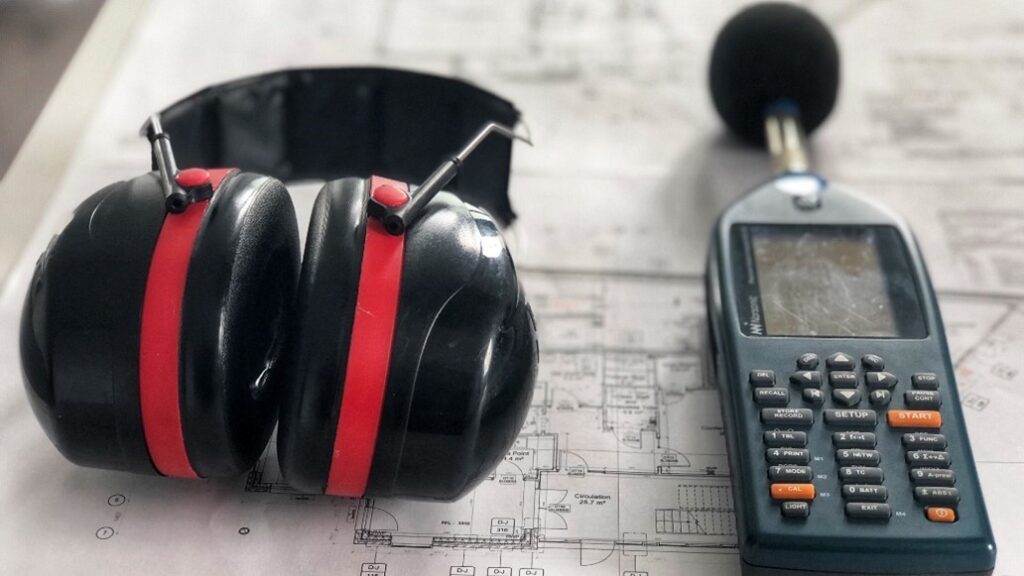
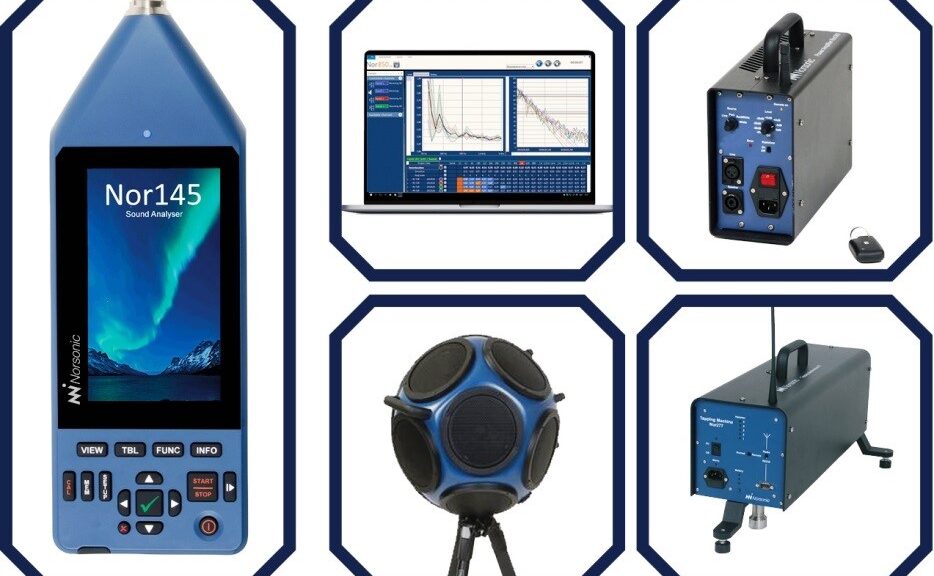
This type of noise is used because it is made up of a wall of sound that has a wide spectrum of frequencies. This provides an indication of sound insulation performance for a wide range of sounds that may be experienced within a dwelling from speech to a kettle boiling. The pink noise is measured in the room which contains the speaker or sound source using a Class 1 Norsonic sound level meter; thereafter the noise is measured on the other side of the wall or floor partition that is being tested. In layman’s terms the difference between these two levels is the amount of sound that is stopped by the sound insulating qualities if the wall or floor partition/s.

The result is then corrected and adjusted depending on the echo or reverberation time within the receiving room, and any background noise such as builders work noise etc. to give the airborne sound insulation result (DnT,w). The results of these tests are then compared to the performance criteria of Approved Document E – 45dB new build & 62dB for conversions) and a pass or fail sound test certificate is produced

Testing Impact Sound Insulation Performance
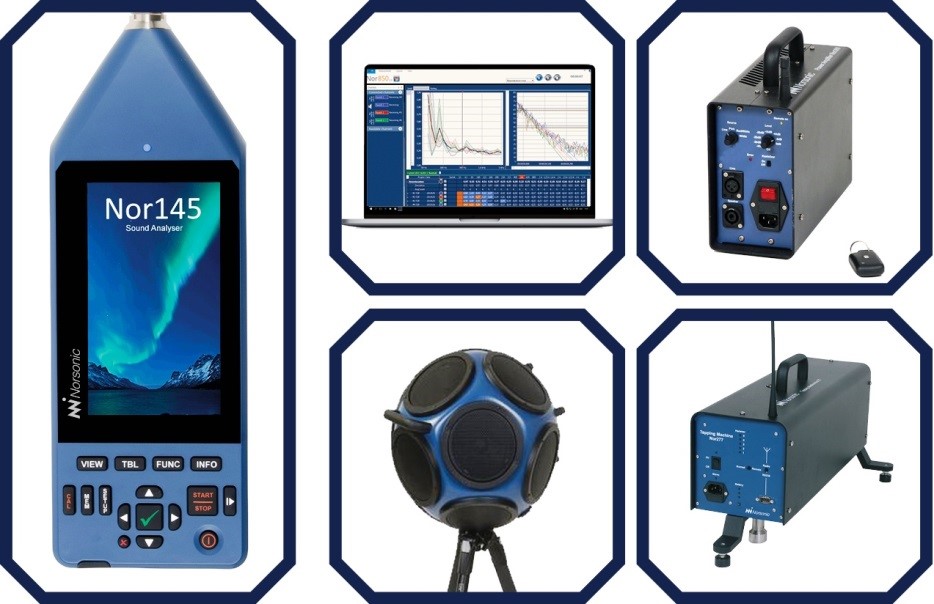
To test the impact sound insulation performance of a floor, a Norsonic tapping machine which consists of five small hammers that are dropped onto the floor to simulate foot fall, is placed on the floor. The resultant noise in the room below is measured with a Norsonic Class 1 sound level meter and the amount of noise that passes through the floor is the impact sound transmission level and is expressed as a single number. This result is then corrected and adjusted depending on the reverberation time of the rooms as well as any background noise to give the impact sound transmission result (LnT,w). The results of these tests are then compared to the performance criteria of Approved Document E – 62dB new build & 64dB conversions) and a pass or fail sound testing certificate is produced.

If pre-completion test results do not satisfy the performance criteria of Approved Document E, then our test engineer will attempt to determine the possible causes of failure. This may be to do with construction detailing around services or at junctions, or simply, poor acoustic design. Once the results have been finalised along with the associated graphs, our acoustician (with the aid of the information from the sound test engineer, we should be able to determine the specific cause of failure. Once a specific reason for failure has been determined, we can then advise the client on remedial actions that can be undertaken.

Contact APT Sound Testing
If you have a project that’s needs acoustic design advice or needs pre-completion sound testing then please contact us by visiting the  APT Sound Testing Website and we should be able to offer you an acoustic solution to help your project achieve practical completion.
The Secret to Successful Sound Testing

The Secret to Successful Sound Testing

The Secret to Successful Sound Testing
There are many considerations to achieving successful sound testing on your development. The main areas that need to be addressed are the dividing wall and flor construction.  When dealing with walls you normally just need to worry about airborne sound; however, with walls, it’s both airborne and impact sound which can be far more difficult to deal with.

The usual noise problems associated with airborne sound transmission are TV noise, music, and speech. This can be dealt with by applying ceiling treatments as well as mass and isolation to the building components. Impact sound (footfall) performance is increased by the use of resilience layers and isolation of components to prevent noise flanking through the partition.

Secret to Successful Sound Testing

Airborne Sound Testing
For airborne sound testing Building Regulation Part E requires you to achieve at least 45dB for new build properties and 43dB for conversion developments, this applies both to party walls and floors between properties. This level is the difference between the source level and the receiver level during sound testing. Therefore, if the source level in one flat is 110dB and the receiver level in the neighbouring flat is 55dB, the level difference (or sound reduction performance) is 55dB.

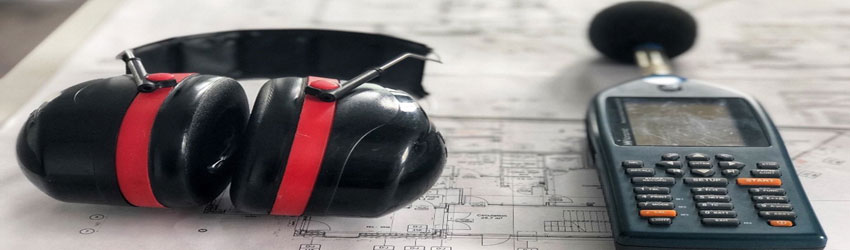
The measurement is corrected for several factors such as background noise, room characteristics and frequency weighting, giving the final sound insulation performance value of the tested partition. In this case the higher the number the better the sound insulation performance. The measurement is done by using a Class 1 Analyser and the associated equipment.

Impact Sound Testing
For impact sound testing Building Regulation, Part E requires you to achieve at least 62dB for new build properties and 64dB for conversion developments. Impact insulation performance only applies to party floors and is related to the effectiveness of the floor construction in absorbing shock such as footfall noise. The measurement is done by using a Norsonic tapping machine (as shown below). The machine has 5 weights that tapping in regular succession on the tested floor which emulates footfall noise. The noise levels are taken in the receiving room below, which are then measured and averaged for different tapper positions, which then gives the sound reduction rating of the floor. In this case the lower the figure, the better the performance.

Good Acoustic Design
To try and ensure you meet the standards stipulated within Building Regulations Part E, careful consideration should be shown to the acoustic design detailing from the stat of the project. offset. Tackling the acoustic design for both new build and conversion projects requires two different construction techniques and acoustic design detailing. With new build properties, you have a blank canvas in terms of the overall design whereas with conversions you usually need to work with the existing’ onsite’ construction which can be quite difficult.

We offer an acoustic design package, which contains the following elements:

a.            Sample Sound Testing – of the existing construction. This offers an accurate overview of the acoustic performance of the existing partitions which enables us to offer a targeted acoustic design using the sound insulation performance of the existing construction.

b.            Acoustic Design Review – a full design review of the proposed developments party walls and floors.

c.             Site Survey Visits – to let us view the existing site construction. This allows us to check for potential problematic construction such as the inclusion of lightweight blocks in the existing construction. It also lets us check that the installation teams are installing the acoustic materials as per the manufacturer’s guidelines.

d.            Final Precompletion Sound Testing in compliance with Building Regulations Part E.

Useful Acoustic Design Considerations

a.            Avoid the use of lightweight blocks in the inner envelope construction and/or stairwell construction etc. as sound will travel both vertically and horizontally from dwelling to dwelling.

b.            The use of resilient suspended ceilings will help improve the performance of the floor partition.

c.             Ensure all support steels/timbers are carefully boxed out where they travel from flat to flat vertically and horizontally.

d.            Use a high-quality resilient acoustic membrane on top of the floor to improve the impact performance of a floor.

e.            Ensure all penetrations are fully sealed where they terminate through floors and they are adequately boxed with acoustic quilt and two layers of plasterboard.

In our experience, the main 5 considerations when designing for separating walls and floors between dwellings are: If used together or in various combinations they will improve sound insulation properties over a wide range of frequencies. The main factors are:

a.            Mass

b.            Isolation

c.             Absorption

d.            Resilience

e.            Stiffness

If used together or in various combinations they will improve sound insulation properties over a wide range of frequencies and should achieve compliance with Building Regulations Part E.

Successful Sound Testing with APT
In our experience, if the acoustic design is taken into consideration from the offset of the project, then it usually results in compliance with Building Regulations Part E.  In Some cases, sound test failure can also be down to poor workmanship rather than the acoustic design that is why we offer a full‘4 step’ acoustic package. If you have a project that needs acoustic design advice or sound insulation testing, then please visit the APT Sound Testing website or phone us directly on 07775623464.

Infrared Inspections to Electrical Installations

Infrared Inspections to Electrical Installations

Infrared Inspections to Electrical Installations
Electrical Thermal imaging surveys detect abnormally high temperatures and are a non-disruptive way of inspecting electrical and mechanical installations.

It provides an extremely low impact fault diagnosis tool for electrical fault finding. It requires no contact being made with the components which means that the components can be checked in a live state with little danger to the user, there is no effect on the components or interruption in any processes the electrical system may be controlling, thus no downtime for server rooms and/or manufacturing plant etc.

Infrared Inspections to Electrical Installations

Electrical faults can lead to breakdowns and the potential for fire hazards. In both cases the losses due to downtime and repair costs can become hugely costly.

What can cause failure in electrical equipment?

  • The age of the equipment – gradual breakdown/wear and tear.
  • Loose connections
  • Overloading sockets in your workplace
  • Loose or corroded contacts
  • Load imbalances
  • Poor cable joints
  • Overloaded transformers

The most common electrical equipment that requires surveys are:

  • Switchgears and switchboards
  • Distribution boards and fuse boards
  • Transformers
  • Control panels
  • Busbar systems
  • High voltage systems
  • Batteries
  • UPS systems
  • Heating and ventilation panels
  • Motor and pumps
  • Generators

Why should you undertake a thermographic survey?

Electrical thermal imaging surveys help to identify hot spots in electrical systems that you might not be able to see with the naked eye and makes sure that they are running safely. Thermographic surveys are low impact to the work environment so there is no down time for you to be affected by.

What type of Buildings need a thermal imaging survey?

  1. Commercial Buildings
  2. Office Blocks
  3. Schools and Colleges
  4. Warehouses & Storage
  5. Data Centres
  6. Military Infrastructure
  7. Flats, Houses & Residential Tower Blocks
  8. Housing Stock (Councils & Property Managers)

What does a Thermal image look like?

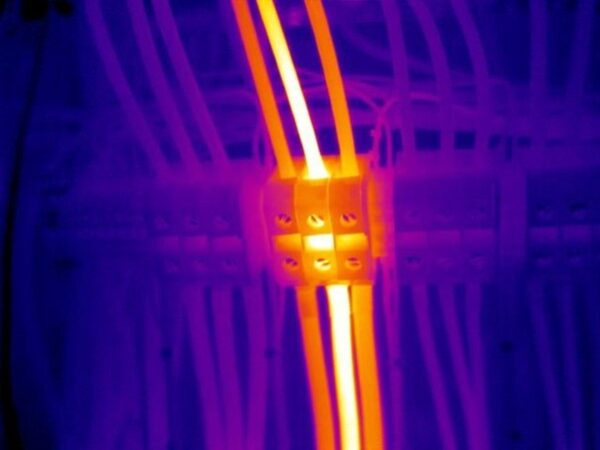
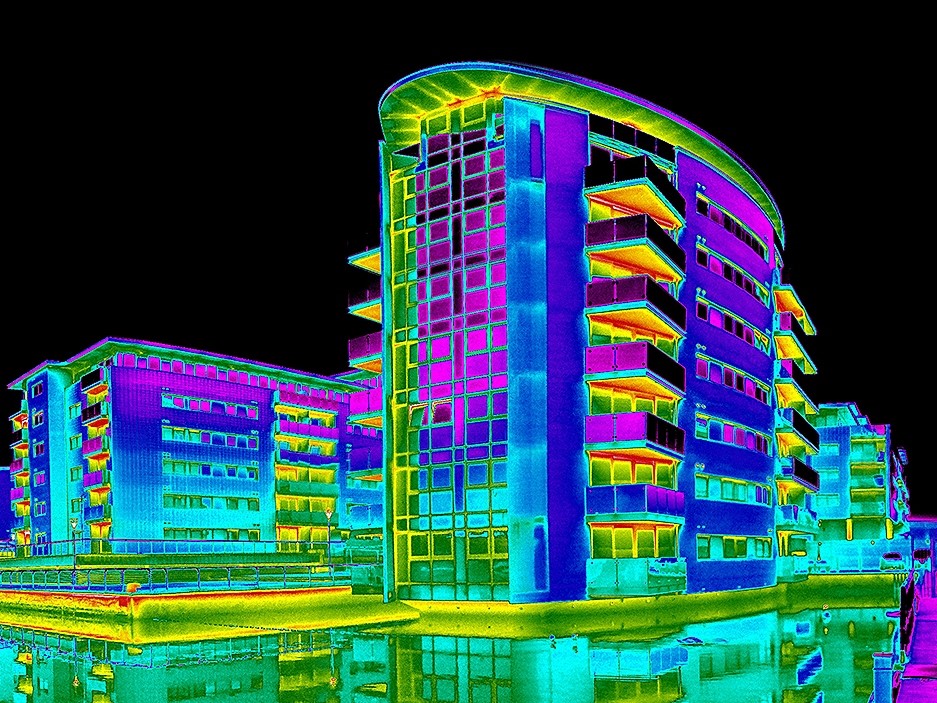
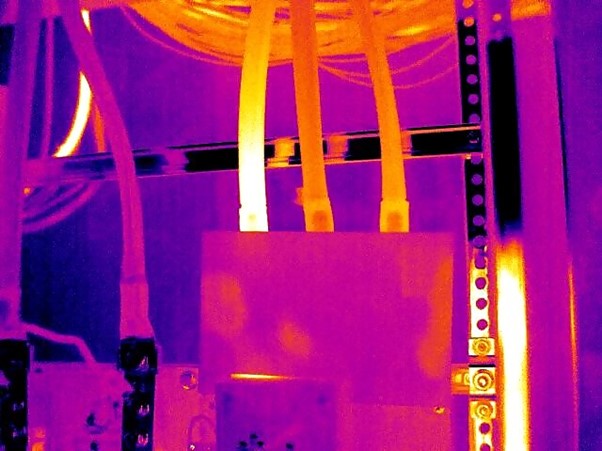
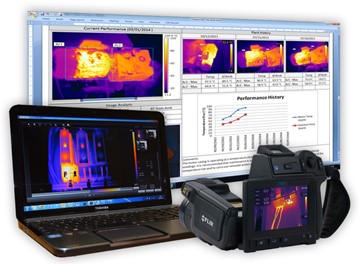
Based on infrared radiation, thermal images will have wide colour palate. The hottest areas of the thermal image from the thermographic survey will be yellow in colour, the coolest will appear in blue this provides a clearly defined imagine highlighting hot and cold spots.

Also, more expensive high resolution camera can be much more effective. The resolution of the camera is how many pixels the camera has on the scene. Higher resolution means that each image contains more information: more pixels, more detail, and a greater likelihood of getting an accurate measurement – that is why we always use cameras with a minimum of Resolution of 640×480 pixels along with Ultramax imaging for up to 1.2 MP thermal resolution. Here is some more information on why you should use high quality thermal imagining cameras.

Infrared Inspections to Electrical Installations

How often should Thermographic inspections be carried out?

It is recommended that thermographic inspections to the electrical installations are carried out during the formal periodic inspections, which are usually carried out annually. Thermographic surveys of critical parts for an installation could mean they have to be isolated in order for them to be inspected. This would obviously cause disruption; however, a routine thermographic inspection of these parts will help your business to run and could identify underlying defects which in turn could lead to a failure of the electrical supply. This shows how important it is to have thermographic inspections routinely incorporated into the annual maintenance schedules, to stay safe.

How many issues can I expect to find within my building?

Historically, we usually find defects during each visit. This can be loose or corroded contacts, load imbalances, poor cable joints or an overloaded transformer – all of which will generate excess heat and previous data from thermal imaging of electrical installations shows a significant rate of potential fault detection for an initial survey, typically in the region of one to two faults for every 10 panels inspected – if you have 50 panels that may result in 10 faults!

A thermal camera can often show the problem before an electrical test or visual inspection would uncover it. The severity of the problem can be determined by comparing the temperature rise of the fault with the properly operating component under the same loading conditions.

Past data from thermal imaging of electrical installations shows a significant rate of potential fault detection for an initial survey, typically in the region of one to two faults for every 10 panels inspected.

Thermal Imaging Inspection

How Much Does a Thermal Imaging Inspection Cost?

This one of the most common questions we get asked, and its has a simple answer: it depends on numerous factors.  When we sit down to work out our fee proposal for a Thermal imaging inspection, we ask the client a number of questions:

  1. The type and size of building.
  2. The amount of preparation required.
  3. The amount of time required to safely undertake the survey.
  4. The type of equipment required to undertake the inspection.
  5. The project location and subsequent travel costs/time.
  6. The required deliverables – what needs to be included within the thermal survey report.
  7. The amount of health and safety requirements i.e., some sites ask for 4-hour safety inductions.

We pride ourselves from being able to offer a basic electrical thermal survey from as little as £495 plus Vat, right up to the huge industrial areas that may need to be done in multiple visits that may be over £10,000 plus Vat and everything in between. It’s always best to call us to so we can get a more accurate overview of our project and quote; accordingly, so please contact us to discuss your project (along with any site-specific issues) and obtain a quote.

Are you engineers trained to carry out a thermographic inspection?

When you are employing a thermographer, you should check to see that they incorporate the high specifications possible for their inspections. Are they certified to Level 3 and do they use large format FLIR thermal imaging cameras?

Their specification should include:

  1. Level 3 thermographic certification
  2. Level 3 qualified thermographers
  3. Large format FLIR cameras with 45-degree lenses

The importance of clear and concise thermographic reports

We spend much a large amount of time on our thermography reportage, that’s why it’s one of the best in the industry, this is obviously a part of the service which is off site and clients don’t see. Whilst we may draw initial conclusions on site, which may need more investigation; usually, our final conclusions and report will only be finalised after all the data has been studied. It’s our ongoing aim to provide thermographic reports that are clear, concise, and easy to reference. Our aim is to take the guesswork out of the equation.

Please contact us now.

If you require a electrical thermal imaging inspection our professional and certified Level 3 Thermographer’s will carry out your thermographic Inspections for all necessary standards and current regulations.

All we need are a few details such as the building address and the number of electrical installations within the building. Floor plans and would also be helpful to allow us to orientate ourselves during the inspection. We will also send across our informative checklist to help you prepare for the thermal survey.

If you would like to contact us for more information on our thermal imaging services, please contact us on 01525 303905 or email us at info@aptsoundtesting.co.uk Please call 01543 225306 or fill out one of our contact forms to discuss our service levels and to run a thermographic inspection for your business. Talk to us today so we can keep you and your business safe.

Types of Sound Testing in London

Types of Sound Testing in London

Different Types of Sound Testing in London
Building Regulations Part E require that builders demonstrate the sound insulation performance of separating walls/floors in new-build dwellings and/or converted dwellings or rooms for residential purposes (as well as those newly formed by a material change of use). This applies when separate dwellings are attached via a common partition not exclusively used by the same occupants. The only way to satisfy the relevant compliance with building regulations is to undertake sound testing in London.

The regulations set minimum performance requirements for sound insulation between spaces, to provide reasonable conditions for living. Performance can be demonstrated either by sound testing a sample of as-built constructions/properties.

Different Types of Sound Testing

Sound Insulation Testing needs to be carried out between pairs of rooms separated by party walls or floors. In most cases, the rooms to be sound tested will be the two main habitable rooms – living rooms and bedrooms. The sound testing procedure involves setting up a noise source in a room on one side of the party wall or floor and measuring the noise on both sides of the partition.

Sound Testing for Part E of Building Regulations has been a mandatory requirement since July 2003. All new build dwellings and conversions that were built after this date require 10% of each party wall/floor construction type to be tested.

There are two main types of Sound Testing in London that need to be carried out prior to the building handover, they are:

Airborne Sound Testing
Airborne sound tests are usually required between horizontally and vertically separated pairs of rooms. The sound tests are undertaken by using a sound source, amplifier, and loudspeaker to generate a high noise level in one room (the source room). Noise measurements are then taken in both the source and receiver rooms using a prescribed number of source and microphone positions. The background levels in the receiver room are measured and the reverberation time in the receiver room is also measured. From the results, the airborne sound insulation (DnT,w + Ctr) is calculated and compared to the requirements of Approved Document E. For new build projects, you are required to achieve 45dB for airborne sound testing through walls and floors and 62dB for Impact sound testing for floors. For refurbishment projects this changes to 43dB for airborne and 64dB for impact.

Impact Sound Testing
For vertically separated rooms, an Impact sound test may also be required. This sound test is undertaken using a “tapping machine”, (as above) which drops a series of weights onto the floor of the upper room. The noise level in the lower (receiver) room is measured for a prescribed number of source and microphone locations. The background levels in the receiver room are measured and the reverberation time in the receiver room is also measured. From the results, the impact sound insulation (L’nT,w) is calculated and compared to the requirements of Approved Document E.

Sample Sound Tests
If you are undertaking a conversion project, i.e. subdividing a commercial office building into flats, it is important to ascertain the performance of your existing floor and wall partition. In our experience, there is often noise that travels directly through the separating partition due to lack of mass or isolation; or, it may be coming along another indirect route – called a flanking path. One of the most common flanking paths is the inner leaf of an external cavity wall, especially if it’s been constructed out of a lightweight weight material such as thermalite blockwork. To offer our clients peace of mind we can visit site before any construction works have taken place and undertake a series of sample sound tests to check the acoustic performance of the existing partitions. This allows our clients to undertake a targeted acoustic design, saving time and money.

Sound Testing of Building Facades
For the sound testing of external facades, we place the loudspeaker outside the building at a distance of 5m from the facade with the angle of sound incidence equal to  45° ± 5°  and such that the real traffic noise impact is simulated the best possible way.  The speaker and amplifier are used to generate a steady random noise signal via the loudspeaker source. The sound pressure levels are then measured at 2m in front of the facade plane and 1.5m above the ground.

Sound Proofing Walls in London
APT provides acoustic testing and consultancy to help architects, developers, and homeowners achieve the minimum requirements of Part E of the Building Regulations for new build and/or conversion projects. Sound transfer between walls in dwellings is a common problem and it is often down to poor-quality construction – this is often down to the contractors installing party walls and floors being on price work and not taking time and care during the construction process resulting in poor workmanship.

Contact APT Sound Testing
All APT’s test engineers carry the latest Norsonic sound testing equipment, which is class one rating. All of our sound testing is completed to a strict quality-controlled standard. We provide full ISO & UKAS compliant sound testing. If you would like more information in regards to sound testing in London, please contact us on 01525 303905 or visit our website APT Sound Testing Services website.

Sound Insulation Testing in London

Sound Insulation Testing in London

Sound Insulation Testing in London
With many of us now living in this overcrowded environment, it is essential that noise transference between adjoining properties is kept to a minimum for the occupant’s wellbeing. One way of ascertaining that a building is in compliance with Building Regulations Part E for the prevention of noise transference is to undertake Sound Insulation Testing in London.

We have undertaken thousands of sound insulation tests throughout London and the South East on all types of projects from simple flat conversions to large developments containing hundreds of flats. We also undertake Sound Insulation Testing where a leaseholder dispute has arisen, i.e. where the lease of the building stipulates that wooden floors should not be used instead of carpets and as a result of the change of floor finish the noise levels have increased – especially the impact noise. We can also undertake sample sound testing to highlight the existing noise levels so a targeted acoustic design can be undertaken.

Different Types of Sound Testing

Currently, we are also experiencing a rise in the amount of sound testing required to existing blocks of flats, such as existing council stock. This is hardly surprising as the amounts of noise complaints have more than doubled within the last 10 years due to residents experiencing excess noise between the dividing wall and floor partitions.  By utilising our extensive knowledge of different materials and construction we can forward a simple, explanative cost-effective solution for wall and/or floor upgrade. Where our clients have followed our advice they have achieved a 100% success sound test pass rate, ensuring compliance with Part E of Building Regulations.

The Sound Testing procedure is fairly simple and our engineer will be happy to explain this on site. Essentially, for party walls, there is one type of sound insulation test which is an airborne sound test and for compartment floors, there are two types of sound insulation tests which are airborne and impact sound insulation tests. The airborne sound insulation test is carried out by means of a loudspeaker emitting a steady source of noise on one side of the partition (wall or floor) to be measured. The corresponding sound level is measured on the other side of the partition. Impact sound insulation tests are carried out by means of a tapping machine placed on the floor sample to be measured and the noise measured in the room or space below

All our engineers carry out the sound test measurements in full accordance with the measurement procedures of BS EN ISO 140-4:1998[3] for field measurements with a single figure DnTw and LnTw in accordance with BS EN ISO 717.

Ongoing problems with airborne and structure-borne sound are often associated with direct noise flanking transmission through floors and supporting walls and other associated structures. One common cause of noise flanking is often associated with the inclusion of lightweight blocks within the construction of the building envelope and/or blocked cavities. It all cases it is essential to establish if your problem is due to direct transmission, flanking transmission or a combination of both so that the most cost-effective remedial treatment can be chosen.

Unwanted noise travelling along flanking paths will make the building structure vibrate which causes the sound to radiate into your room. One simple cost-effective solution is to build another wall or ceiling in front of the original, but not connected to it (often called an independent wall or ceiling) so it provides isolation between materials.

One way to reduce the chance of flanking transmission is through careful consideration to the design at the start of the project.  Unfortunately, by simply specifying high-performance wall and floor partitions it is no guarantee to adequate sound isolation and successful sound testing.

APT Sound Insulation Testing offers both preconstruction and post-construction design solutions if a project has failed the sound testing. We also offer onsite inspection services to ensure that the sound insulation elements are being installed as per manufacturers guild-lines.

If you require pre-completion sound testing and/or you would like acoustic design advice on your project, please contact us now at info@aptsoundtesting.co.uk.

Is a Thermal Imaging Survey Worth Doing?

Is a Thermal Imaging Survey Worth Doing?

Is a Thermal Imaging Survey Worth Doing?

A healthy building envelope also makes the facility more comfortable and healthier for its occupants. This improved environment can also increase productivity and be very beneficial for the life cycle of a building.  A healthier building means healthier occupants – a double win for employers and employees.

What are other names for Thermal Imaging Surveys?

This procedure is also known as a thermographic survey, thermal survey, BREEAM Thermographic survey, BREEAM thermographic assessment, heat-loss survey, thermal imaging home inspection or Infrared thermography (IRT).

Thermal Imaging

How much does a London Thermal Imaging Survey cost?

This is one of our most common questions, with a very easy answer: it depends on various factors!

How much a thermal imaging survey costs depend on the following:

1.    The type and size of the building

2.    The number of buildings

3.    The preparation required

4.    Potential access issues that may slow down the survey

5.    The projected survey time and equipment required

6.    The location and travel costs/time

7.    The deliverable: in other words, the type of reportage is required.

Once the above items have been considered, we can forward an accurate fee proposal for the works.


When is the best time to do a Thermal Imaging Survey?

Thermal imaging surveys should generally be conducted in the early hours of a cold morning, approx. 2 hours before the sun rises to prevent solar loading on the building envelope. Generally, when it’s cold outside you heat the building to provide a temperature differential of 10c. The bigger and steadier the temperature differences between inside and outside, the easier the job will be. Also, thermal surveys should not usually be undertaken if heavy rainfall is present at the time of the thermal survey.

It is with noting that it is more difficult to conduct these types of heat loss survey during summer months as the ground temperatures and surrounding building envelope can maintain high temperatures for months on end; however, we can overcome this by using the latest advanced – and sensitive – thermal imaging cameras as well as utilising our highly trained and experienced thermography engineers. 

APT Sound Testing is a company that provides specialist thermal imaging surveys to customers through all industry sectors throughout the UK including construction and facility management projects throughout London and the South East.

Specialising in electrical thermal imaging surveys and building thermography, APT sound Testing is one of a few companies that only use surveyors that are trained certified to a minimum of ITC Level 2, which is the minimum requirement to undertake BREEAM Thermal Inspections throughout London and the rest of the UK for practicing thermographers.

We have over 15 years of experience carrying out building thermal imaging surveys in support of industrial and commercial applications, our thermal inspections reportage contains the required reporting structures to satisfy the requirements expected by Construction and Insurance Companies, Facility Managers, Building Controls and BREEAM 2011 Assessors etc.

Here at APT Sound Testing, we realise that thermal imaging inspections can be vital in establishing potential defects in your buildings at the earliest possible stage. This can save you time and money during future operations together with reducing the risk of making the wrong decision and potential building shutdowns.

The combination of highly trained and certified and experienced thermographic surveyors as well as high specification calibrated equipment guarantees our customers the best possible thermal imaging survey report to meet all of their needs.

Our thermal imaging team makes sure that customer satisfaction comes first, and our surveys are carried out with the utmost thoroughness and expertise.

We have the equipment and experience necessary to identify underlying maintenance issues that can lead to expensive and unforeseen maintenance costs. Whether it BREEAM Thermal Imaging Survey be a Leak Detection Survey, an underfloor heating survey, a damp survey, or an energy efficiency survey, please contact us today and see how we can assist you.

To learn more about our London thermal imaging surveys and how they can help you maintain your home better, call APT Sound Testing today on 01525 303905 or visit the APT Sound Testing Services website.

Thermal Imaging for Electrical Equipment Maintenance

Thermal Imaging for Electrical Equipment Maintenance

Thermal Imaging Inspections for Electrical Equipment Maintenance

Over the last few years facility management companies are seeing the importance of electrical thermal imaging inspections for their predictive maintenance programmes.

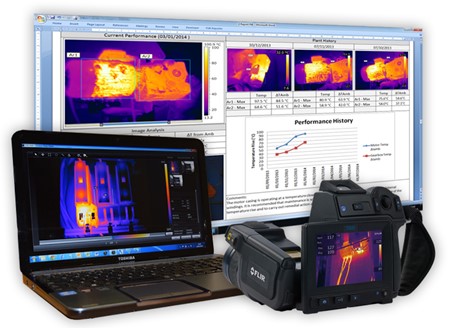
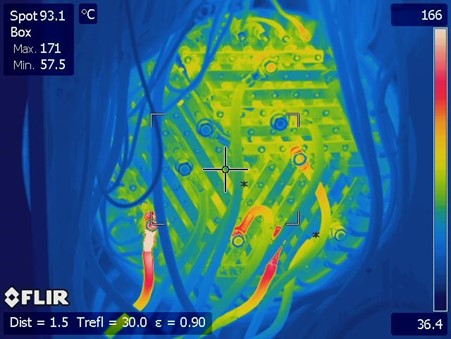
Thermal imaging is essential in electrical predictive maintenance programs because it identifies potential faults and allows for swift inspections and one image can show you various detail unlike using a spot pyrometer where you would have to test individual fuses, this allows maintenance teams to undertake remedial works before critical asset failure.

A picture containing an image from a electrical thermal imaging report.

At APT Thermal Imaging we can analyse your assets and provide you with unique easily understandable thermal imaging reports. That can be rolled out within your predictive maintenance programs. Also, also if you need help analysing the data provided within the thermal inspection report you will have your own dedicated thermographer at hand to explain everything in layman’s terms.

Electrical Maintenance thermography can be used on a wide range of electrical equipment including:

  • Distribution boards and fuse boards
  • Switchgears and switchboards
  • Control panels
  • Busbar systems
  • Transformers
  • High voltage systems
  • Batteries
  • UPS systems

It’s worth noting that our electrical thermal imaging surveys are carried out while plant and equipment is running. There will be no interruption to electrical supplies and your operations (critical assets) will not be affected while the thermal survey is being undertaken. Our thermal inspections engineers are all certified electrical professionals with extensive experience in thermal scanning of electrical systems.

A picture containing a electrical thermal image.

Benefits of thermal imaging inspections

Thermal imaging inspections can help to prevent fires, explosions or breakdowns. It can find loose connections, overloaded and/or fatigued components, uneven voltage distribution and blockages in cooling tubes of transformers. The principal advantage over other types of testing and inspection is the ease with which components can be checked in a non-intrusive and safer way. Other benefits are normal operations can continue unabated with limited downtime and large installations with hundreds of electrical installations can be covered in a short space of time.

So why do you need electrical thermal imaging inspections.

It’s a very cost-effective way of ensuring that your electrical system doesn’t burn out or break down. This is especially important in industries with high voltage systems and/or where continuity of power is critical to the business, e.g. data centres, banks, utility suppliers, manufacturing, hospitals.

The most common benefits are:

  • Extension of equipment/building life
  • Less plant (critical asset) down time
  • Less energy wasted through inefficient operation.
  • The ability to prioritise and better target preventive maintenance
  • The avoidance of consequential damage to plant or facilities from fires/short circuits

Our clients include:

  • Office Blocks
  • Hospitals
  • Industrial Plants and facilities.
  • Warehouses & Cold Stores
  • Shops and stores

Thermal inspections of electrical systems must be carried out by suitably qualified personnel using the correct systems and procedures.

Why pick APT Thermography to undertake your electrical thermal imaging inspection?

All our thermal imaging engineers are trained to level 3, which is the highest level you can achieve as a thermographic engineer. We also use large format thermal imaging cameras; this provides you with the absolute best chance of solving any potential issues by utilising thermographic technology.

Our specification includes:

  • Level 3 thermographic certification
  • Level 3 qualified thermographers
  • Large format FLIR cameras with 45-degree lenses

As our level 3 certified electrical thermal imaging surveyors are trained to a minimum of Level 3 and use only the highest resolution thermal imaging equipment, its means we can keep further away from the danger zone. Our engineers also have a vast amount of experience in conducting this type of survey which further lowers risk.  We issue a risk assessment and method statement for each and every survey we undertake.

APT thermography has been carrying out professional thermal imaging surveys since 2010. We only use the highest resolution thermal imaging camera equipment, and our surveyors are all certified Thermographers with strong electrical, building and engineering backgrounds.

Our team of Level 2 & 3 certified professional Thermographers are highly experienced in carrying out thermal imaging surveys and have many years’ experience in all aspects of engineering, construction, maintenance, management, and professional survey work.

Our thermal imaging equipment is the best and most accurate on the market, ensuring we pick up faults that other equipment may miss. Our reports are professionally presented and are clear, concise, and easy to follow. We endeavour to give our clients a first class service every time.

Please contact us for more information

If you would like to contact us for more information on our thermal imaging services, please contact us on 01525 303905 or email us at info@aptsoundtesting.co.uk. Alternatively if you would like more information on how to prepare for your thermal imaging survey, please visit our website here or download our thermal imaging checklist

Sound Insulation in Historical Houses

Sound Insulation in Historical Houses

Improving the Sound Insulation Performance in Historical Houses
Heavy concrete floors and masonry walls, therefore, have very good sound insulation properties; whereas single met-sec walls with 1 layer of standard plasterboard on either side and lightweight timber walls are much poorer acoustically and usually fail the sound insulation tests. This isn’t the whole story as by isolating materials by utilising resilient fixings and/or layered systems, the better the insulation performance for absorbing impact sounds.

Many companies try to improve their sound testing results by improving wall thickness and weight of the material, however, simply adding layers of plasterboard to a standard wall system often has little impact to the sound test results. There is also the problem of covering important architectural internal features found in historic buildings, such as detailed cornices and other mouldings; therefore this is often a contentious issue, especially if it’s an upgrade to a listed building. 

Sound Insulation in Historical Houses

Read more on Cost-Effective Soundproofing for Walls

Installing baffles within airbricks and blocking up redundant chimney flues are often enough to greatly improve the sound test results, secondary measures such as the installation of draught-proof strips to doors and applying the acoustic sealant to the skirting’s boards at the wall/floor junction can also be beneficial and improve the acoustic levels.

To improve ambient noise levels it may be better to make acoustic upgrades to the front of the house where roads etc. are usually located. There is usually just a garden at the rear so this will usually be less noisy.

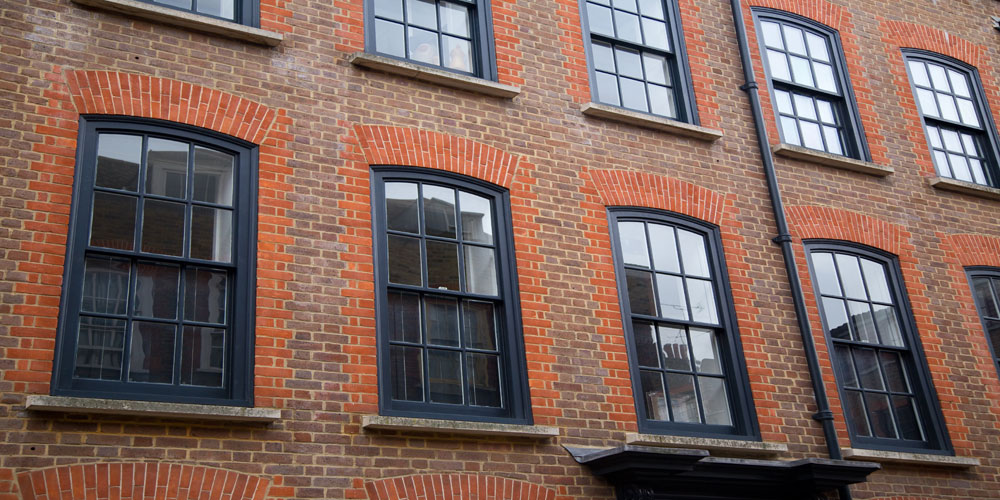
In all instances, acoustically the weakest part of external walls will be the window units. These are often Sash units and subsequently are one of the most important features within the external façade of historic buildings.

Many councils/local authorities will not let you remove and replace original window units unless the frames are rotten and beyond reasonable repair, however decent acoustic improvements can be made by installing a draught-proofing strip to the opening lights, and by providing an acoustic caulk seal around the window frame. If it’s extremely noisy a secondary glazing units along with demountable shutters may be an option. One of the simplest improvements can be made via the installation of good quality heavy curtains fixed close to the wall; this can also be one of the most attractive upgrades.

If the building is being subdivided into new apartments then the walls between apartments will need to be sound tested in line with Part E for Converted Dwellings. In this instance, we can undertake sample sound testing on walls and floors to check the existing sound insulation performance. Thereafter we can forward an acoustic design to comply with Part E of Building Regulations as well as undertaking the final pre-completion sound testing.

If you would like more information in regards to sound testing and acoustic design for your historical development, please contact us at info@aptsoundtesting.co.uk or phone us on 0777 5623464 or visit the APT Sound Testing website today.

Soundproofing Walls to Reduce Noise

Soundproofing Walls to Reduce Noise

Soundproofing Walls to Reduce Noise from Neighbours

Have you moved into a new house and realised you have noisy neighbours and thought it a good idea to soundproof your party walls?  

There are many soundproofing methods you can undertake to reduce noise through your party walls, many of which can be installed by yourself or by a trained handyman; such a hybrid acoustic panel plasterboard, which minimise the impact the build up, or lost space within the room; however, these types of solutions come at a price and are usually more expensive than a more standard ‘off the shelf’ solution.

Unfortunately, in most instances the more space you lose within the room/s typically the better the result. Although these come at a price and are usually more expensive than a more standard solution such as batten the walls, install 50mm of acoustic insulation (min 45/kg/m2) then install resilient bars to the timber baton. The wall can be finished with two layers of acoustic plasterboard with suitable laps. Although this type of system would be cheaper in terms of materials, it may cost more in terms of labour.

Soundproofing Walls to Reduce Noise

Another thing you need to check is where the noise is coming from – is it travelling through the centre of the wall, or the edges of the wall? If it’s the edges of the wall you may be experiencing a noise flanking problem which is quite common in older dwellings.

Also, you need to consider if it’s a brick/block cavity wall or a timber/metal construction as masonry walls usually have more mass which results in better airborne wall sound results.

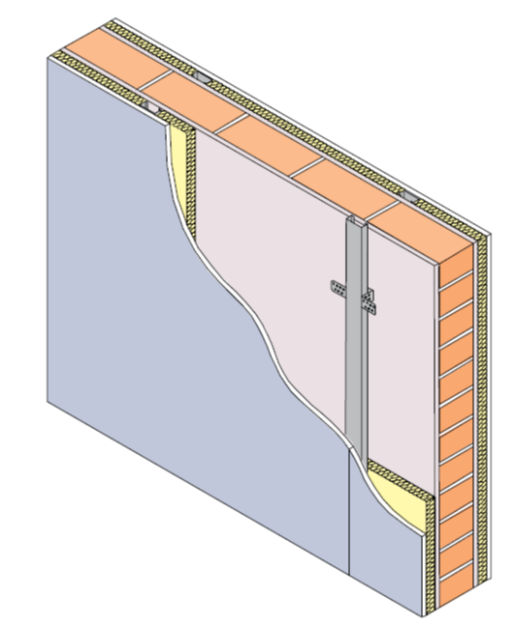
One of the most common party wall soundproofing solutions would be to install a metal frame system that is independent of the wall – say a 75mm met-sec wall. This would need to be kept 20mm off the face of the existing wall. Then install a RW45 Acoustic Wool (min 45kg/m3) within the metal frame and finish with 2 layers of 15mm acoustic plaster board. However, this system comes at a space premium as will lose you about 115mm with skimmed 15mm sound board, or 125mm with two layers of 12.5mm soundboard

Soundproofing Walls to Reduce Noise from Neighbours

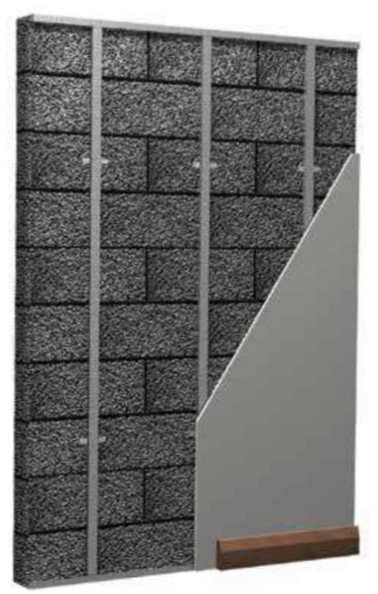
Here is a detail showing the types of some information There is some information on this type of system below, though you are going to lose approximately 100mm of room space when building an independent metal wall solution (min gap to the wall 20mm)

Also, it’s worth checking if you have a disused chimney breast in the house, as this can be solid between older properties and sometimes people connect their TV’s soundbars, speakers etc. to the chimney breast the base sound (lower frequencies) can travel through the solid construction. In this instance you can add baton, resilient bars, acoustic wool and soundboard to the chimney breast which should help.

Another issue may be joists which over-hang the cavity and touch the other joists or the wall in the neighbouring property which can quite a difficult to remedy. Also, on older houses they often used a “soldier course” of brick, the bricks were laid on end, hence the word “soldier” as opposed to being laid flat – to see if this is the case, you need to lift a couple of floorboards along the party wall and have good look at the pointing on the soldier or standard brickwork.

On closer inspection you’ll often find gaps in the masonry mortar, as the bricks are harder to lay properly due to the confined space between the joists.  Also, also the mortar may degrade and crumble due to the general movement in the timber joists (deflection) as well as shrinkage. In most cases the mortar can be replaced/repointed. In some cases, large areas of masonry may be missing which will need to be replaced. You can also install some extra acoustic wool within the joist voids against the party wall, which should further improve the soundproofing.

Soundproofing Walls to Reduce Noise from Neighbours

Have a look at the Gyplyner system below, it’s quite a robust and cost-effective solution as it reduces the build-up of an independent wall solution, whilst maintaining good soundproofing properties, this system would lose you about 52mm with skimmed 15mm sound board, or 62mm with two layers of 12.5mm soundboard. It’s a good off the shelf solution as the GL1 profile is held in stock by most large building merchants and the brackets a just screwed to the wall and bent round, then screwed to the GL1 profile, which makes it quite quick and easy to install.

Sometimes a single skin of lightweight blocks (such as thermalite) may have been used in the party wall construction which is a poor soundproof wall construction due to its lack of mass. This type of masonry may be only 500kg/m3 (50kg/m2), masonry should be around 1850kg/m3 (185kg/m2) which can easily lead to sound test failure if used in the inner envelope construction and or party walls.  

It’s worth remembering for sound to conduct through a wall, it has to actually move or vibrate the party wall ever so slightly. A heavy mass wall is always much harder to move than a lighter wall. It is very important to note that a heavy wall will still vibrate, just not as easily as the lighter one.

If you understand the above elements that make up party wall and floor design and construction, you’ll have a more educated eye for the acoustic design on your dwelling,  for instance, the  4 main elements of soundproofing construction are:

  1. Adding mass in your party walls
  2. Decoupling of materials within party walls
  3. Noise absorption within party walls
  4. Noise damping in party walls

In a nutshell soundproofing is the art of trying to prevent vibrations crossing party walls and floor partitions.

Getting the acoustic design right from the word go, is key, and APT Sound Testing can help in all areas of sound insulation design and sound testing. Please get in touch on info@aptsoundtesting.co.uk  to request a quote or call us on 07775623464 or 01525 303905 to discuss your development.

Please Note: although we take every care to ensure the information was correct at the time of publication. Any written guidance provided does not replace the user’s professional judgement. It is the responsibility of the duty-holder or person carrying out the work to ensure compliance with relevant building regulations or applicable technical standards.

Sound Proofing – Adding Mass to Walls

Sound Proofing – Adding Mass to Walls

Sound Proofing – Adding Mass to Walls

How exactly do soundproof a wall? Well, that’s a very common question. Let’s start with a basic understanding of the main 4 elements of soundproofing construction – they are:

  1. Adding mass
  2. Decoupling of materials
  3. Noise absorption
  4. Noise damping

If you understand the above elements that make up party wall design and construction, you’ll have a more educated eye on the acoustic design of your project. view your problem room. In a nutshell, we are trying to prevent vibrations from crossing the wall partition.

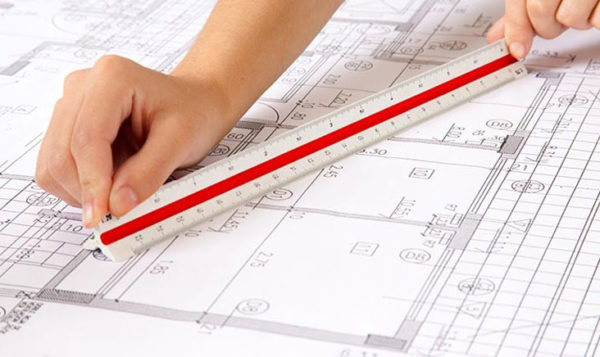
Hand holding ruler over plans for soundproofing party walls

When it comes to soundproofing walls and ceilings, we cannot understand the importance of adding mass. However simply adding mass is not often enough, you also need to consider two important factors:

  1. That of what type of material to use.
  2. where the material should be installed within the wall construction.

when adding mass to walls in buildings one the most common ways is to add cement board or soundboard. This adds mass and makes the walls as heavy and thick as possible. Adding mass to walls is one of the easiest ways to decrease sound vibration, although will not reduce deep bass sounds from being heard.

Another good reason for adding mass to any room is a good way to provide extra insulation, which in turn makes the room more energy-efficient and environmentally friendly.

How do I work out the required mass?

Working out the required mass for the wall to pass the sound insulation test can be quite difficult. For instance, the acoustic rating of a typical masonry wall increases from 45 dB to 50 dB when the thickness is increased from 100 mm (block laid on edge) to 215 mm (block laid flat).

This doubling of mass does not need to be achieved by doubling the thickness of a wall, as you can greatly increase the mass by opting for masonry that has a minimum mass of 1900kg/m3 or (190/m2) whereas many lightweight blocks such as thermalite are only 500kg/m3 (50kg/m2), which can easily lead to sound test failure if used in the wrong situation such as the inner envelope construction and or a single skin construction for party walls.

Acoustic design party walls

It’s worth remembering for sound to conduct through a wall, it has to actually move or vibrate the party wall ever so slightly. A heavy mass wall is always much harder to move than a lighter wall. It is very important to note that a heavy wall will still vibrate, just not as easy as the lighter one, with this in mind we then need to use the 2nd element of soundproofing design which is the Decoupling of materials – this is covered in our next article here.

Getting the soundproofing design right from the word go is key, and APT Sound Testing can help in all areas of sound insulation design and testing. Get in touch on info@aptsoundtesting.co.uk  to request a quote or call us on 01525 303905 to discuss your development.