Sound Testing needs to be carried out between pairs of rooms separated by party walls or floors. In most cases, the rooms to be sound tested will be the two main habitable rooms – living rooms and bedrooms. All new build dwellings and conversions that were built after this 2004 are required to have 10% of each party wall/floor construction type to be tested.
The sound test procedure involves setting up a noise source in a room on one side of the party wall or floor and measuring the noise on both sides of the partition. The three types of Sound Tests usually required – depending on the project configuration) are:
Airborne Wall Tests
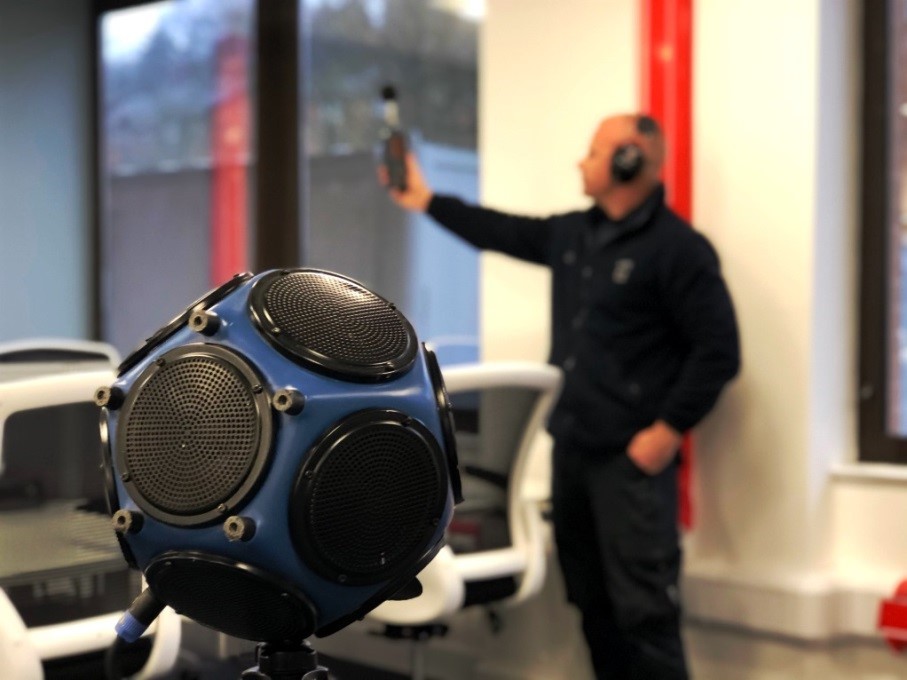
Airborne wall sound tests may be required between separate dwellings where a lounge and/or bedroom are positioned against the dividing wall partition. The sound tests are undertaken by using a sound source, amplifier and loudspeaker to generate a high noise level in one room (the source room). Noise measurements are then taken in both the source and receiver rooms using a prescribed number of source and microphone positions.
The background levels in the receiver room are measured and the reverberation time in the receiver room is also measured. From the results, the airborne sound insulation (DnT,w + Ctr) is calculated and compared to the requirements of Approved Document E.
Airborne Floor Tests
For vertically separated dwellings, airborne floor sound testing may be required, where a lounge and/or bedroom sit’s against the dividing floor partition above and/or below a ‘habitable’ room. The sound tests are undertaken by using a sound source, amplifier, and loudspeaker to generate a high noise level in one room (the source room). Noise measurements are then taken in both the source and receiver rooms using a prescribed number of source and microphone positions.
Impact Sound Tests
For vertically separated rooms, an Impact sound testmay also be required. This sound test is undertaken using a “tapping machine”, (as above) which drops a series of weights onto the floor of the upper room. The noise level in the lower (receiver) room is measured for a prescribed number of source and microphone locations. The background levels in the receiver room are measured and the reverberation time in the receiver room is also measured. From the results, the impact sound insulation (L’nT,w) is calculated and compared to the requirements of Approved Document E.
Non-Residential Sound Testing
It is worth noting that sound insulation testing may also be required in non-residential buildings such as schools, hospitals, workplaces, whereas built performance needs to be demonstrated to ensure noise-sensitive areas (e.g. classrooms, wards, meeting rooms) are suitably insulated from noisier areas or to comply with BB93 & BREEAM requirements.
Sample Sound Testing
If you have an existing building that you are about to convert into flats etc. and need to establish the acoustic performance of the existing partitions, we can undertake sample sound testing on walls and floors to check the sound insulation performance. Thereafter we can forward a targeted acoustic design to comply with Part E of Building Regulations, as well as undertaking the final pre-completion sound testing.
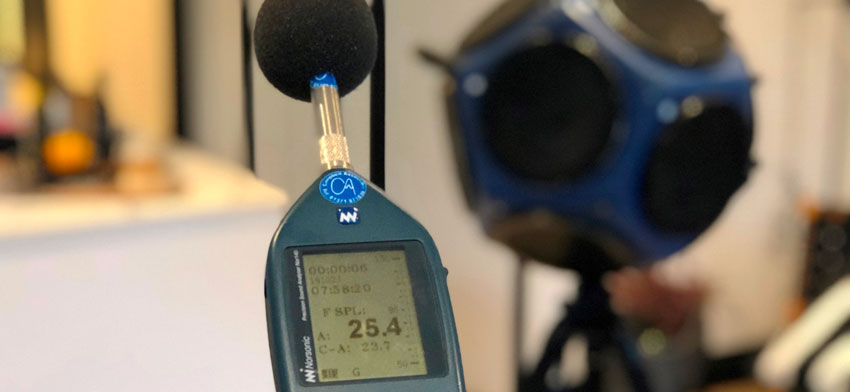
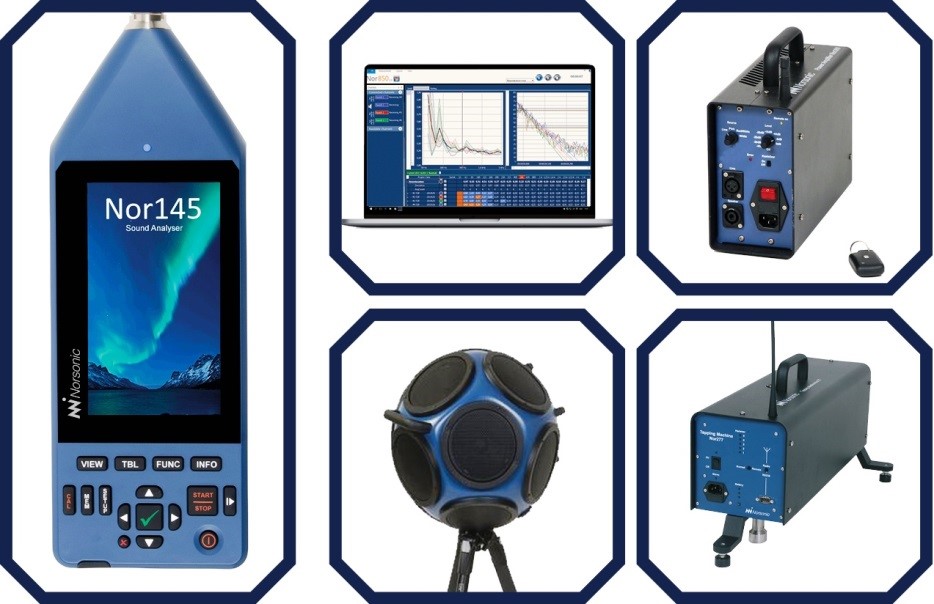
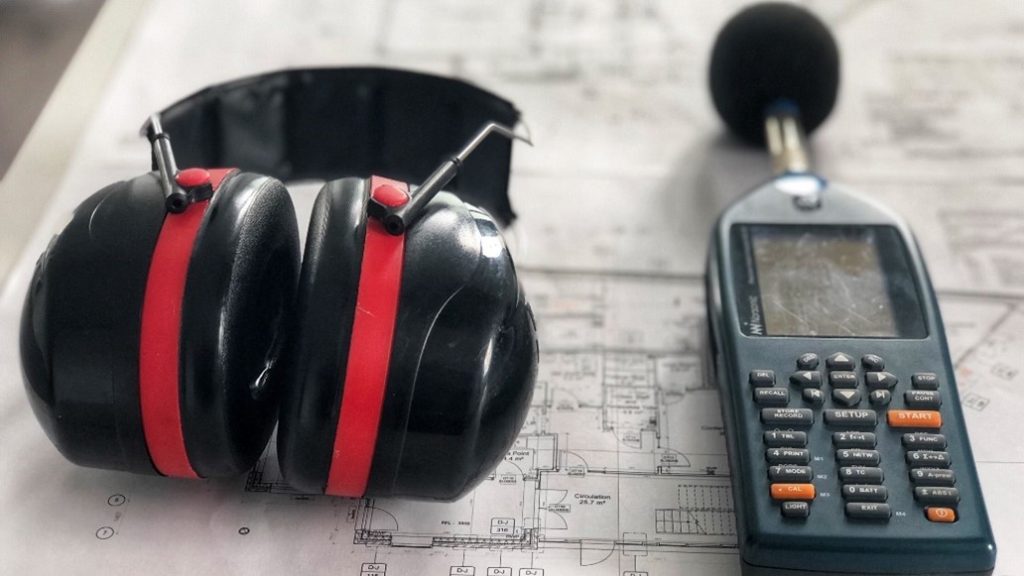
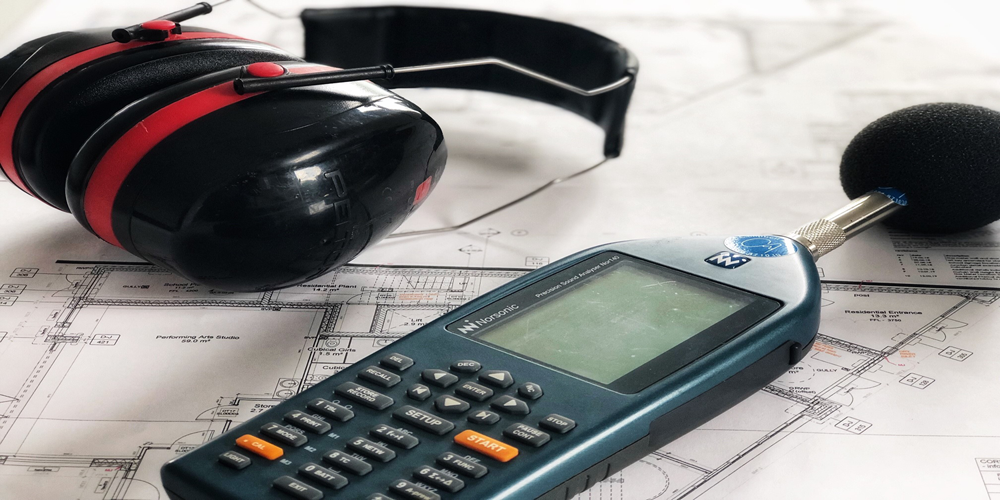
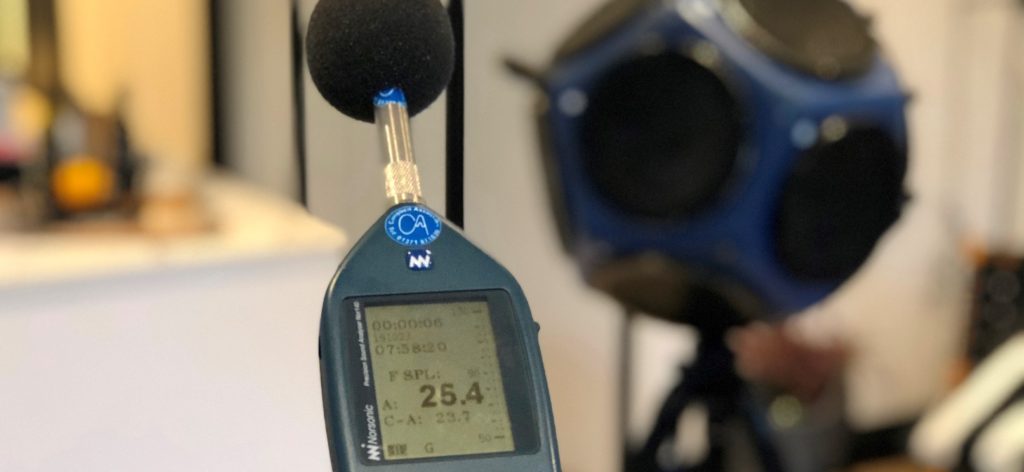
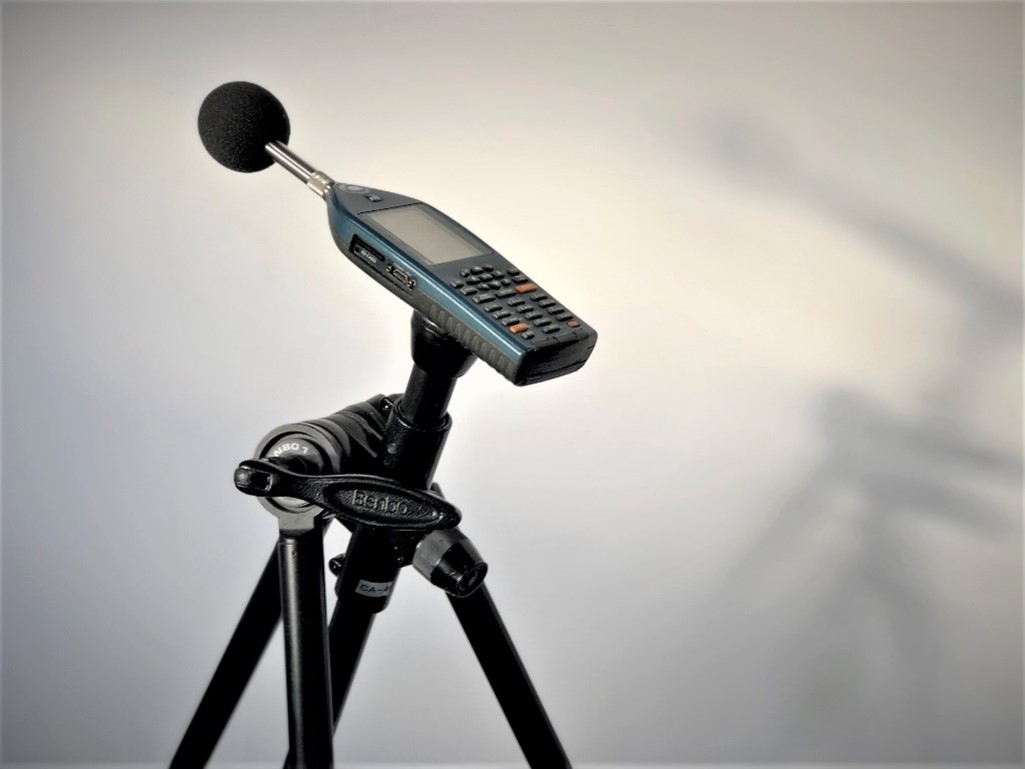
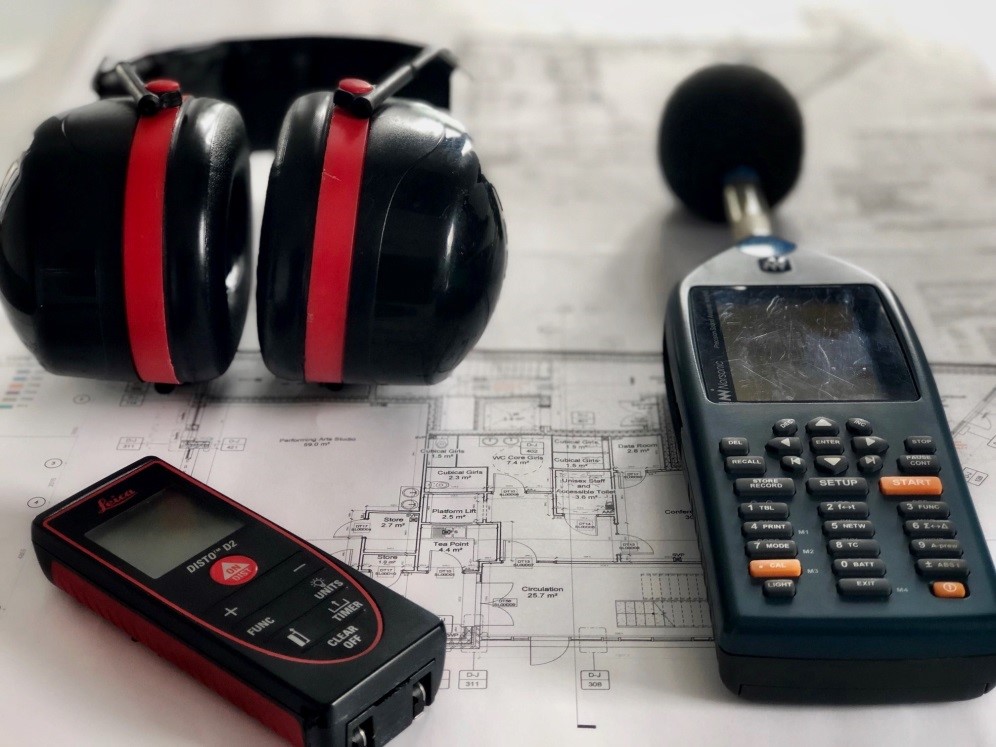
All APT’s test engineers carry the latest Norsonic equipment, which are class one rating all of our acoustic testing/sound testing is completed to a strict quality controlled standard. We provide full ISO & UKAS compliant sound testing.
If you would like more information in regards to your air and sound testing please contact us now at info@aptsoundtesting.co.uk or call us on 07775 623464
Designing Buildings to Pass Sound Testing From the very start of the design phase of a new building, it’s extremely important that careful consideration is given to the acoustic element of the building.
By getting APT involved at the start of the design process we can undertake comprehensive acoustic design reviews and ongoing site surveys. We always advocate meeting with the design team at the earliest opportunity to go through all acoustic elements for the building’s design, taking into account the site constraints and the most cost-effective method of achieving Part E of Building Regulations. We try to forward any possible ‘onsite’ construction problems and difficulties in achieving successful acoustic construction and subsequently the sound testing for Part E.
Designing Buildings to Pass Sound Testing Once we have completed the acoustic design review our services don’t finish there. We provide the site team with ongoing design support and site visits. You will have direct contact with the allocated acoustician from the start of the process through to the successful completion of the project.
Once the first phase of the building is completed, we can undertake sample sound testing to ensure the acoustic design and onsite construction methods are sufficient to pass Part E sound testing.
When it comes to refurbishment projects i.e. houses converted into flats and/or an office block into flats we can undertake a sample test of the existing wall and floor construction. Once we have established the sound levels for the existing construction we can then look at the extent of the acoustic upgrades to attain Part E Complaisance. This is much more effective than just forwarding an acoustic design that may be too excessive and expensive when the existing construction is already ‘acoustically’ robust and therefore only needs to improve by a few dB.
One problem we often encounter (without our design input) is that the building marginally fails during the sound test. The potential problem that is often overlooked is that many types of acoustic design/materials have attained an acoustic rating within a laboratory. It is very difficult and extremely unlikely that the sound levels achieved on a construction site will be as good as in the confines of a stringent laboratory environment.
When the construction assembly is tested in the lab, it is also certified and an exact description of the materials and the installation techniques are described in detail and followed to the letter, obviously, this should be replicated on your site as closely as possible, however, this seldom happens. This is one of the reasons why a 5dB point difference is allowed between the construction design on paper and the actual on-site construction performance. When you consider that sound doubles every 10dB, then 5dB can make a huge difference to the overall performance of the dividing partition under test. If consideration is not allowed during the design process then there will be a greater chance of a sound test failure on your project.
Another potentially problematic area of sound transference and potential sound test failures is down to flanking sound. Noise flanking is when travels along a continuous path due to insufficient isolation/break within the building wall & floor elements. One of the most common flanking paths is along with the inner leaf of an external cavity wall. This may be due to lightweight block construction resulting insufficient mass to prevent noise transference.
Unwanted noise travelling along flanking paths makes the building structure vibrate and this causes the sound to radiate into your room. One solution is to build another wall or ceiling in front of the original, but not connected to it (often called an independent wall or ceiling). APT can help to locate the flanking sound and propose a cost-effective design that will pass the sound testing and satisfy Part E of Building Regulations.
For the smaller projects, we undertake a more simplified acoustic design service consisting of a review of the design drawings, such as floor plans and sections. This usually takes place straight after planning has been approved as increased cost savings can be realised at the earliest stage. We can also undertake sample sound testing if the client is not sure of the existing onsite construction.
We can then evaluate the building design to ensure that it the walls and floors are capable of meeting the acoustic requirements of Approved Document E.
Some of the main areas we consider are:
• There are no potential flanking points, where isolated partitions are wrongly mechanically fixed together to caused noise bridging or the wrong materials have been specified such as lightweight blocks etc.
• The acoustic treatments for Soil Pipes, Stair Cases Steel Beams, etc. to ensure they are acoustically fit for purpose, as these are some of the many areas that get missed.
• Acoustic floor treatments are compatible with the proposed floor finishes i.e. Carpets, Laminates, Floor Tiles and under-floor heating systems.
• The Lighting specification to, ensure they are acoustically compliant to the overall design i.e. down lighter design etc.
If you would like more information in regards to sound testing please contact us on 01525 303 905, email us at: info@aptsoundtesting.co.uk or visit the APT Sound Testing website.
Robust Acoustic Design to Pass Sound Testing in Conversion Projects It is essential that acoustic design is carefully thought out at the start of every conversion project to avoid sound test failures. Throughout the 1980s, most timber frame separating floors involved the following standard construction details:
Floorboards (18–22mm thick)
Gypsum-based board
Mineral wool batt (80kg/m3)
Sub decking
220mm joists
100mm quilt insulation between the joists
One/Two layers of gypsum-based board for the ceiling
Using the combination of floorboard, gypsum board, and mineral wool batt is termed a “platform floor”. There is a wide range of batt densities. If the density is too low the floor surface is able to ‘bounce’ and deflect much more easily. If the density is too high then the floor may be too hard and impact sound is able to transmit more easily to the residential dwelling below.
Sound Testing in Conversion Projects Even when resilient battens are used, continuous structural contact along the joist between the floor sub-deck and ceiling provides a strong path for sound transmission. If contact between the ceiling and the joists can be reduced, an increase in airborne and impact performance will be achieved.
One solution is to add another ceiling element to the overall construction. This can provide the extra isolation required to pass the sound testing in London. This can be achieved by incorporate resilient metal bars which are connected to the underside of the joists and mounted perpendicular (90˚) to the joist direction. If plasterboard has already been tacked to the underside of the joists you can firstly add timber batten and then add the resilient bars, also mounted perpendicular (90˚ to the batten.
Squeaking Floors One common problem is that the Joists are often spaced too far apart can result in a reduction in floor stiffness and complaints about footstep noise at low frequencies. Over-notching of joists can also lead to a reduction in floor stiffness and also potential squeaking. This can result in successful airborne and impact sound tests, however, it won’t stop the squeaking of the floors under the extra load imposed by people walking above.
To help with impact sound testing, timber floors often pass as the separating floors normally have a resilient floor surface or “timber floating floor”. This not only assists impact sound insulation (against footstep noise transference) but also reduces airborne sound transference.
Timber floating floors must use a flanking strip to isolate the floorboards from the perimeter walls and skirtings. If flanking strips are not fitted then footstep noise can easily enter the structure via walls etc. and flank into the adjacent dwellings. In the 1980s, mineral wool was used as a flanking strip but it was difficult to turn round at the floorboard edge. It was also prone to deterioration due to compression and movement under dynamic load. As a direct result of this, 5–10mm polyethylene flanking strips were incorporated into the acoustic design and construction., They are also easier to install and do not degrade over time to the same extent.
There are many reasons why floors may fail the sound testing, such as the use of incorrect mechanical fixing can reduce the insulation performance provided by floating floor treatments and resilient ceiling bars. Using very long screws will lead to the bridging of the resilient layers and noise flanking. Inserting pipes or services within a platform floor can reduce the potential acoustic performance if they are not adequately boxed. Placing pipes or cables under resilient battens can also bridge the resilient layer.
Potential problems with timber frame separating floors
Incorrect bridging of resilient layer by over-long screws/nails
Fixings connecting ceiling boards to resilient bars should not bridge to joists
Extra wide joist spacing that reduces floor stiffness
Platform floor resilient layers damaged by inserting pipes and services within the layers
Reduction in stiffness due to use of joist hangers
Ceiling boards not staggered
Over-notching of joists for services reduces floor stiffness
Incorrect omission of flanking strips at floor edge perimeters.
Whilst it is normal practice to have a building surveyed for its structural integrity, however often the acoustic conditions of a building are not considered until the project is well advanced and the partitions are already built. In some cases, the acoustic performance of the building may not have been considered until the work is complete and the verifier requests a sound test to demonstrate compliance with the Building Standards. If it is found that the separating wall or floor does not comply you may need to action the following:
Extensive remedial works may be required to the wall/floor partitions.
The sound test completion certificate may not be accepted by the verifier
There may be considerable delays to entry for occupants and subsequent accommodation costs.
Pre-conversion sound tests can both avert the risk of non-compliance and avoid damage to the existing fabric.
Potential Problems with Services
It’s very common to run services such as electricity cables as well as water and gas pipes within the floor void. This is acceptable and should not require any additional acoustic attenuation measures. However, care should be taken to ensure that their installation does not damage the deafening material or resilient layers, which is a common cause of sound test failures.
It is strongly recommended not to run waste or rainwater pipes horizontally within a party floor. The pipes can then be boxed properly using insulation rapping and soundboard boxing.
Steel columns can be a source of flanking transmission, in particular hollow steel columns. They can also provide a strong path for structural impact transmission. Pre-conversion sound tests should be able to identify whether any columns act as a significant transmission path and whether any treatment is required. It may not be necessary to treat the column in all dwellings if flanking is limited, however, in many instances, the columns will need to be acoustically boxed to prevent sound test failure. One such treatment for columns would be to construct a free-standing metal stud partition around the column, incorporating 50mm insulation quilt and sheeted with two layers of gypsum-based board. Where columns pass through separating floors, as in old bonded warehouses, the junction between column and floor should be well sealed not only for sound insulation but also for fire. The column linings should be double lined with gypsum-based board (minimum mass per unit area 10kg/m2).
Timber beams do not significantly affect the sound insulation performance of a separating floor. However, if a beam has been installed for strengthening, the boxing around the beam may be a single sheet of lightweight board and may be fixed directly to the beam as this will result in a weak area for airborne sound insulation. This can be resolved by stripping off the boxing, packing any voids with dense mineral wool batt and re-sheeting with two layers of dense gypsum-based soundboard.
Contact APT Sound Testing We hope the above information helps you to understand the potential problems with acoustic design and pre-completion sound testing on your development. If you have a project that needs acoustic design advice or sound testing in London, then please visit our Sound Testing website or phone us directly on 07775623464.
The Different Types of Sound Testing Sound Insulation Testing needs to be carried out between pairs of rooms separated by party walls or floors. In most cases, the rooms to be sound tested will be the two main habitable rooms – living rooms and bedrooms. The sound testing procedure involves setting up a noise source in a room on one side of the party wall or floor and measuring the noise on both sides of the partition.
Sound Testing for Part E of Building Regulations has been a mandatory requirement since July 2003. All new build dwellings and conversions that were built after this date require 10% of each party wall/floor construction type to be tested.
There are two mains types of sound tests that need to be carried out prior to the building handover, they are:
Airborne Sound Tests Airborne sound tests are usually required between horizontally and vertically separated pairs of rooms. The sound tests are undertaken by using a sound source, amplifier, and loudspeaker to generate a high noise level in one room (the source room). Noise measurements are then taken in both the source and receiver rooms using a prescribed number of source and microphone positions. The background levels in the receiver room are measured and the reverberation time in the receiver room is also measured. From the results, the airborne sound insulation (DnT,w + Ctr) is calculated and compared to the requirements of Approved Document E. For new build projects, you are required to achieve 45dB for airborne sound testing through walls and floors and 62dB for Impact sound testing for floors. For refurbishment projects this changes to 43dB for airborne and 64dB for impact.
Impact Sound Tests For vertically separated rooms, an Impact sound test may also be required. This sound test is undertaken using a “tapping machine”, (as above) which drops a series of weights onto the floor of the upper room. The noise level in the lower (receiver) room is measured for a prescribed number of source and microphone locations. The background levels in the receiver room are measured and the reverberation time in the receiver room is also measured. From the results, the impact sound insulation (L’nT,w) is calculated and compared to the requirements of Approved Document E.
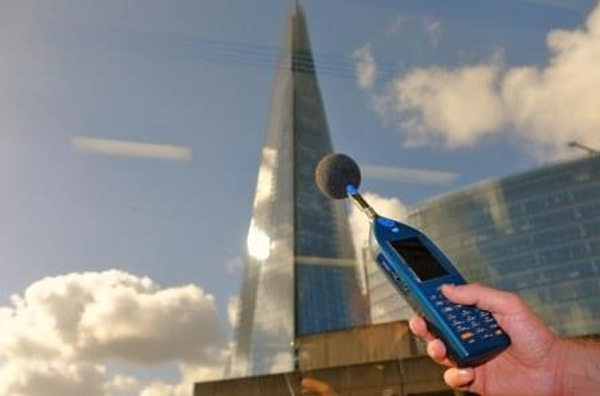
Airborne Sound Testing of Building Facades For the sound testing of external facades, we place the loudspeaker outside the building at a distance of 5m from the facade with the angle of sound incidence equal to 45° ± 5° and such that the real traffic noise impact is simulated the best possible way. The speaker and amplifier are used to generate a steady random noise signal via the loudspeaker source. The sound pressure levels are then measured at 2m in front of the facade plane and 1.5m above the ground.
All APT’s test engineers carry the latest Norsonic sound testing equipment, which is class one rating. All of our sound Testing is completed to a strict quality-controlled standard. We provide full ISO & UKAS compliant sound testing.
If you would like more information in regards to sound testing please contact us at 01525 303905 or visit the APT Sound Testing website today.
A floor plenum is a void between a building’s floor structure and a raised access floor, used for distributing the conditioned air to the spaces above. It is important that conditioned air in a floor plenum flows into the occupied zone and does not leak into cavities, risers, stairwells, heating trenches or other adjacent zones. A properly sealed floor plenum will allow the diffusers and grilles to fulfil their primary role of delivering air at the correct flow rate.
APT Sound Testing undertakes floor plenum testing using a special fan that is set up in the test zone. All air ducts must be turned off and sealed. The test is conducted by taking a series of pressure readings. If the plenum fails the test we can then carry out a smoke survey to highlight the air leakage paths and issue a report for reference during the remedial sealing works.
If you require raised access floor testing, we can arrange a site visit and recommend the tests appropriate for your needs. We will advise you on the most suitable specifications for your structure and we will carry out extensive testing on your floor plenum.
If you want to know more about our plenum floor test services, please contact us today and our expert staff will be happy to advise you further.
In all instances, our strong focus on customer satisfaction, along with a can-do attitude, coupled with the knowledge of a UKAS accredited laboratory, are the key benefits to you when partnering with APT Sound Testing.
What is a Floor Plenum?
A floor plenum is part of a building that normally facilitates air circulation for heating/air conditioning systems by providing pathways for either heated/conditioned or return airflows. The airflow is often supplied at a greater pressure than atmospheric pressure.
Air leakage from floor plenums can be a serious energy efficiency issue and a source of discomfort to users. A floor plenum is a void between a building’s floor structure and a raised access floor, used for distributing the conditioned air to the spaces above. It is important that conditioned air in a floor plenum flows into the occupied zone and does not leak into cavities, risers, stairwells, heating trenches, or other adjacent zones.
It is important that the air supplied to the floor plenum discharges through the floor-mounted diffusers or grilles rather than through joints in the raised access floor or between the raised access floor and the walls. A properly sealed floor plenum will allow the diffusers and grilles to fulfil their primary role of delivering air at the correct flow rate.
What is Floor Plenum Testing?
If you have floor or ceiling plenums in your building you need to be aware that a staggering 70-70% fail their first airtightness test. APT Sound Testing has years of experience of raised access floor plenum air pressure testing and can work with you to ensure you pass your floor plenum air test at the first attempt.
We can ensure that an onsite air test site audit is arranged as soon as the floor is in place; we can then undertake an initial floor plenum air test and smoke survey to check the air leakage result and check for air leakage paths within the plenum envelope. Once we have assessed the air leakage paths we can then supply a smoke survey report for your sealing contractors to use as a reference to ensure your plenums are adequately sealed
Why do so many floor plenums fail their first air test?
There are many reasons why 70-75% of floor plenums fail their first airtightness test. One of the most common reasons is due to a lack of understanding within the construction industry as to how airtight a plenum needs to be. One common problem is that many plenums are built and tested under laboratory conditions; unfortunately, there is a big gap between what happens in a lab to the reality of plenums construction on a building site. With multiple contractors needing to put pipes, cables etc. through the plenum, this is just one of many things that can affect the airtightness of a plenum. APT have years of experience and can work with you to ensure you achieve an air test pass on your plenum at the first attempt.
What happens if we fail the floor plenum test?
A large number of floor plenums fail the initial airtightness test so don’t panic. If we undertake the testing our UKAS accredited air tightness engineers will undertake a targeted smoke survey to highlight the main air leakage paths. We will then issue a smoke survey report for your contactors to reference during the remedial sealing works. We also allow for the option of visiting the site during the sealing works to ensure your contractors are adequately sealing the plenum prior to the second airtightness test. If you would like more information in regards to the most common air leakage paths, please visit our Floor Plenum Checklist.
The main considerations when constructing floor plenums?
In offices, carpet tiles are usually laid over the raised access floor, if joints between carpet tiles are not lined up with the joints between the raised access panel’s floor tiles or panels, the air leakage will be reduced, particularly if the carpet tiles are glued in place. That said, the laying of carpet tiles should not be relied on to achieve the target for the raised access floor itself as these can de-bond over time.
Many raised access floors include electrical and date boxes. The air leakage of these boxes should be ascertained, to ensure that they will not significantly contribute to the raised access floor leakage, and reduce the air flor to the grills or diffusers. Where there are decorative or functional connections through the raised access floor, for example cabling to display boards, a suitable method of air sealing these penetrations should be designed.
The perimeter of the floor plenum where the access floor meets the wall is often an area of increased air leakage. To minimise this leakage it may be beneficial to fix a length of metal angle along the perimeter of the floor. Lengths of closed-cell board or neoprene strips will increase the quality of the seal between the raised floors and the wall and should prevent excess air leakage.
The walls of floor plenums are most vulnerable to air leakage as they are dependent on the type and quality of construction. Plasterboard can be used as the airtightness barrier; however, care should be taken to ensure all joints should be sealed where boards abut other boards, walls, floors and the underside of the raised access floor. This is the same for coated mineral fire boards used in conjunction with fire mastic, the boards should be specified with an air leakage rate of 0.15 l/(s.m2)@50Pa with a life expectancy of at least 25 years.
While poured in-situ concrete floors don’t have any significant air leakage, hollow-core and solid composite precast planks need to be sealed along the plank joints and carefully sealed around service penetrations. Beam and block floors need to be covered by a screed to prevent excess air leakage
How we carry out Plenum Air Tests on your project?
In brief, a temporary tile is removed from the plenum and our fan housing is installed directly above the opening. A fan is then installed into the box and this is all sealed against the floor.
Any air handling ducts serving the test zone need to be turned off, isolated and temporarily sealed, stopping the passage of air to outside of the test zone via ductwork
Thereafter another tile is removed and a mock floor tile with a drill hole for the high-pressure tube is installed in its place.
After the equipment is set up a series of tests is undertake and the readings recorded and then checked against the floor plenum airtightness specification.
If the plenum test fails, your APT air test engineer will carry out a smoke test to look for air leakage paths.
Is there a Standard associated with Floor Plenums Tested?
At present, there is no set standard for floor plenum testing. The specification is usually set by the project’s Mechanical Engineers and is normally set in litres per second per square metre (l/s/m2). APT will need to know what pressure the specification is set at, e.g. 0.7l/s/m2 @ 50 Pascals. It is also possible that the specification can be set in l/s/m3 by the mechanical designers, for this type of test we would require the volume of the Plenum.
What are the most common air leakage paths within floor plenums?
In order to create an effective air-tight floor plenum, all utility penetrations and perimeter joints must be properly sealed. An evaluation of the following areas/components that can typically create inefficiencies should be undertaken during the early design phase and during the onsite construction. For clarity, we have shown the main air leakage paths below.
Penetrations through the access floor, walls and subfloor including
Cable bundles and cable trays
Pipes
Fire/plenum barriers
Cable trunking – must be internally sealed within the void
Masonry work – incomplete or poorly jointed walls will result in greater air leakage
Risers need to be properly sealed for plenums/ducting
Plasterboard on studs at board edges and the ends below the raised floor level
Gaps between compartment barriers, top of raised access floor and sub floor respectively
Gaps between any curtain walling/glazing
If you are worried about the airtightness integrity of your floor plenum then please contact us now on 01525 303905. or get in touch via our contact form to discuss your specific requirements with our friendly and knowledgeable consultants!
To try and help our clients achieve compliance with Approved Document E, we offer the following 4 step acoustic design & sound test package:
Site Survey Visits – This allows us to check for potential problematic construction such as inclusion of lightweight blocks in the existing construction. It also lets us check that the installation teams are installing the acoustic materials as per manufacturer’s guidelines.
Sample Sound Insulation Testing – This offers an accurate overview of the acoustic performance of the existing partitions which enables us to offer a targeted acoustic design using the sound insulation performance of the existing construction.
Acoustic Design Review – we can undertake a full design review of the party walls and floors on the development.
Pre-completion Sound Insulation Testing – To satisfy Approved Document E and achieve building control signoff.
APT Sound Testing can advise on all types of acoustic design, whether it’s accomplished during initial construction or during a refurbishment/renovation project. We also undertake UKAS accredited sound testing providing a ‘one stop’ solution for all your acoustic testing and design requirements throughout London and the South East.
APT Sound Testing – Acoustic Design & Sound Test Package Sound insulation testing is usually required on all London development/s between rooms or spaces that share a common area of separating wall and/or floor as stipulated in Building Regulations Part E for the passage of sound. The main aim of sound insulation testing is to ensure that minimum standards of sound resistance have not been compromised by poor workmanship and/or poor design.
The most common buildings that require sound Insulation testing are:
Dwelling-houses, flats or rooms for residential purposes created by conversion of existing buildings or new build rooms for residential purposes.
New build dwelling-houses and flats
APT Sound Testing can advise on all types of acoustic design, whether it’s accomplished during initial construction or during a refurbishment/renovation project. We also undertake sound insulation testing, providing a ‘one stop’ solution for all your acoustic testing and design requirements throughout the South East.
You are normally required to undertake sound testing to a 10% sample of the individual type of partition. For instance, if you have a project with 9 flats you would be required to do 1 x 6 packs of tests; each 6 pack contains 2 airborne wall, 2 airborne floor and 2 impact sound tests; however, if any test failures occur, then the number of sound tests may need to increase on the development.
When sound test failures occur we study the design and construction of the failed partitions to try and evaluate the reasons for the failure; thereafter, agreement can be reached on how to rectify problem. We have carried our hundreds of acoustic design reviews, so we are well placed to help you overcome any potential problems to achieve compliance with Building Regulations Part E.
Many people who phone us with noise complaints, say they can hear the neighbours talking to each other across the and they are not even shouting! Excess noise can be debilitating, distressing, and upsetting which can lead to health problems if left unchecked.
Sound transfer between walls and floors in dwellings is a common problem of attention to detail in many cases has resulted in poor-quality construction – this is often down to the contractors installing party walls and floors being on price work resulting in poor workmanship.
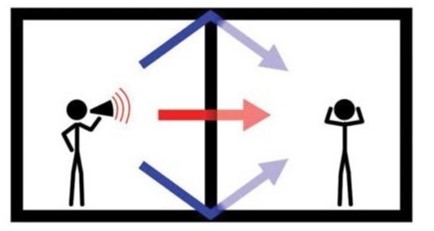
Excess sound transfer occurs as a result of airborne noise (tv, voices, music, etc). The airborne sound wave strikes the wall, and the pressure variations cause the wall to vibrate resulting in noise. This noise (vibrational energy) is transferred through the wall partition and radiated as airborne sound on the other side.
The main issue is often due to the lack of mass of the masonry wall construction. If lightweight (thermalite) blockwork has been used (or a single 70mm metal partition) there is a much higher chance that the wall will fail a sound insulation test due to its lightweight construction. Taking the above into account it’s critical that the acoustic design of the party wall is considered from the start of the project.
The 4 main elements of good soundproof design
There are 4 main elements of soundproofing that need consideration throughout the process, all of which have a direct relation to the conduction and transmission of sound vibrations.
Adding Mass: if the wall construction has a higher mass, the soundwave will struggle to vibrate the wall itself in order to permeate through it as it will have less movability, making it less probable for sound vibrations to travel through.
Adding Decoupling: with decoupling, you can introduce a cavity between two layers of drywall which separates the two wall constructions. By doing this, a layer of air is created in-between the walls which provides good sound insulation.
Adding Absorption: acoustic Insulation material such as RW3 mineral wool (min mass 45kg/m3). The material is placed into the wall in order to absorb these soundwaves, but the insulation is not compressed.
Adding Damping: such as acoustic underlay There are several products that are used for this, and Green Glue (check my review) is a popular option. Green glue helps in converting some of the sound energy to heat energy.
All elements of soundproofing are major influences for the way in which soundwaves and vibrations behave within the space. The best results come through the inclusion of all of these four elements in relation to the physical properties of the wall.
What can you do retrospectively of the wall fails the sound insulation test? It is difficult to soundproof an existing party wall particularly around adjoining partitions such as floors and ceilings.
Sound Proofing Masonry Walls
In all, there are three main ways to soundproof a masonry party wall:
For High mass Masonry – apply a layer baton to the wall, then add resilient bars and a later of 15mm sound insulation board. This only needs to be done to one side of the wall, where high mass masonry has been used.
For Low mass Masonry – apply a layer baton to the wall, then add resilient bars and a later of 15mm sound insulation board. This needs to be done to both sides of the wall, where low mass masonry has been used.
Where high levels of sound insulation are required – Creating a new partition wall – using 70mm met-sec with a cavity void to the party wall, fill the metal frame with acoustic insulation (min mass 60kg/m3) and finish with 2 layers of Acoustic Plasterboard. Unfortanly, this reduces the width of the room by up to 125mm.
Sound Proofing Metal Walls
In all, there are three main ways to soundproof metal party wall:
For internal metal walls –fill the metal frame (min width 70-100mm) with acoustic insulation (min mass 45kg/m3) and install 1 x 15mm layer of soundboard to either side of the metal frame.
For dividing metal walls – fill the metal frame (min with 100mm) with acoustic insulation (min mass 60kg/m3) and attach “resilient channel” to the studs and install 2 x 15mm sound board to either side of the wall.
For high spec dividing metal walls – use 2 x 70mm met-sec wall, with a 50mm cavity. Fill both metal frames with acoustic insulation (min mass 45kg/m3) and finish with a single layer of 15mm Acoustic Plasterboard.
If the walls are existing i.e., it is a conversion project, you may need to gain access to the base and head of the party wall, to undertake the acoustic upgrades within floor and ceiling voids, this is also required to reduce the chance of flanking noise.
Unfortunately, retrofitting to improve sound insulation performance is difficult to achieve and not always 100 per cent successful. We always recommend you have sample sound testing undertaken between dwellings before embarking on expensive insulation works and on conversion projects. For block of flats, it’s worth remembering that you will need to consider require both airborne and impact sound tests to ensure compliance with the 2014 Building Regulations Technical Guidance Document E (Sound). For houses you just need to consider walls.
Searching for SoundTesting Services in London London is a huge capital city containing over 5 million properties. In this overcrowded environment, it is essential that noise transference between properties is kept to an absolute minimum for the occupant’s wellbeing.
We undertake UKAS accredited Part E sound testing throughout London, including soundproofing of walls in London. We have extensive knowledge regarding the way different materials and construction methods can influence the results of a sound test, to ensure your company achieves complies with Sound Testing Regulations Part E.
Pre-completion sound testing under part E has been a mandatory requirement since July 2003. All new build properties and conversions that were built after this date require 10% of each party wall/floor construction type to be tested. Sound Testing is to be carried out between pairs of rooms separated by party walls or floors. In usual circumstances, the room/s to be sound tested will be the living rooms and bedrooms, which are classed as the two main habitable rooms.
The sound Test Procedure The sound test procedure involves setting up a noise source in a room on one side of the party wall or floor and measuring the noise on both sides of the partition.
Airborne sound tests may also be required between horizontally and vertically separated pairs of rooms. The sound tests are undertaken by using a sound source, amplifier and loudspeaker to generate a high noise level in one room (the source room). Noise measurements are then taken in both the source and receiver rooms using a prescribed number of source and microphone positions. The background levels in the receiver room are measured and the reverberation time in the receiver room is also measured. From the results, the airborne sound insulation (DnT,w + Ctr) is calculated and compared to the requirements of Approved Document E.
For vertically separated rooms, an Impact sound test may also be required. This sound test is undertaken using a tapping machine that drops a series of weights onto the floor of the upper room. The noise level in the lower (receiver) room is measured for a prescribed number of source and microphone locations. The background levels in the receiver room are measured and the reverberation time in the receiver room is also measured. From the results, the impact sound insulation (LnT,w) is calculated and compared to the requirements of Approved Document E.
Our sound test engineers carry all the latest Norsonic equipment, which are class one rating and all of our acoustic testing/sound testing, is completed to a strict quality controlled standard. We provide full UKAS Accredited sound testing.
Pre-completion sound testing is generally carried out at the request of the Building Control Officer. The guidance contained within Approved Document E gives detailed recommendations for the partitions to be tested and for the number of sound tests that should be carried out. We recommend that the proposed sound testing is agreed in advance with the Building Control Officer prior to the London sound testing.
We can undertake both acoustic airborne sound testing to allow for speech, television etc, and impact sound testing to allow for footfall etc. This is in accordance with the requirements of Approved Document E of The Building Regulations and the relevant European and International standards.
The testing methods for airborne and impact sound insulation testing in London are in full accordance with: the suggested methods presented in BS EN ISO 140-parts 4 and 7: 1998.
Sound Testing in London If you are in the construction stage of a new project and are not sure if your design will pass the building regulations then contact us on 01525 303 905 and we will check your acoustic design and offer advice (if required) for the wall or/and floor partitions. Alternatively, if you require sound testing for your London project please contact APT Sound Testing services today.
We provide an extensive range of acoustic services from APT Sound Testing Our team of experienced acoustic engineers and technicians can assist you with independent acoustic design advice and compliance with Building Regulations and Code for Sustainable Homes requirements.
We work with our customers to provide effective acoustic solutions whilst saving you money. Whether you are an architect, developer, or private self-builder, we can provide advice in terms of Building Acoustics for your New-build, Conversion or Material Change of Use projects such as HMO.
We can offer all types of advice from a quick site visit to provide verbal advice, through to a fully-fledged design review of all relevant details for a larger development. Not only do we review the separating construction but also the junction details considering potential noise flanking issues.
Following the design stage advice, we can then carry out the sound insulation testing at the pre-completion stage so our clients can achieve building control sign off for the acoustic element of the development. We provide our acoustic services for all types of projects from small housing developments to the largest residential developments.
What is Part E of Building Regulations?
Approved Document E of the Building Regulations requires that new attached homes are designed and constructed to provide reasonable resistance to the passage of sound via the party walls and floors and that, unless the homes are registered with Robust Details Limited, a sample of 10% of dwellings on every new development will have to be sound tested.
Our acoustic engineers have carried out over 10,000 sound insulation tests and have the experience to help you on any scheme. Using our pre-completion testing service gives you:
quick response, fast results – the sound testing is arranged around your build schedule, and you will receive an immediate indication of test performance on site, with a full certificate/report sent electronically shortly afterwards.
expert remedial acoustic advice – if your project fails any of the sound tests, we try to help you achieve compliance as quickly as possible. We will, whenever possible, undertake re-tests during the same visit to help you get the pass you need.
complete compliance signoff solution – if you combine your sound insulation testing with our air leakage and energy assessment services. We will ensure swift communication between teams to clear outstanding technical conditions.
We provide an impartial, professional acoustic consultancy and design advice service.
In our experience, achieving good acoustic performance in buildings is not always easy, especially if:
your building is a conversion project.
the performance requirements are set higher than the standard Part E minimum.
you have already failed the sound insulation testing.
there are issues with the onsite construction, such as the inclusion of lightweight masonry in the perimeter wall.
Using our friendly and proactive approach our acoustic engineers will work with you to achieve the required level of performance, however complex the project. Using the APT Sound Testing team, you will benefit from:
vast amount of technical knowledge gained from providing consultancy on a wide range of projects for over 25 years (from small housing developments to multi-residential, mixed-use or commercial sites) as well as experience from carrying out over 10,000 sound insulation tests.
ongoing impartial independent advice – we are not affiliated with any acoustic manufacturers so the advice you receive is completely impartial. All correspondence with you remains strictly private and confidential.
we endeavour to provide the cheapest acoustic solution to try and reduce costs and buildability issues. This will an off the shelf solution wherever possible.
all in one acoustic solution, that considers sample sound testing, acoustic design and final pre-completion sound testing.
Our roadmap to acoustic success
Sample Sound Insulation Testing – We undertake sample sound testing to identify the sound levels for the existing party walls and floors. Thereafter a more targeted acoustic design can be undertaken to the partitions saving time and money through the construction process.
Acoustic Consultancy – We have considerable experience in all matters related to architectural acoustic design and detailing. We can help develop the initial acoustic design of the project from the initial design scheme stage, in particular acoustic isolation, and interior acoustics. We also use the latest Norsonic equipment analysers and sound sources for conventional and binaural acoustic measurements.
Site Visits – we undertake site visits which allow you (the client) and your contractor to feel confident about the outcome of testing at the end of the build. The site visits let us check that the installation teams are installing the acoustic materials as per manufacturers avoiding crucial onsite mistakes. You can often have a compliant design which still fails due to poor workmanship; the site survey visits negate the risk of sound test failure.
Precompletion Sound Insulation Testing – We visit site and undertake the final pre-completion testing to ensure compliance with Building Regulations Part E and achieve building control sign off for the acoustic elements of the project.
We are also a UKAS accredited sound testing, so you can be sure of a friendly and professional service providing a ‘one stop’ solution for all your acoustic requirements.
There are many reasons why party walls fail the pre-completion sound testing. To try and help our customers we have written this article, which should help you achieve a sound test pass at the first attempt and avoid expensive remedial works.
What is airborne sound?
Airborne noise/sound is defined as any sound that is transmitted via the air, like speech or music. Sound waves are picked up and carried by air until they hit something solid, like a wall, floor, or ceiling. The collision sends vibrations through the wall and into the space beyond it. This is why you are able to hear music or shouting from neighbours as if it were inside your home; the sound waves created are carried by air until they reach your walls and vibrate through them which can be a real pain.
Under Approved Document E you are only required to undertake airborne sound testing for party walls. For floor partitions you are required to carry out both airborne and impact sound testing. The airborne sound insulation test is carried out by means of a loudspeaker emitting a steady source of noise on one side of the partition (wall or floor) to be measured.
To improve the chance of a successful sound test and reduce the chance of noise flanking you will need to ensure that you allow for the following five acoustic design considerations, when upgrading an existing floors and walls in flats they are:
Mass
Isolation
Absorption
Resilience
Stiffness
Items to action prior to the undertaking of sound testing through Walls.
The whole building envelope and internal walls and floors should be fully completed.
All service boxings should be in place – usually located around kitchens/ bathrooms etc.
All electrical fittings must be completely in-place, and fully functional. Poor electrical installation can lead to excess noise.
Electrical sockets should never be placed back-to-back in walls as this can cause an acoustic weak point.
If kitchens are constructed on party walls it is a good idea to introduce a service liner so excess services penetrations holes are not cut through the party wall.
All internal and external doors and windows should be installed and closing properly.
No carpets or laminated flooring should be fitted at the time of the testing. These materials can affect the movement of noise, and as a result could impact on whether a building passes the sound check test.
The building skirting board should not touch the floating floor – an acoustic flanking strip should be installed.
All gaps in walls and floors should be sealed. Noise can leak out through any gaps, affecting the movement of sound and impacting on the space’s performance.
All noisy works should be stopped for the duration of the testing as this can have a negative effect on the sound test results.
If you have an existing party wall that is being retained in your conversion project, one quick and simple way to improve the acoustic performance of existing dividing wall partition can be achieved by installing a 70mm met-sec partition in front of the existing wall – it is usually best to install this in the largest room. Leave approx. 25mm gap between the back of the met-sec and the wall. Then install 50mm acoustic wool with a minimum mass of 45kg/m3 to the inside of the met-sec. This can then be fished by adding two layers of 15mm soundboard to the outside of the met-sec frame – ensure all boards are properly lapped and the perimeter joints are filled with acoustic mastic.
How APT Sound Testing can help with your acoustic requirements
It can be very time-consuming trying to identify the cause of a failed sound test. Therefore, it is always best to hire an experienced consultant. APTs acoustic consultants have years of experience and will advise you on the best course of action to rectify any problems with the acoustic design on your project. We are also a UKAS accredited company, so you can be sure of a friendly and professional service providing a ‘one stop’ solution for all your acoustic requirements.
APT can advise on all types of acoustic design to help you pass your sound testing to party walls and floors in flats, whether it is accomplished during initial construction or during a refurbishment or renovation project. Whatever the problem we can usually find an acoustic solution that will help you achieve Building Regulation compliance, reducing the risk of costly remedial works to your project prior to handover.
If you require sound insulation to party walls or floors, or you need an acoustic design review on your development, please contact us now or visit our acoustic design page.
For further advice on acoustic design and sound testing services please contact our expert acoustic consultants today on 01525 303905 or email us at info@aptsoundtesting.co.uk for friendly advice about building party walls and floors and/or sound insulation testing on your construction project.