There are two types of sound
insulation testing, Airborne and Impact. As the two types of
testing are quite different here is a quick article explaining both types.
Airborne
Sound Testing
Airborne sound testing is
undertaken to walls & floors. Firstly a controlled noise is generated by an
amplifier and loudspeaker across a broad range of frequencies. The generated
noise is very loud and is often in excess of 100dB. Initial measurements are
taken using a class 1 sound level meter within the ‘source room’ followed by
further measurements in the ‘receiver room’ on the other side of the wall or
floor under investigation. The source room speaker position is then changed and
the measurements repeated either side of the partition under test.
Thereafter background noise
measurements are made using a class 1 sound level meter in the receiving room
and are used to apply appropriate corrections for external sound such as
traffic noise. Similarly the reverberation time (the time taken for sound to
decay by 60dB) is measured within the receiving room using the sound source and
a sound level meter to determine the corrections that must be applied to
account for the characteristics and absorptiveness of the room.
The difference in the two airborne noise
levels (for walls and floors), corrected for background and reverberation
characteristics determines the airborne sound insulation performance of the
wall, or floor. A greater airborne noise difference between the source room and
the receiver room determines a higher airborne sound insulation performance.
The time taken to undertake
sound testing varies from project to project as no site is exactly the same.
Taking into account standard site conditions a set of tests on houses -two
airborne walls will take one to two hours. A six pack of tests on flats – 2
airborne wall tests will usually take between one and two hours, although this
is dependent on our engineers having full free uninterrupted access between all
the units/rooms under investigation.
Impact Sound Insulation
Testing
Impact sound transmission
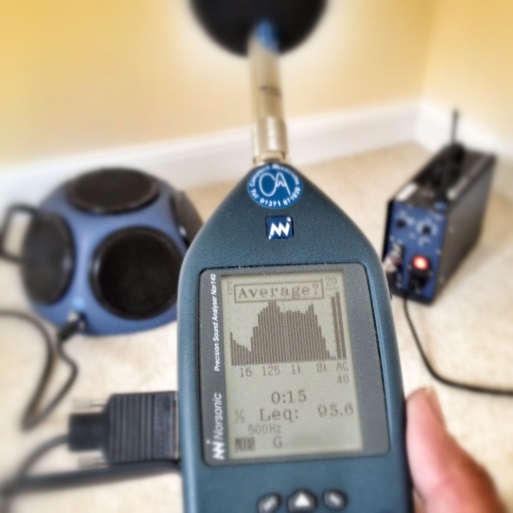
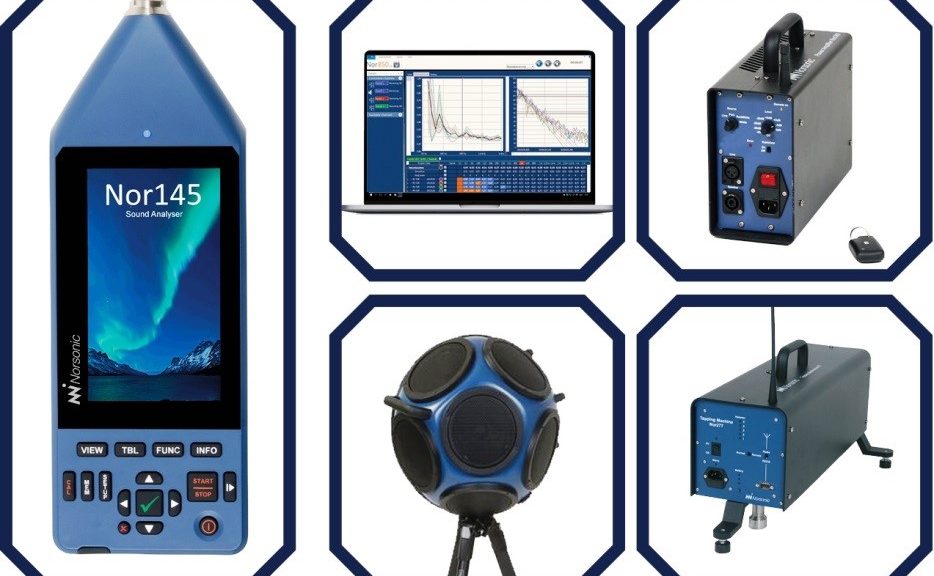
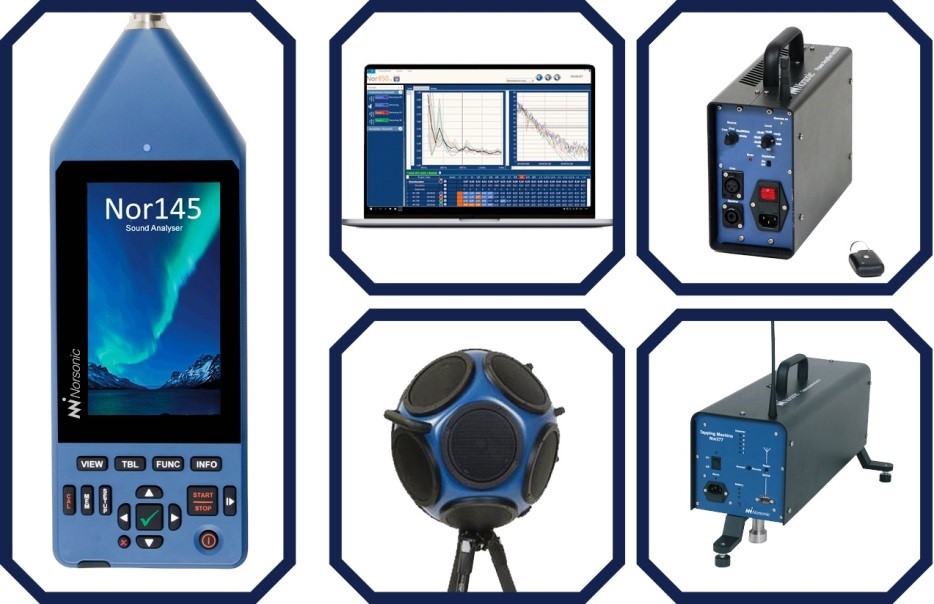
testing is undertaken to floors only. This test is different; a calibrated Norsonic
‘tapping machine’ which comprises of five ‘hammers’ driven up and down by a cam
and electric motor is used to “tap” the floor surface by applying a
known force on the floor structure. The machine is placed in several
pre-determined positions. The resulting noise is measured in the dwelling
below, using a sound level meter.
Thereafter, background noise
measurements are made using a class 1 sound level meter in the receiving room
and are used to apply appropriate corrections for external sound such as
traffic noise. Similarly the reverberation time (the time taken for sound to
decay by 60dB) is measured within the receiving room using the sound source and
a sound level meter to determine the corrections that must be applied to allow
for the characteristics and absorptiveness of the room.
The measured noise levels in
the receiving room are corrected for background and reverberation characteristics
determine the impact sound insulation performance of the floor. For the impact
noise the lower the measured level, the better the performance as less sound is
being transmitted into the dwelling below.
The time taken to undertake
sound testing varies from project to project as no site is exactly the same. Impact
testing is usually undertaken as part for a 6 pack test, consisting of 2
airborne walls, 2 airborne floor and 2 impact sound tests. A standard 6 pack
test will usually take between two and three hours, although this is dependent
on our engineers having full free uninterrupted access between all the
units/rooms under investigation.
APT Sound Testing has carried out thousands of air tightness tests on residential and commercial buildings. Over the last 12 years, we leaned quite a few things on how to seal buildings to pass air tightness testing to achieve building control sign-off. To try and help clients prepare their buildings, we have collated our top 10 tips to pass your air testing. :
1.Design
and apply an air tightness strategy from the start of the project.
Once the design air permeability rate has been
established, sit down with the design team and subcontractor trades to ensure
they know the importance of designing and constructing the building to be air
tight.
The air tightness line needs to be established as early as possible. This can be as easy as drawing a red line through all the elements that separate heated and unheated elements – such as plant rooms or external store rooms. Also, it is also important to have an air tightness coordinator on site to check consultant details and the associated on site construction.
2. Onsite construction signoff sheets throughout
the build
An onsite inspection regime should be put in place
throughout the construction phase to ensure that the air barrier is not
compromised by poor workmanship. If the building fails the air tightness test,
it can lead to very expensive remedial works.
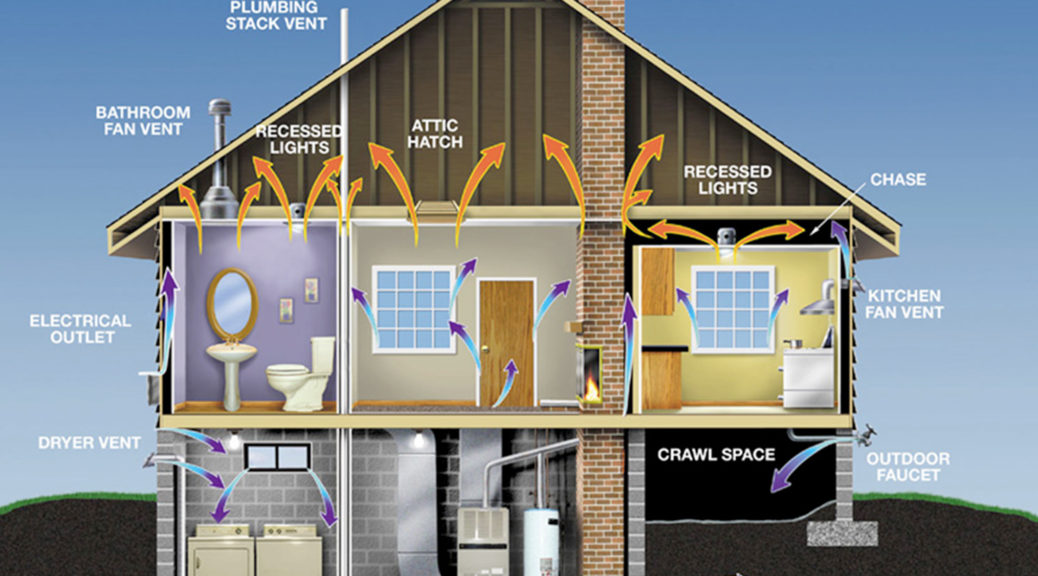
Air leakage commonly
occurs due to the inner lining of the building envelope being breached during
construction. One way to prevent excess air leakage paths is to use joist
hangers, rather than ‘built in’ floor joists.
3. Careful sealing during the Drylining phase
In our experience dot and dab plasterboard is often
a major cause of air leakage, as any missed leakage due to unfilled mortar
joints in the brick or blockwork, has a potential path from behind the board to
the floor slab and up behind and through the walls.
To lower the chance of air
leakage on these areas or use solid lines of adhesive around all sides of the
board and any cut outs for sockets and/or parge coat the masonry walls first.
It is also recommended you seal at the skirting boards/floor/wall junction wherever
possible.
4. Seal around service penetrations – waste and
supply pipework
Ensure all service penetrations such as waste and
supply pipework is sealed where it penetrates through walls and floors. Use
mastic/gunned sealants on smaller gaps; on larger gaps use pre-compressed flexible
expanding foam strips or plasterboard fillets.
Do not use expanding foam as it can shrinks and break away from the
surrounding construction. There are flexible foams, which are tested for air
tight applications which should be fit for purpose.
5. Seal around Windows and Doors
We still see large
amounts of ceilings and doors which have not been adequately sealed or are not
fitting properly and need to be adjusted or eased. Use suitable draught strips, seals and sealants and
to ensure there are no gaps or cracks around all window/door jambs, sills and
lintels and ensure that the installers have properly checked the doors and/or
windows to ensure they are closing tightly against the surrounding frames.
6. Seal around Radiator Pipes and Manifolds
Also many radiator pipes penetrate the wall behind
a rad, or through the floor – which are not always obvious. Manifolds from
underfloor systems are often not sealed into the floor screed, which is then covered
up with carpet which still results in a large air leakage path. Carefully check
and seal the areas prior to finishes being applied.
7.Seal
around Loft Hatches and Eaves Cupboards
With space at a premium many dwellings have rooms designed
in the roof; unfortunately this can often be the main air leakage area in
dwellings. Historically, we have seen a lot of air leakage through loft
hatches, eaves cupboard doors and service cupboards. As the cupboards are
usually unheated the door need to be sealed as well as external doors and
windows.
8. Ensure light fittings
are sealed.
Down lighters can be a
major cause of air leakage. Seal holes around light fittings and pull cords in
the ceiling, choose airtight fittings if possible, otherwise install air tight
boxes over the fitting in the ceiling void”.
9. Seal around mechanical and electrical services
It is essential that water, drainage, gas pipes,
boiler flues and electricity cables are fully sealed prior to the air tightness
test. Historically we often find leakage in kitchens, bathrooms, and boiler
cupboards due to leaky services.
10. Kitchens and Bathrooms the main air leakage culprits
The main areas of air
leakage in most new dwellings are usually within kitchens and bathrooms. Kitchens
should be finished, with all mechanical and electrical service penetrations
completely sealed as well as sealing to the wall/floor junction – there is not
usually skirting board installed behind kitchen units as they can’t be seen
once the kitchen units are in place. All appliances should be installed and all
service boxing such as SVP drops fully sealed at the wall/floor junction. All extractors
are fully fitted.
Bathrooms
should be carefully checked and sealed around all SVP and waste pipe work. All
bathroom fittings should installed and fully complete. Bathrooms often suffer
with excess air leakage due leaky bath panels and waste pipe work, also the
wall/floor junction is usually unsealed. You should ensure air leakage paths
are fully sealed before fitting bath panels, shower bases. All boxing to vanity
unit and extractors should also be sealed. For more tips on air leakage paths,
see our air tightness checklist
11.
Apply all temporary seals before we get to site:
If you seal all the temporary seals
before we get to site it can help to expedite the test, to allow for
comprehensive smoke testing in the event of a test failure.
Official
guidance has set firm guidelines around what can and can’t be temporarily
sealed when it comes to air tightness testing. The main contractor has the
responsibility to put temporary seals in place in line with the guidelines
published by ATTMA. Temporary seals can be achieved simply by using low tack
masking tape as not to damage the surrounding finishes.
The
allowed temporary seals are:
Chimney
flues
Mechanical
ventilation systems such as kitchen and bathroom extractor fans
Trickle vents
Air
conditioning grilles
Passive
ventilation such as air bricks, passive stacks and sub floor ventilation
systems
12. Don’t undertake the Air Tightness Test too early
In our experience a large
amount of air tightness tests failures are due to us being called in too early.
This
can be a very costly mistake, which may result in re-tests, as well as the
wasted man hours for the clients sealing teams as well as penalties imposed for
delayed handovers. Our air tightness checklist helps our clients to check that
their project is fully prepared to undertake the air tightness test.
Room Integrity Testing in London There are literally tens of thousands of protected enclosures
throughout London and the South East. With many of the banking and commercial
institutions based in the capital the requirement to provide a safe environment
of for critical equipment is greater than ever.
It is now a requirement of the BFPSA that all protected
enclosures such as server rooms and/or data centres have valid enclosure
certification – it is also a requirement of all major commercial institutions.
The benefits of ensuring room integrity are widely recognised by insurers and
regulatory authorities, who frequently require room integrity testing in London
to prevent critical system failure on valuable assets such as server rooms and
data centres. It is also worth noting
that you may negate your buildings insurance if you don’t have the valid
certification.
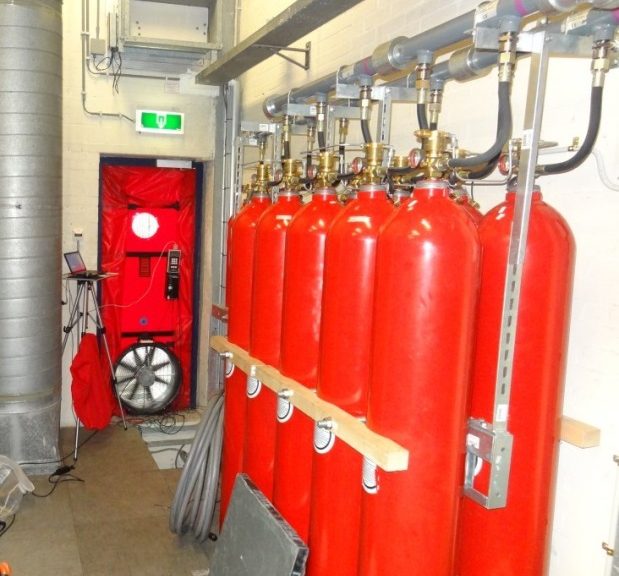
Enclosures protected by gaseous fire suppression system
-such as server rooms should be tested for air-tightness upon commissioning of
the system and annually thereafter. This is critical to ensure that the system
will work effectively when activated; too much air-leakage will result in the
concentration of the fire suppressant agent falling too quickly resulting in
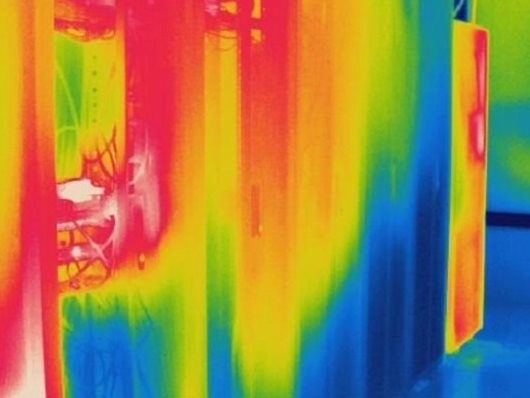
rapid fire spread as shown in the image below.
For most extinguishing system types, a retention time of
ten minutes is the minimum period the suppressant agents is required to be
retained for within the enclosure. NFPA 2001, Standard on Clean Agent Fire
Extinguishing Systems, requires that a minimum concentration of 85% of the
adjusted minimum design concentration be held at the highest level of
combustibles for a minimum period of 10 minutes. This is usually long enough to
prevent re-ignition for most deep-seated fires and should provide adequate time
for the emergency services to attend and prevent the fire taking hold.
Unfortunately, in the relevant ISO standard BS EN15004if
you don’t have valid room integrity certification you may negate your buildings
insurance in the event of a fire. In all instances the integrity certification
should always be attached to the front of the protected enclosure/s to show it
has valid certification and to clearly show the dates of the next test. The
certification also has other useful information that should be adhered to at
all times. If you don’t have integrity test certification fixed to the front of
the enclosure, then the chances are that your enclosure may not have valid
certification.
Within the In many cases the stakeholder may not be aware
that any modifications have been undertaken to the room’s envelope as this may
further reduce the integrity of the enclosure envelope. That is why it’s always best to plan any
works within protected enclosures so that everyone’s aware of the importance of
maintaining the integrity of the enclosure envelope and the requirement for a
fresh integrity test after any modifications have taken place.
Smoke Testing to Find Air Leakage Paths
APT’s highly trained and experienced Enclosure Testing
Engineers will be able to locate the problem areas and identify where air is
leaking out of the building by walking around the test enclosure with a
localised smoke puffer – as shown in the image below) checking the most common problem areas first.
By combining our door fan blower equipment and a small smoke
puffer we can quickly locate any penetrations in in the enclosure envelope as
the smoke is more visible. Smoke leaking from the enclosure can be easily seen
and photographed to provide a record of any external leakage paths. Pressurised
smoke tests are ideal for identifying both generic and torturous areas of air
leakage. Crucial remedial sealing work should then be undertaken to reduce the
leakage from the enclosure. The sealing works may include:
• Sealing all holes, cracks or penetrations
• Pipe chases and cable trays to be sealed
• Walls to be caulked around the inside perimeter
• Sealing
of porous block walls
• Addition of drop seals, weather stripping around jambs
• Sealing
of windows/glazed sections to the area
One of the advantages of the sealing works being
conducted whilst a test fan kit is in place, is that it can be seen if the
works being conducted are effective via ongoing smoke testing and sealing
works. Once the appropriate remedial work has been undertaken the enclosure
should be retested to confirm the acceptable retention time as been achieved –
usually 10 minutes.
Air Pressure Testing provides the necessary Room Integrity Testing & air tightness testing in London to the required NFPA 2001 or ISO 14520 methodologies. We have undertaken hundreds of enclosure integrity tests around the UK and Europe.
As part of our service, we can also arrange an annual test plan and remind you when the enclosure test/s are required to make sure your building’s insurance is not at risk. If you require room integrity testing in London, please call: 07775 623464 or visit the APT Sound Testing website today.
A gaseous fire suppression
system is a highly effective method of protecting your server rooms etc. from
fire. To ensure it works properly, it is important that room integrity testing
is carried out when the system is first installed and thereafter at least once
a year to ensure the protected area remains adequately sealed; unfortunately,
this is often overlooked by the building management.
Room integrity testing checks whether the server room or enclosure – where the fire suppression system has been installed, is adequately sealed.
When undertaking the integrity
testing of a new system the company tasked with undertaking the works requires
quite a lot of information, which the client often struggles to answer. To try
and help with this we have tried to explain the differences between a
Descending Interface, Continual Mixing and Extended Discharge.
What is a Descending Interface?
The fire retardant agent is
discharged from the ceiling –highest point) into the protected enclosure. An
‘interface’ with a constant concentration – known as the Initial Concentration)
descends from the discharge level as gas leaves escapes from the enclosure via
air leakage paths. The time it takes for this ‘interface’ to reach the minimum
protected height such as the top of the server racks is defined as the Hold
time. The time retention time for
a Room Integrity Test Pass is usually set at 10 minutes.
What is Continual Mixing?
The suppressant Agent is
discharged at near-ceiling level into the enclosure, thereafter fans circulate
gas throughout the room, resulting in a uniform agent concentration. This
concentration begins at initial concentration and lowers until it eventually
reaches a specified minimum concentration. The time it takes for the initial
concentration to reach the minimum concentration is defined as the hold time.
What is an Extended Discharge?
Typically extended discharges
consist of an initial discharge for 10 to 60 seconds to get the concentration
up to the design concentration. Then the extended discharge will continue at a
lesser rate. The intention is for the extended discharge to replace the agent
that leaks out of the room. It is assumed that the extended discharge will
create enough turbulence to create a continual mixing situation throughout the
extended discharge period.
We
are currently experiencing a large rise in the amount of housing stock that’s
requiring sound testing in London. As commercial buildings such as
offices etc. are converted into residential dwellings sound testing then
becomes are requirement under Part E of building regulations. We have carried
out a large amount of sound testing in office conversions with varying success
as office buildings are not usually designed with acoustics in-mind.
To reduce the chance of sound testing
failure, it is imperative that flanking transmission is considered at the
design stage and any construction detailing is specified to minimise any
potential of noise flanking which will downgrade the acoustic performance. Good
detailing at the design stage will minimise this effect and optimise the overall
levels of acoustic privacy achieved. If designing for residential units, design
advice on flanking details must be followed to maximise the possibility of
achieving the specified acoustic performance. It is imperative that the design
advice is followed, otherwise the site sound insulation values may not meet the
performance criteria required and subsequent expensive remedial treatment may
be required.
If
the onsite construction has gaps, cracks or holes it will conduct airborne
sounds and can significantly reduce the sound insulation of a construction. For
optimum sound insulation a construction must be airtight. Most small gaps can
be sealed at the finishing stage using Gyproc jointing compounds. Small gaps or
air paths around perimeter Gypframe framework can be sealed with sealant. At
the base of the partition, gaps will occur which can be filled with acoustic
mastic.
The
most common noise flanking pathways are as follows:
Dividing Ceiling Partitions – Above and
Through the Ceiling Space (where an adequate acoustic break has not been
carried on through the ceiling void)
Dividing Floor Partitions – Through
Floor and Floor Joist Space (if insulation has not been installed or direct
fixing to joists without a drop ceiling below the partition under test)
Shared Structural Building Components –
Floor Boards, Floor Joists, Continuous Drywall Partitions, Continuous Concrete
Floors, and Cement Block Walls.
Through Structural Steel (structural
steel beams are often a major cause of noise transmission as plasterboard is
often fixed directly to the steel without sound breaks)
Plumbing Chases – Junctures Between the
Walls & Floor Slab Above or at the Exterior Wall Juncture (this should be
filed with mortar etc. to add mass to this weakened area)
Through Windows (if they are no double
glazed or have secondary glazing as a minimum)
Fixtures & Outlets – Light Switches,
Telephone Outlets, and Recessed Lighting Fixtures (if penetrations have been
cut back to back with the opposite dwelling under test)
Structural Joints – Perimeter Joints at
Wall & Floor, Through Wall & Ceiling Junctures (these should be filled
with acoustic mastic)
Around the End of the Partition Through
the Adjacent Wall (acoustic mastic should be used to seal this junction)
When
offices are converted into dwellings we often undertake sample sound tests to
check the existing sound levels prior to the commencement of works, once we
have established the sound test results we can then come up with a more cost
effective design to comply with Part E of Building Regulations.
Historically
we have found that if the floor structure is a typical 200mm concrete slab the
sample airborne results are coming close to the requirements of Part E without
any modifications to the existing slab; however, the impact results are poor.
This is because the airborne sound is broken down by the mass of the concrete
slab, therefore sounds such as speech & TV etc. are minimised.
Unfortunately, impact sound results are poor due to the lack of isolation
within the slab, therefore the sound travels straight through the slab to the
area below. Sound such as people walking can be very loud and unacceptable.
To
help reduce potential control noise issues APT Sound Testing can undertake an acoustic design review of the floors after sample sound
testing to ensure both the airborne and impact sound tests pass Part E of
Building Regulations. Using our extensive knowledge regarding the way different
materials and construction methods can influence the results of sound testing
we can offer easy to follow acoustic advice on the most awkward developments.
We can advise on all types of Acoustic Design and Sound Testing in London, whether it’s accomplished during initial construction or during a refurbishment/renovation project. We also undertake UKAS accredited sound testing providing a ‘one stop’ solution for all your acoustic requirements. If you would like more information in regards to sound testing please follow our blog at: http://soundtestinguk.blogspot.co.uk or visit our website at: www.aptsoundtesting.co.uk
Server rooms and data centres that have gaseous fire extinguishing systems are required to be tested on an annual basis. This is obviously critical given the consequences of fire damage and down time for such equipment. It is essential that an server room integrity testis undertake prior to handover of the enclosure and annually thereafter. Over the last 12 months we are seeing an increasing amount of server rooms fail the annual integrity test due to the inability of the server room’s envelope to adequately retain the extinguishant.
This is often due to penetrations through the wall, ceiling and floors the enclosure is not able to retain the extinguishant agent for the required holding period – usually 10 minutes. If the server room fails the integrity test, remedial work should then be undertaken to reduce the leakage from the enclosures envelope, this may include;
Sealing the underside of doorways within the
floor void (Risk Level 10)
Sealing all cracks or penetrations leading
into or out of the protected enclosure (Risk Level 8)
If a false ceiling is installed below the
structural soffit, ensure the air tightness line – usually above the false
ceiling is fully sealed. (Risk Level 10)
Ensure all structural steels are sealed where
they go through the inner envelope (Risk Level 8)
Seal around the all air conditioning/cooling
vent frames (Risk Level 8)
Sealing all pipe chases and cable trays to be
sealed around the outside and inside where they penetrate the perimeter
boundaries of the protected enclosure (Risk Level 10)
Walls to be caulked around the inside
perimeter at both high and low level (Risk Level 9)
The sealing of porous block walls – this can
be remedied by painting etc. (Risk Level 8).
The addition of door sweeps or drop seals,
weather stripping around jambs (Risk Level 9)
Sealing of windows/glazed sections to the area
(Risk Level 8)
For fire suppression system to work properly, the room must have sufficient
integrity to retain an extinguishing concentration for a specified period after
discharge – usually 10 minutes) if the enclosure can’t adequately hold the
extinguishment the fire may reignite causing further damage. As this is the
predominant cause of failure, the British and International Standard (BS:
ISO14520) requires that a server room integrity
test be conducted on system installation and thereafter
at annual intervals, failure to do so may negate your buildings insurance.
In the event of a failed server room integrity test we can quickly
locate the air leakage paths using low impact smoke-puffers – if permitted. We can then issue an air leakage report
highlighting the air leakage paths within the server room enclosure. This will
ensure that you have all of the required information to undertake targeted remedial sealing
works on the enclosure.
Once
the air leakage paths are sealed a second room
integrity test can be undertaken – if
time permits. Once the appropriate remedial work has been
undertaken then the enclosure should be retested to confirm if an acceptable
level of integrity has been reached and the results recorded.
Our professional engineers, using the very latest in testing technology will provide thorough informative assessments concerning potential areas of leakage, advice and recommendations on protection and solution, as well full retention reports.
If you would like more information
in regards to Room Integrity Testing Please visit reference the following ISO
standards: ISO 14520, NFPA 2001 and ISO 15004
To try and help our clients better understand Sound Insulation Testing for Approved Documents E, we have collated the most common and questions (along with answers) clients have asked us over the last ten years. If you have further questions not contained within this article then please don’t hesitate to contact us.
What is Sound Insulation Testing? Sound insulation is the property of a wall and /or dividing partition to resist the passage of noise. The sound Insulation testing is a method of quantifying the sound insulation performance of walls and/or floors. Sound Insulation testing can be carried out on party walls, party floors or facades of any building.
Do I needsound insulation testingon my Property? One of the largest single reasons for disputes between neighbours
is noise complaints. Approved Document Part
E – Resistance to the passage of sound describes minimum standards
to be achieved by newly built domestic dwellings.
What is Approved Document E?
Approved Document Part E of the Building Regulations, sets out
minimum standards for sound insulation performance to be achieved by party wall
and party floors, you can achieve compliance with Part E by undertaking Pre-Completion Sound
Testing
When is the Sound Testing carried out?
The Sound Insulation
Testing is carried out when the buildings are
complete. Windows should be in place with any vents closable. Internal and
external doors should be in place, along with skirting, cornicing and plug
sockets in place. Sound testing must be carried out before any soft coverings such
as carpet have been laid to the floors. No furniture – such as beds or settees
should be in the rooms during the sound testing as it will have an effect on
the results.
Are internal partitions within a single dwelling sound tested?
No, Laboratory test based performance standards (Rw) exist for certain internal
walls and floors, but they are not intended to be verified as-built by on site
measurement and therefore sound insulation testing is not a
requirement; however, approved document E does state that internal partitions
should achieve 40dB.
Do detached properties require sound testing for Part E of
Building Regulations?
No, only attached properties require sound tests such as semi-detached
dwellings or blocks of flats. Detached properties share no common partitions
with any other properties.
How many sound insulation tests should I need on my Project?
Approved Document E states that one set of sound tests is required for every 10 units in a group or sub-group. A group or sub-group is defined where significant differences in construction or layout occur, for instance:
For a pair of semi-detached Houses – a set of tests would usually comprise two airborne sound insulation tests of a separating wall.
For Flats (up to 10 units) – a six pack would normally be
required, this comprises of: two airborne wall tests, two airborne floor tests
and two impact floor sound
tests.
For Rooms for Residential Purposes (student accommodation, hotel
rooms, care homes etc.) – a set of tests would usually comprise: one airborne
sound insulation tests of a separating wall; one airborne sound insulation test
of a separating floor; one impact sound transmission test of a separating
floor.
Which plots selected for sound testing?
We usually specify the amount of sound insulation tests that is required
on each project and this will be shown on a schedule within our fee proposal.
This allows our clients to forward the schedule to building control to seek
their approval prior to the test. We first look at the floor plans then work out
a testing schedule taking into account testing through the projects ‘habitable
rooms’ i.e. lounges & bedrooms where possible. When we have specified the
sound testing schedule it should always be checked by building control and/or
the client to seek their approval before the commencement of sound insulation testing.
How do I Prepare my Site forSound Insulation Testing?
APT Sound Testing always send out a sound testing checklist along with
our fee proposals to help you prepare for the sound testing,
as we always want our clients to be fully prepared so they can pass their sound
testing at the first attempt.
How long will the sound testing take?
The time taken to undertake the sound insulation testing varies with site conditions, but generally a ‘6 pack’ set
of tests on houses and flats takes about one to two hours. Obviously this
depends on the site being fully prepared in line with our sound testing
checklist.
Will
the sound insulation testing disrupt work on site?
we
require relatively quiet conditions are needed to take accurate measurements.
This means that anyone working in the testing area will have to leave
temporarily and any noisy works in the vicinity of the test rooms will need to
be halted i.e. using power tools or loud hammering etc.
How do I know if I’m ready for a sound insulation test?
We send out a checklist with all quotations to allow our clients to check they
are ready for the sound
testing. Basically the plots should be at least at
second fix stage – for further details please refer to our sound test checklist.
What sound testing equipment do you
use?
We use the latest UKAS calibrated acoustic equipment, for ease of
use and reliability. unlike many other companies we able inform clients if they
have passed or failed straightaway whilst on site. This allows us to offer acoustic
advice and collect detailed construction information whilst on site, in the
event of wall and/or floors failing the sound testing.
What if I only have 110V and not 240V on site?
Unfortunately
we cannot undertake the testing off 110V or localised generator power; we will
need 240V to undertake the sound testing.
Should I inform my neighbours of the impending sound testing?
If the building is attached in any way to occupied properties then you will
need to inform the neighbours. We need to gain access to the neighbouring
properties to undertake the sound test as we test the wall
partition. You will also need to ensure that access is provided to the neighbouring
properties throughout the sound testing.
Can you offer acoustic advice to help me to
pass my sound testing?
APT offer an acoustic design service to help
you design your buildings partitions to pass Part E sound testing. If you send
through the relevant drawings such as sections and floor plans during the design
stages of the project, we can check the design to see if there are any
junctions or details where ‘noise flanking’ may occur, we can then advise if
any changes are required to lower the chance of sound test failures.
Rest Assured
We believe in working with our clients on all types of projects
from small end of terrace developments up to large blocks of flats. We believe
that by being involved at the beginning of a project we can often save our
clients expensive and difficult remedial works at the completion stage of a
project.
If you need sound
insulation testing for your current project, please call our team on 01525
303905 or email info@aptsoundtesting.co.uk We can
provide you with expert advice and are happy to offer a free, no obligation
quote along with our informative
checklist to help you
prepare for the sound testing.
Floor Plenum Testing. A floor plenum is a void between a building’s floor structure and a raised access floor, used for distributing conditioned air to the spaces above. It is important that conditioned air in a floor plenum flows into the occupied zone and does not leak into cavities, risers, stairwells, heating trenches or other adjacent zones. A properly sealed floor plenum will allow the diffusers and grilles to fulfil their primary role of delivering air at the correct flow rate.
APT Sound Testing undertakes floor plenum testing using a special fan which is set up in the test zone. All air ducts must be turned off and sealed. The test is conducted by taking a series of pressure readings. If the plenum fails the test we can then carry out a smoke survey to highlight the air leakage paths and issue a report for reference during thr remedial sealing works.
If
you require raised access floor testing, we can arrange a site visit and
recommend the tests appropriate for your needs. We will advise you on the most
suitable specifications for your structure and we will carry out extensive
testing on your floor plenum.
If
you want to know more about our plenum floor test services, please contact us
today and our expert staff will be happy to advise you further.
In
all instances our strong focus on customer satisfaction, along with a can-do
attitude, coupled with the knowledge of a UKAS accredited laboratory, are the
key benefits to you when partnering with APT Sound Testing.
What is a Floor Plenum?
A
floor plenum is part of a building that normally facilitates air circulation
for heating/air conditioning systems by providing pathways for either heated/conditioned
or return airflows. The air flow is often supplied at a greater pressure than
atmospheric pressure.
Air leakage
from floor plenums can be a serious energy efficiency issue and a source of
discomfort to users. A floor plenum is a void between a building’s floor
structure and a raised access floor, used for distributing conditioned air to
the spaces above. It is important that conditioned air in a floor plenum flows
into the occupied zone and does not leak into cavities, risers, stairwells, heating
trenches or other adjacent zones.
It is
important that the air supplied to the floor plenum discharges through the
floor-mounted diffusers or grilles rather than through joints in the raised
access floor or between the raised access floor and the walls. A properly
sealed floor plenum will allow the diffusers and grilles to fulfil their
primary role of delivering air at the correct flow rate.
What is Floor Plenum
Testing?
If
you have floor or ceiling plenums in your building you need to be aware that a
staggering 70-70% fail their first air tightness test. APT Sound Testing has
years of experience of raised access floor plenum air pressure testing and can
work with you to ensure you pass your floor plenum air test at the first
attempt.
We
can ensure that an onsite air test site audit is arranged as soon as the floor
is in place; we can then undertake an initial floor plenum air test and smoke
survey to check the air leakage result and check for air leakage paths within
the plenum envelope. Once we have assessed the air leakage paths we can then
supply a smoke survey report for your sealing contractors to use as reference
to ensure your plenums are adequately sealed
Why do so many floor
plenums fail their first air test?
There
are many reasons why 70-75% of floor plenums fail their first air tightness
test. One of the most common reasons is due to a lack of understanding within
the construction industry as to how airtight a plenum needs to be. One common
problem is that many plenums are built and tested under laboratory conditions; unfortunately
there is a big gap between what happens in a lab to the reality of plenums construction
on a building site. With multiple contractors needing to put pipes, cables etc.
through the plenum, this is just one of many things that can affect the air
tightness of a plenum. APT have years of experience and can work with you to
ensure you achieve an air test pass on you plenum at the first attempt.
What happens if we fail
the floor plenum test?
A
large number of floor plenums fail the initial air tightness test so don’t
panic. If we undertake the testing our UKAS accredited air tightness engineers
will undertake a targeted smoke survey to highlight the main air leakage paths.
We will then issue a smoke survey report for your contactors to reference
during the remedial sealing works. We also allow for the option of visiting
site during the sealing works to ensure your contractors are adequately sealing
the plenum prior to the second air tightness test. If you would like more
information in regards to the most common air leakage paths, please visit our
Floor Plenum Checklist.
The main considerations
when constructing floor plenums?
In
offices, carpet tiles are usually laid over the raised access floor, if joints
between carpet tiles are not lined up with the joints between the raised access
panel’s floor tiles or panels, the air leakage will be reduced, particularly if
the carpet tiles are glued in place. That said, the laying of carpet tiles
should not be relied on to achieve the target for the raised access floor
itself as these can de-bond over time.
Many raised access floors include
electrical and date boxes. The air leakage of these boxes should be
ascertained, to ensure that they will not significantly contribute to the
raised access floor leakage, and reduce the air flor to the grills or
diffusers. Where there are decorative or functional connections through the
raised access floor, for example cabling to display boards, suitable method of
air sealing these penetrations should be designed.
The
perimeter of the floor plenum where the access floor meets the wall is often an
area of increased air leakage. To minimise this leakage it may be beneficial to
fix a length of metal angle along the perimeter of the floor. Lengths of closed
cell board or neoprene strips will increase the quality of the seal between the
raised floors and the wall and should prevent excess air leakage.
The
walls of floor plenums are most the most vulnerable to air leakage as they are dependent
on the type and quality of construction. Plasterboard can be used as the air
tightness barrier; however, care should be taken to ensure all joints should be
sealed where boards abut other boards, walls, floors and the underside of the
raised access floor. This is the same for coated mineral fire boards used in
conjunction with fire mastic, the boards should be specified with an air
leakage rate of 0.15 l/(s.m2)@50Pa with a life expectancy of at
least 25 years.
While
poured in-situ concrete floors don’t have any significant air leakage,
hollow-core and solid composite precast planks need to be sealed along the
plank joints and carefully sealed around service penetrations. Beam and block
floors need to be covered by a screed to prevent excess air leakage
How we carry out a Plenum
Air Tests on your project?
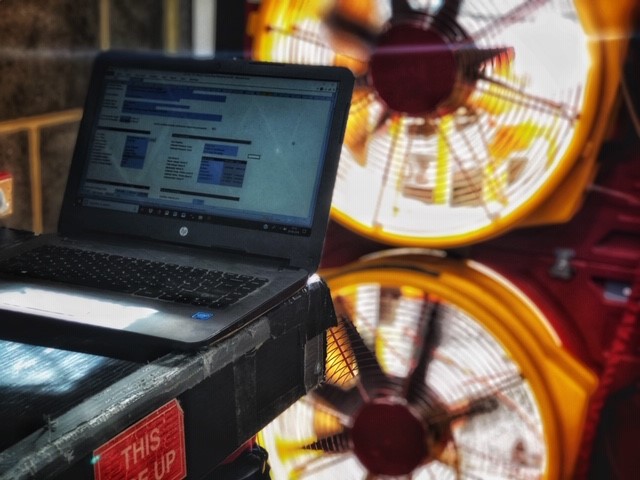
In
brief, we remove a box a temporary a tile is removed from the plenum and our
fan housing is installed directly above the opening. A fan is then installed
into the box and this is all sealed against the floor.
Any
air handling ducts serving the test zone need to be turned off, isolated and
temporarily sealed, stopping the passage of air to outside of the test zone via
ductwork
Thereafter
another tile is removed and a mock floor tile with a drill hole for the high
pressure tube is installed in its place.
After
the equipment is set up a series of tests is undertake and the readings
recorded and then checked against the floor plenum air tightness specification.
If
the plenum test fails, your APT air test engineer will carry out a smoke test
to look for air leakage paths.
Is there a Standard associated
with Floor Plenums Tested?
At
present there is no set standard for plenum testing. The specification is
usually set by the project’s Mechanical Engineers, and is normally set in
litres per second per square metre (l/s/m2). APT will need to know what
pressure the specification is set at, e.g. 0.7l/s/m2 @ 50 Pascals. It is also possible
that the specification can be set in l/s/m3 by the mechanical designers, for
this type of test we would require the volume of the Plenum.
What are the most common
air leakage paths within floor plenums?
In order to
create an effective air tight floor plenum, all utility penetrations and
perimeter joints must be properly sealed. An evaluation of the following
areas/components that can typically create inefficiencies should be undertaken
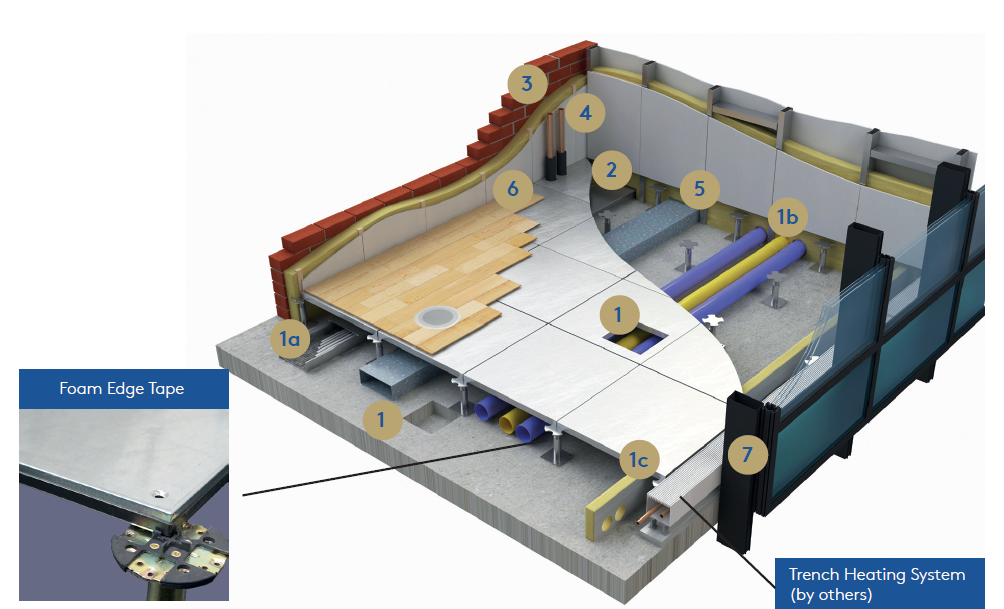
during the early design phase and during the onsite construction. For clarity we have shown the main air leakage paths below.
Penetrations through the access floor,
walls and subfloor including
Cable
bundles and cable trays
Pipes
Fire/plenum
barriers
Cable trunking – must be internally
sealed within the void
Masonry work – incomplete or poorly
jointed walls will result in greater air leakage
Risers need to be properly sealed for
plenums/ducting
Plasterboard on studs at board edges and
the ends below the raised floor level
Gaps between compartment barriers, top
of raised access floor and sub floor respectively
Gaps between any curtain walling/glazing
Contact Floor Plenum Testing If you are worried about the air tightness integrity of your floor plenum then please contact us now by telephoning 01525 303905 or Email us on: info@aptsoundtesting.co.uk
Secret to Successful Sound Testing. There are many considerations to achieving successful sound testing on your development. The main areas that need to be addressed are the dividing wall and flor construction. When dealing with walls you normally just need to worry about airborne sound; however with walls it’s both airborne and impact sound which can be far more difficult to deal with.
The usual noise problems associated with airborne sound transmission is TV noise, music and speech. This can be dealt with by applying ceiling treatments as well as mass and isolation to the building components. Impact sound (footfall) performance is increased by the used of resilience layers and isolation of components to prevent noise flanking through the partition.
Successful Sound Testing
Airborne Sound
Testing For airborne sound testing Building Regulation Part E requires you achieve
at least 45dB for new build properties and 43dB for conversion developments,
this applies both to party walls and floors between properties. This level is
the difference between the source level and the receiver level during sound
testing. Therefore, if the source level in one flat is 110dB and the receiver
level in the neighbouring flat is 55dB, the level difference (or sound
reduction performance) is 55dB.
The measurement is corrected for several factors such as
background noise, room characteristics and frequency weighting, giving the
final sound insulation performance value of the tested partition. In this case
the higher the number the better the sound insulation performance. The
measurement is done by using a Class 1 Analyser and the associated equipment.
Impact Sound Testing For impact sound testing Building Regulation Part E requires you achieve at
least 62dB for new build properties and 64dB for conversion developments.
Impact insulation performance only applies to party floors and related to the
effectiveness of the floor construction in absorbing shock such as footfall
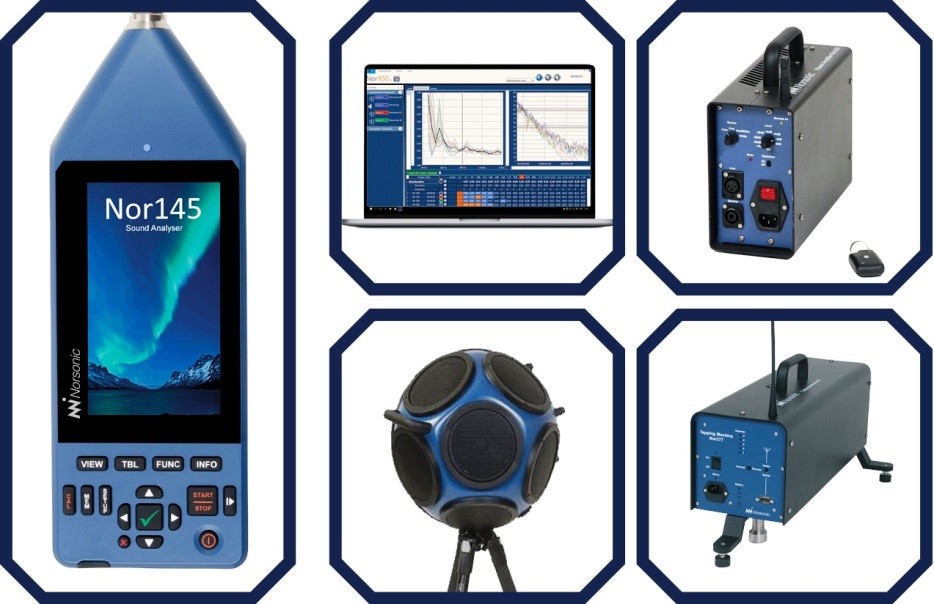
noise. The measurement is done by using a Norsonic tapping machine (as shown
below). The machine has 5 weights which tapping in regular succession on the
tested floor which emulates footfall noise. The noise levels are taken in the
receiving room below, which are then measured and averaged for different tapper
positions, which then gives the sound reduction rating of the floor. In this
case the lower the figure, the better the performance.
Good Acoustic Design To try and ensure you meet the standards stipulated within Building
Regulations Part E, careful consideration should be shown to the acoustic
design detailing from the stat of the project. offset. Tackling the acoustic
design for both new build and conversion project requires two different
construction techniques and acoustic design detailing. With new build
properties you have a blank canvas in terms of the overall design whereas with
conversions you usually need to work with the existing’ onsite’ construction
which can be quite difficult.
We offer an acoustic design package, which contains the following
elements:
a. Sample
Sound Testing – of the existing construction. This offers an accurate overview
of the acoustic performance of the existing partitions which enables us to
offer a targeted acoustic design using the sound insulation performance of the
existing construction.
b. Acoustic
Design Review – a full design review of the proposed developments party walls
and floors.
c. Site
Survey Visits – to let us view the existing site construction. This allows us
to check for potential problematic construction such as inclusion of
lightweight blocks in the existing construction. It also lets us check that the
installation teams are installing the acoustic materials as per manufacturer’s
guidelines.
d. Final
Precompletion Sound Testing in compliance with Building Regulations Part E.
Useful Acoustic Design Considerations
a. Avoid the
use of lightweight blocks in the inner envelope construction and/or stairwell
construction etc. as sound will travel both vertically and horizontally from
dwelling to dwelling.
b. The use
of resilient suspended ceilings will help improve the performance of the floor
partition.
c. Ensure
all support steels/timbers are carefully boxed out where they travel from flat
to flat vertically and horizontally.
d. Use a
high quality resilient acoustic membrane on top of the floor to improve the
impact performance of a floor.
e. Ensure
all penetrations are fully sealed where they terminate through floors and they
are adequately boxed with acoustic quilt and two layers of plasterboard.
In our experience the main 5 considerations when designing
for separating walls and floors between dwellings are: If used together or in
various combinations they will improve sound insulation properties over a wide
range of frequencies. The main factors are:
a. Mass
b. Isolation
c. Absorption
d. Resilience
e. Stiffness
If used together or in various combinations they will
improve sound insulation properties over a wide range of frequencies and should
achieve compliance with Building Regulations Part E.
In our experience if the acoustic design is taken into consideration from the offset of the project, then it usually results in compliance with Building Regulations Part E. In Some cases sound test failure can also be down to the poor workmanship rather than the acoustic design that is why we offer a full‘4 step’ acoustic package.
If you have a project that’s needs acoustic design advice or sound insulation testing, then please visit the APT Sound Testing website or phone us directly on 07775 623464.
This guide helps to explain the way Acoustic Test results are displayed
and what they mean. We have also added a section offering guidance highlighting
common errors which can lead to Sound Insulation Test failures
Acoustic Testing is often associated with UKAS accredited testing
laboratories. It is good practice for those involved in Acoustic Testing be a
UKAS accredited. An organisation with this accreditation is valuable, as they
adhere to rigorous testing in the above areas. APT Sound
Testing is a UKAS accredited
Acoustic Testing Company.
This is an excerpt from UKAS;
“Accreditation
is increasingly being recognised as a valuable tool across a wide range of
Government policy areas including better regulation, good governance, fair
markets and public confidence. It is already being used by Government as an
effective market-led tool for delivering policy more efficiently and to help
deliver on its obligations in areas as diverse as healthcare, food production,
energy supply, climate change and personal safety.”
There are two types of sound insulation testing that are most commonly
carried out in the field, to help to establish the sound insulation performance
of wall and floor partitions for Part E Building Regulations.
The
airborne sound insulation of a separating wall or floor should be measured in
accordance with BS EN ISO 140-4:1998. All measurements and calculations should
be carried out using one-third octave frequency bands. Performance should be
rated in terms of the weighted standardised level difference, DnT,w, and
spectrum adaptation term, Ctr, in accordance with BS EN ISO 717-1:1997″
An Airborne sound insulation test is carried out using the following
methodology:
Check full access is possible to the two properties
(or more depending on the testing sequence).
A background noise level is taken in the receiving
room and used for corrections in the measurement (external noise issues such as
traffic noise, weather conditions and other influential noises that are outside
the test engineers control).
A reverberation test is carried out in which a
controlled noise is introduced to the receiver room, the noise is then stopped
a measurement is taken the tail at the
end (reverb) to check how long it takes for a sound to reduce below 60dB
(RT60).
Controlled noise is introduced across a broad range
of frequencies is amplified through a large Dodecahedron speaker (which should
be on a tripod to prevent it from sitting directly on the floor partition). The
noise levels can be in excess of 100dB, so no other operatives should be in the
vicinity of the testing location. Multiple readings are taken in various
locations within the source and receiving room to investigate any variations in
performance.
When undertaking the testing, there is a source room and receiving room
– the source is where the sound is being carried out or where the speaker is
positioned – usually the larger room – and the receiving room being the
recording on the other side of the partition from the speaker. The results of
this are referred to as onsite sound testing or Field Measurement.
The measurements are expressed as the following;
The Weighted Standardized Level Difference with Spectrum Adaption Term
(DnT,w + Ctr), DnT,w is the measured amount without correction, Ctr is the
correction for low frequency interference (traffic etc.) and most commonly used
in the expression – you would deduct this from the 1st number. For example; DnT,w (C;Ctr) =65 (-1;-5) dB = 60dB using the
correction methodology.
The impact sound transmission of a separating floor
should be measured in accordance with BS EN ISO 140-7:1998. All measurements
and calculations should be carried out using one-third-octave frequency
bands. Performance should be rated in terms of the weighted standardised impact
sound pressure level, L’nT,w in
accordance with BS EN ISO 717-2:1997.”
An Airborne sound insulation test is carried out using the following
methodology:
Check full access is possible to the two properties
(or more depending on the testing sequence).
A background noise level is taken in the receiving
room and used for corrections in the measurement (external noise issues such as
traffic noise, weather conditions and other influential noises that are outside
the test engineer’s control)
A reverberation test is carried out in which a
controlled noise is introduced to the receiver room, the noise is then stopped
a measurement is taken the tail at the
end (reverb) to check how long it takes for a sound to reduce below 60dB (RT60).
A UKAS calibrated Tapping Machine is placed, which
taps the floor with a concise pattern and pressure. This is measured in various
locations in the upper room to highlight any potential deviations in acoustic
performance.
The tapping machine is places in the source room with the receiving room
being the room directly below the tapping machine. Results of this are referred
to as a Field Measurement.
The measurements are expressed as the following;
Weighted Standardized Impact Sound Pressure Level (L’nT,w). No
correction is applied to this measurement. For example; L’nT,w = 35dB.
Contributing Factors that may
affect Sound Test Results in the Field There is a huge amount of
factors that may affect the sound test results whilst undertaking sound
insulation testing in the field (onsite) one of the main factors is the quality
of workmanship – The quality of building workmanship is very important, and
often the most influential to acoustic test results. If the site construction
is of a poor standard/quality the sound proofing would need to be more robust
to help alleviate these issues. Some negative contributions to the onsite
construction may be:
Noise flanking due to the materials bridging
cavities etc.
Unfilled mortar joints.
Gaps within plasterboard joints due to poor cutting
and sealing of acoustic plasterboard.
Not following manufactures installation guidelines.
Butting soundproofing materials up against adjacent
walls and fixing elements through a neighbouring partition walls or floors.
Dot and Dab plasterboard as a way of ‘soundproofing’
instead introducing a cavity – air gap – between materials.
Installing underperforming acoustic mineral wool
with poor sound density.
Packing dense acoustic mineral wool into a cavity,
thus bridging the air gap.