Author: admin

Infrared Thermography on Building Envelopes

Infrared Thermography on Building Envelopes

Infrared Thermography on Building Envelopes

Infrared thermography is diagnostic surveys you can undertake on building envelopes.

APT Sound Testing has been using thermography successfully to examine electrical systems and building envelopes for more than 15 years. What makes it such a versatile diagnostics solution is that it allows for non-destructive testing with a high rate of accuracy. It only takes a matter of hours to perform a thermography building inspection and identify all existing and potential problems with its envelope system and supply a detailed report to the customer.

The aim of the thermal analysis is to help quantify building sustainability and save ongoing building energy costs that are increasing year on year. The thermal imaging survey can help to identify damaged insulation, air leakage paths and HVAC & electrical failures which can lead to heat loss and/or building downtime.

Here at APT we try to be at the forefront of advanced predictive maintenance technologies. That means we have everything it takes to perform thermal imaging inspection latest high-resolution thermal imaging equipment. Its key applications include:

  • clear visualisation and reportage of energy losses
  • examination of thermal bridges in insulation;
  • analysis of HVAC systems
  • checking doors and windows for infiltration/exfiltration issues
  • detection of floor leaks and moisture build-ups
  • detection of flat roof leaks
  • identification of mould growth
  • assessment of the overall building condition

How you can benefit from thermography building inspections?

When used as part of preventative diagnostics, thermal building inspections can be used to detect energy losses in both commercial and industrial buildings as well as existing historical and cultural heritage sites.

You can also use thermographic inspections as part of your refurbishment and redevelopment projects because it allows you to analyse the performance of the existing structure that’s about to be renovated. You can then evaluate the performance of the building insulation etc. and the information can be used in the redesign of the building envelope.

If you’re a building contractors and/or consultant our services will be useful to you. Thermographic inspections for building diagnostics are now part of BREEAM certification requirements. Under the latest edition of the BREEAM Technical Manual (SD5076) it is possible to be awarded a BREEAM credit by conducting a thermographic survey of the building fabric. The BREEAM thermography survey is required to be completed in accordance with MAN 04 Commissioning and handover compliance notes CN3.3 and CN3.4.

Basically the BREEAM thermographic survey is required to confirm:

  • Continuity of insulation in accordance with the construction drawings
  • Avoidance of excessive thermal bridging
  • Avoidance of air leakage paths through the fabric (except through intentional openings)

Any defects identified via the post construction inspection are required to be rectified.

The BREEAM thermal survey needs be undertaken by a UKTA Approved Level 2 thermographic surveyor, all our engineers are trained to Level 2 & 3 so our reports will be acceptable to BREEAM.  

If you are looking commission a thermal imaging survey to secure a BREEAM credit and require estimation on the cost, please contact us on info@aptsoundtesting.co.uk for any questions and/or visit our website on www.aptsoundtesting.co.uk or download our thermal imaging checklist.

Detection of Air Leaks Using Thermal Imaging

Detection of Air Leaks Using Thermal Imaging

Detection of Air Leaks Using Thermal Imaging and Air Tightness Testing

Air leaks through building envelopes lead to higher energy consumption and often places extra strain on the heating and ventilation systems. Air leaks can also lead to condensation which can cause a poor indoor climate for the occupiers of the building.

To detect air leaks through the building envelope using a thermal imaging camera a temperature difference and a pressure difference is needed. With a thermal imaging camera you detect the characteristic patterns that occur when cold air is coming through a leak in the building construction which runs along a surface and cools the surface down.

A thermal imaging inspection should always be undertaken on the side of the construction with negative pressure. Air leaks are often detected with the help of the air tightness pressurisation method often referred to as an air tightness test. When air tightness testing and thermal imaging survey inspections are used together they make a powerful combination for building fault diagnosis.

Detection of Air Leaks Using Thermal Imaging

Set up an air tightness test and thermal imaging inspection

Small cracks and crevices can cause internal draft in the building. This is not only annoying for the occupants; it can also cause severe energy loss and higher ongoing costs. Building Air leakage can account for up to half of the energy consumed for heating purposes. By undertaking an air tightness test you can easily make the smallest cracks visible.

Using a Blower Door to help pressurise the building helps exaggerate air leaking through defects within the building shell which can easily be picked up during the thermal imaging inspection.

Our Blower Door systems include the following three components:

  1. A calibrated Retrotec door fan
  2. A compatible expandable a door panel system
  3. A Retrotec pressure gauge to measure fan flow and building pressure.

Our Blower Door fan is temporarily sealed into an exterior doorway using the corresponding door panel system. The fan is used to blow air into or out of the building, which creates a small pressure difference between inside and outside the building under test.  Using our air tightness fan system we can either suck air out of the building or blow air into it, causing a pressure difference. In situations where the outside air is colder – which is often the case in the UK – the most common method is to suck air out of the building using the depressurisation method.  

BREEAM Thermal Imaging Survey

During the air tightness test we aim to attain a pressure difference of 50 Pascal between the inside of the building and outside air pressure. Due to this pressure difference the outside air will rush into the building through the cracks that are present in the building envelope (floor, walls and/or ceiling). The outside air will quickly cool down the location where an air leakage crack is present. This temperature difference will clearly show up in the thermal image as a cold spot or cold area, allowing our Thermal Imaging Engineer  to accurately locate and map the air infiltration pathway within an easy to follow report.

We have extensive experience in conducting commercial building air tightness and thermal imaging surveys across the following types of buildings/businesses:

  • Warehouses
  • Factories
  • Office Blocks
  • Blocks of Flats
  • Universities
  • Schools
  • Hospitals
  • Railway Stations

If you require a BREEAM Thermal survey our professional and certified Level 2 Thermographer’s will carry out your thermographic Inspections for BREEAM compliance in accordance with all necessary standards and current regulations, all we need are a few details such as floor plans and elevation drawings and the building location to provide a quotation. We will also send across our informative Thermal Survey Checklist to help you prepare for the thermographic Inspection.

Contact APT Sound Testing for a free quotation for a thermographic inspection. All we need are a few details such an elevation drawings, floor plans and location to provide a quotation.

If you would like more information about the detection of air leaks using thermal imaging or BREEAM Thermographic Inspection Surveys, please contact us now at info@aptsoundtesting.co.uk or call us today on: 07775 623464.

Thermal Imaging London

Thermal Imaging London

Thermal Imaging London Deal
If you require a thermal imaging survey carried out in London we are currently offering a 10% Discount, please contact us and quote “London Thermal Imaging Deal” to get your discount.

Thermal Imaging or thermographic building surveys is a non-invasive temperature measurement testing method.  Thermographic inspections can provide a no-contact survey for many applications in detecting missing insulation in building envelopes and mechanical and electrical faults before they actually give rise to unplanned and costly breakdowns.

BREEAM thermal image of a building shown in 3D

Thermal Imaging London
Whether it is for insulation continuity in Building Regulations Part L2, paths of air leakage, insulation we have a survey to fit your requirements. Our integrity is guaranteed to bring you true results.

Common problems that Thermal imaging in buildings can help to identify are:

> Missing, damaged, or inadequate insulation,
> Building envelope air leaks and moisture intrusion
> Destructive water damage

Upon completion of our thermal imaging survey you will receive a report that details the following:

> High specification 640×480 cameras with a wide-angle lens
Same Day’ delivered reports
> Dedicated scheduling and expert campaign management ensuring all data is returned correctly and quickly
> Recommendations for any further investigation required along with an explanation

The Advantages of Thermal Imaging

Unlike other types of tests, thermal imaging is a non-invasive procedure which requires little physical work. Some of the images can be taken from outside the property. This also means there is no risk of damage to the building, and it can help speed up the process of identifying any problem areas, potentially saving clients time and money.

Thermography is suitable for use on all sorts of new buildings as well as old existing buildings that may suffer from draughts or air tightness issues, to new-builds which have to meet the latest building regulations. It can be used on domestic properties, business premises and all types of public buildings as well.

Thermal Inspections for BREEAM

What are BREEAM thermal inspections? BREEAM is the Building Research Establishment Environmental Assessment Method and is the world’s longest-established system for assessing, rating, and certifying the sustainability of buildings.

We can offer a bespoke BREEAM thermal imaging survey which will fit you or employers requirements. BREEAM, who award credits for surveys carried out by suitably qualified thermographer’s – APT Sound Testing’s thermographic engineers are trained to a minimum of level 2. It is also worth noting that thermal surveys can also help you meet the insulation requirements of Building Regulations Part L2 (b).

APT Sound Testing aims to offer you the best thermal imaging service at local prices. We are currently offering a 10 percent discount on all our thermal imaging inspections, thermal imaging surveys.

For more information, please contact us now at info@aptsoundtesting.co.uk or phone Darren direct on 07775 623464. Alternatively please visit our website.
What is a Thermographic Survey Inspection?

What is a Thermographic Survey Inspection?

What is a Thermographic Survey Inspection?
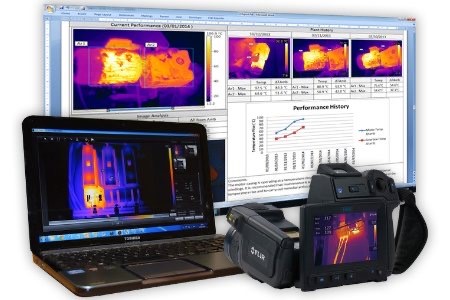
Thermographic survey inspections – which are also known as thermography surveys, can help to determine the thermal performance of a building. It creates a detailed photographic report for the customer (taken on a thermal imaging camera) which shows the temperature of commercial buildings.

APT Sound Testing undertakes detailed Thermographic Surveys to identify heat loss in order to improve energy efficiency and increase thermal comfort within our client’s buildings.

Using thermal imaging cameras, our highly skilled Level 2 engineers can detect infrared radiation and therefore identify increases or decreases in temperature. APT have been working with contractors and consultants to ensure their buildings do not suffer from excessive cold bridging, air leakage or thermal breaks in insulation.

What is a Thermal inspection Surveys?
BREEAM recognise the benefit of a thermographic survey by awarding credits if a thermal imaging survey is undertaken on a project. The survey will also demonstrate compliance with the construction specification on newly constructed buildings in-line with Building Regulations Part L and BREEAM.

What problems can a Thermal inspection survey identify?
The BREEAM thermal survey can diagnose problems within the building fabric such as missing insulations, moisture ingress, condensation and mould growth. The use of thermography can provide excellent visual and quantitative evidence of the causes of the suspected problems.

What is the science behind a thermal imaging survey?
Infrared thermography is a type of photography which is based on infrared wavelengths, rather than visible wavelengths.

Thermal imaging relies on radiated energy in the infrared (IR) spectrum which cannot be seen by our eyes.


Do you need to be trained to carry out a thermal survey?

Yes, to carry out a BREEAM thermal inspection you need to be certified to at least Level 2. Our BREEAM thermal imaging engineers are trained to Levels 2 & 3, so are suitably qualified to carry out thermal surveys.

How do I prepare my building for a thermal imaging survey?
In order to correctly carry out this thermographic assessment, it is necessary to achieve a 10ºC differential in temperature between internal (heated) and external (ambient) – or the inside and outside of the building envelope.

If you would like more information in regards to our Thermal Imaging Surveys, please contact us at info@aptsoundtesting.co.uk or call us Direct on 07775623464.

Alternately, if you would like more information on how to prepare for your BREEAM Thermal Imaging Survey, please visit our website at www.aptsoundtesting.co.uk or Thermal Imaging Inspection Checklist and you can also reference our blog at airpressuretesting.blogspot.com or our Thermal Imaging Knowledge Base Page which offers handy tips on how to prepare for your Thermal Imaging Survey.

Is Thermal Imaging Survey Worth Doing?

Is Thermal Imaging Survey Worth Doing?

Is Thermal Imaging Survey Worth Doing?
Yes, a thermal imaging survey is an extremely useful type of survey. It is a completely non-invasive method of investigating many aspects of a building that are virtually impossible by any other method and you’ll find heat leaks and many other issues that you’d never find any other way. By actioning the items found during a Thermal Imaging Survey – such as missing insulation in the building envelope – you can reduce the building’s carbon footprint and ongoing costs.

A healthy building envelope also makes the facility more comfortable and healthy for its occupants. This improved environment can also increase productivity and be very beneficial for the life cycle of a building. A healthier building means healthier occupants – a double win for employer and employees.

What are other names for Thermal Imaging Surveys?
This procedure is also known as a thermographic survey, thermal survey, BREEAM Thermographic survey, BREEAM thermographic assessment, heat-loss survey, thermal imaging home inspection or Infrared thermography (IRT).

How much does a Thermal Imaging Survey cost?
This is one of our most common questions regarding thermal imaging, with a very easy answer: it depends on various factors!

How much a thermal imaging survey costs depend on the following:

  1. The type and size of building
  2. The amount of buildings
  3. The preparation required
  4. Potential access issues that may slow down the survey
  5. The projected survey time and equipment required
  6. The location and travel costs/time
  7. The deliverable: in other words, what is type of reportage is required.

Once the above items have been considered, we can forward an accurate fee proposal for the works.

When is the best time to do a Thermal Imaging Survey?
Thermal imaging surveys should generally be conducted in the early hours of a cold morning, approx. 2 hours before the sun rises to prevent solar loading on the building envelope. Generally, when it’s cold outside you heat the building to provide a temperature differential of 10c. The bigger and steadier the temperature differences between inside and outside, the easier the job will be. Also, thermal surveys should not usually be undertaken if heavy rainfall is present at the time of the thermal survey.

It is with noting that it is more difficult to conduct these types of heat loss survey during summer months as the ground temperatures and surrounding building envelope can maintain high temperatures for months on end; however, we can overcome this by using the latest advanced – and sensitive – thermal imaging cameras as well as utilising our highly trained and experienced thermography engineers.

APT Sound Testing
APT Sound Testing is company that provide specialist thermal imaging surveys to customers through all industry sectors throughout the UK including construction and facility management projects throughout London and the South East.

Specialising in electrical thermal imaging surveys and building thermography, APT sound Testing is one of a few companies that only use surveyors that are trained certified to a minimum of ITC Level 2, which is the minimum requirement to undertake BREEAM Thermal Inspections throughout London and the rest of the UK for practising thermographer’s.

We have over 15 years of experience carrying out building thermal imaging surveys in support of industrial and commercial applications, our thermal inspections reportage contains the required reporting structures to satisfy the requirements expected by Construction and Insurance Companies, Facility Managers, Building Control and BREEAM 2011 Assessors etc.

We realise that thermal imaging inspections can be vital in establishing potential defects in your buildings at the earliest possible stage. This can save you time and money during future operations together with reducing the risk of making the wrong decision and potential building shutdowns.

The combination of highly trained and certified and experienced thermographic surveyors as well as high specification calibrated equipment, guarantee our customers the best possible thermal imaging survey report to meet all of your needs.

Our thermal imaging team make sure that customer satisfaction comes first and our surveys are carried out with the upmost thoroughness and expertise.

To learn more about our London thermal imaging surveys and how they can help you maintain your home better, call APT Sound Testing today on 01525 303905. We have the equipment and experience necessary to identify underlying maintenance issues that can lead to expensive and unforeseen maintenance costs.

Whether it BREEAM Thermal Imaging Survey be a Leak Detection Survey, an underfloor heating survey, a damp survey, or an energy efficiency survey, please contact us today and see how we can assist you.

Thermal Imaging Surveys

Thermal Imaging Surveys

Thermal Imaging Surveys

APT Sound Testing provide UKAS accredited sound testing & Thermal Imaging Surveys for London and the whole of the UK as required by Approved Document E of the Building Regulations. We undertake projects on all types of residential buildings and commercial buildings. We also undertake sound testing on schools and buildings containing rooms for residential purposes.

apt sound testing

Thermal Imaging Surveys in London

A thermal Imaging survey is a completely non-invasive method of investigating many aspects of a building that are virtually impossible by any other method.

Thermal Imaging Process

A thermal Imaging survey is an extraordinary method of investigating many aspects of a building that is completely non-invasive.

Thermal Imaging Inspections use IR Thermography to identify a wide range of issues such as:

• Incorrectly applied or inadequate insulation within the building envelope

• Locating air leakage paths into/out of your building

• Moisture infiltration

• Poor moisture barriers

There is no other low impact and accurate way to assess the unseen performance of insulation or the building fabric.

A thermal Imaging Survey can is also ideal for identifying water penetration through roofs or other parts of a building structure, alleviating the need for time consuming water dye tests which are not always accurate.

APT Sound Testing uses the latest Flir Thermal Imaging Cameras for our thermography report generation and as well as utilising the latest software for accurate reportage and trend analysis.

This means or thermal imaging reports can be issued within hours of the survey being completed with recommendations to help our clients deal with every eventuality.

How we Prepare for a Thermographic Survey

What is also important is that there must be no direct or residual solar loading from the sun in the building.

Many companies have their thermal imaging surveys undertaken an hour or so after sunset and this is usually flawed and may lead to inaccurate results. Whilst there may be rate exceptions to this, as a rule, there will be solar load in the building for many hours after sunset.

Therefore, we have learnt to undertake more accurate reportage the thermal imaging surveys should generally be conducted in the early hours of a cold morning, approx.

Two hours before the sun can fall on the building. It is more difficult to undertake conduct these types of heat loss survey during summer months when the ground temperatures and surrounding buildings are at high temperatures for months on end; however, this can be overcome by ramping up internal temperatures within the building and using the latest and more advanced thermal imaging cameras.

In all cases APT Sound Testing will check each project in isolation to ensure the correct site conditions are in place prior to undertaking the thermal imaging survey in compliance with the requirements with BS EN 13187. Building Regulations Part L and this link both offer lots of useful information in regards to Thermography Surveys.

We have years of experience working with a wide range of clients that span both the public and private sectors. We have clients ranging from self-builders through to the largest housing developers. We also work with the health authority and the banking sector on their cleanroom testing. Our clients have benefited from our wealth of knowledge and friendly, proactive service that we provide.

If you need more information on how to prepare your building for a Thermal Imaging Survey please download our air tightness testing checklist. If you would like more information in regards to our, please visit our website or call us Direct on 07775 623464.
Clean Room Testing Services

Clean Room Testing Services

Clean Room Testing Services

Cleanrooms play critical roles in maintaining contamination free production environments for critical processes. To ensure your cleanroom is working as designed it is essential that a well planned and executed cleanroom testing and certification and maintenance program is undertaken for operation and regulatory compliance. APT cleanroom testing offers clean room testing and clean room certification. APT Clean Room Testing specialise in the testing and validation of all types of clean rooms from the Nano technology to the automotive industries.

Clean Room Testing Services

We offer the complete range of performance tests, including non-viable airborne particulate monitoring and HEPA filter testing, through to airflow volume flow measurement and air change rate calculations for non-unidirectional systems. We also offer airflow velocity measurements for unidirectional systems and room differential pressure measurement. Using our latest smoke survey equipment we also offer accurate airflow visualisation testing.  We also offer temperature and humidity monitoring and air tightness testing to check for air leakage paths through the clean room envelope.

Our primary cleanroom tests include:

  • Non-viable particulate monitoring
  • Airflow volume/velocity profiling
  • Room air exchange rates
  • HEPA filter integrity testing
  • Room pressurisation monitoring
  • Temperature and humidity monitoring

Using our technical knowledge and experience in cleanroom testing coupled with our steadfast commitment to quality and the highest standards of customer service we provide our clients with reliable, accurate and thoroughly documented clean room testing results, ensuring optimal cleanroom performance, documented regulatory and quality compliance, and minimised facility down time as most companies clean rooms are their main critical asset.

Following our clean room testing service or validation service, we present you with a clear, well-structured reportage that can be compiled, quality checked and issued to you while still on site, minimising the down time of your operations. We will also take time to explain the process and reportage to ensuring that you fully understand the testing process and your final results.

We will issue you with test certificates, as well as calibration certificates for all of the equipment used and we will also document any recommendations for improvements that could be made to make the clean room more efficient in regards to its operation.

APT Clean Room Testing provide trained clean room test engineers, offering comprehensive and proactive validation service to the requirements of all current ISO standards and guidelines. We are customer driven and continually try to exceed our customers’ expectations, both in terms of price and service. Our careful attention to detail ensures that our reports and certificates are of the highest quality and customers can be confident that their external calibration and validation requirements have been met. Our commitment to quality is backed up by our UKAS accreditation. Our test engineers are well trained, highly motivated and flexible individuals who ensure constant and consistent delivery of our high standards.

ISO Standard 14644-1: 1999 has recently been updated to the 2015 version. It requires changes to sampling procedures and monitoring plans for cleanrooms and clean zones, all of which is outlined in the revised ISO 14644-1:2015 standard. Organisations will be required to redefine their validation sampling plans and data evaluation and will obviously affect the clean room testing reportage.

The updated ISO 14644-1:2015, specifies the classification of air cleanliness in terms of concentration of airborne particles in cleanrooms and clean zones and is the first significant revision since its original release in 1999.

The major change from ISO 14644-1:1999 publication is the adoption of a more consistent statistical approach to the selection and number of sampling locations; and thereafter the evaluation of the data collected. 

This new approach allows each location to be treated independently with at least a 95 % level of confidence that at least 90 % of the cleanroom or clean zone areas will comply with the maximum particle concentration limit for the target class of air cleanliness. Cleanroom users will have to make changes to the cleanroom validation procedures to meet the requirements laid out in the latest version of ISO 14644-1:2015 and ISO 14644-2:2015.  It is possible that the revised standard will require cleanroom owners to make changes to their cleanroom to ensure they continue to achieve the required classification and remain compliant.

If you would like more information on our cleanroom testing services please don’t hesitate to contact Darren directly on 07775623464 or email us at: info@aptcleanroomservices.co.uk

Sound Insulation Testing Terminology

Sound Insulation Testing Terminology

Sound Insulation Testing Terminology
Developers and landlords may need to improve sound insulation over a wide range of houses and flats. This may be due to the fact they have just built a new development that requires sound insulation testing under Part E or as part of a general refurbishment programme, i.e. changing houses into flats.

Often confusion can arise from the large amount of ‘terms’ used in conjunction with acoustic design and sound insulation testing. To help with this we have made a list of the following terms for clarity:

Absorption
This is the conversion of sound energy into heat, often by the use of a porous material.

Absorbent Material
This is a material that absorbs sound energy, such as acoustic mineral wool.

Airborne sound
This is sound which is propagated from a noise source through the medium of air. Examples of these are speech and sound from a television

Airborne Sound Transmission
This is direct transmission of airborne sound through walls or floors. When sound energy is created in a room, for instance by conversation, some of the energy is reflected or absorbed by room surfaces but some may set up vibrations in the walls and floor. Depending on both the amount of energy and the type of construction, this can result in sound being transmitted to adjacent parts of the building.

Air Path
This is a void in construction elements, which adversely affects the performance of sound resisting construction. Examples of air paths include incomplete mortar joints, porous building materials, gaps around pipes and shrinkage cracks – this can also effect the air tightness results.

Bonded resilient cover
This is a thin resilient floor covering normally of minimum 3-5mm thickness, which is bonded to the isolated screed surface to reduce impact sound transmission such as footfall noise, however it has a lesser effect when it comes to airborne noise.

Cavity stop
This is a proprietary product or material such as mineral wool (fibre) used to close the gap in a cavity wall.

Composite Resilient Batten
This is composed of a timber batten with a pre-bonded resilient material to provide isolation between the flooring surface layers and floor base.

Cradle/Saddle
This is an intermediate support system (with a resilient layer base, either pre-bonded or already integral) using levelling packer pieces to support a timber batten, isolating it from the floor base.

Decibel (dB)
This is the unit used for different acoustic quantities to indicate the level with respect to a reference level.

Density (kg/m3)
This is the mass per unit volume, expressed in kilograms per cubic metre (kg/m3). Blockwork is commonly referred to by industry in terms of strength (in Newtons). However, it is the density that has the important role in terms of sound insulation.

Direct transmission refers to the path of either airborne or impact sound through elements of construction.

DnT,w
This is the weighted standardized level difference. A single-number quantity (weighted) which characterises the airborne sound insulation between two rooms, in accordance with BS EN ISO 717-1:1997

Façade Testing
This Standard – ISO 140-5:1998) specifies the testing methods to evaluate the sound insulation in buildings and building elements for facades. Three rounds of a proficiency testing scheme for airborne sound insulation measurements have been performed according to the methods specified in the standard for a whole facade by using an external loudspeaker as the noise source.

Flanking element (flanking wall)
This is any building element that contributes to the airborne sound or impact transmission between rooms in a building which is not the direct separating element (i.e. not the separating wall or separating floor).

Flanking strip or edge strip
This is a resilient strip using foamed polyethylene normally 5 mm thick, which is located at the perimeter of a floor to isolate the floor boards from the walls and skirtings.

Flanking transmission
This is airborne or impact transmission between rooms that is transmitted via flanking elements and/or flanking elements in conjunction with the main separating elements. An example of a flanking element is the inner leaf of an external wall that connects to the separating ‘core’ of a wall or floor.

Flexible closer
This is a flexible cavity stop or cavity barrier which seals the air path in cavities linking adjoining dwellings.

Floating floor treatment (FFT)
This is a timber floating floor system which may use battens, cradles or platform base, all of which use a resilient layer to provide isolation from the base floor and adjacent wall elements.

Gypsum based plasterboard
This is a dry lining board applied to walls, ceilings and within floating floor treatments which has gypsum content. It may also have fibre reinforcement within the board.

Impact sound
This is sound which is propagated from a noise source through a direct medium. An example of this is footfall on a floor.

Impact sound transmission
This is sound which is spread from an impact noise source in direct contact with a building element.

Isolation
This is a strategy to limit the number and type of rigid connections between elements of construction.

L’nT,w
This is the weighted standardized impact sound pressure level. A single-number quantity (weighted) to characterise the impact sound insulation of floors, in accordance with BS EN ISO 717-2: 1997.

Mass
This is a physical quantity that expresses the amount of matter in a body. Walls and floors may be described in terms of the surface density (mass per unit area, kg/m2) of the wall face or the floor surface, which is the sum of the surface densities of each component of the construction. The density of materials is expressed as mass per unit volume, kg/m3, which can be provided via the core structure and linings such as in-situ concrete or solid dense block walls.

Mass per unit area (or surface density)
This is is expressed in terms of kilograms per square metre (kg/m2). This is often used to describe boards, panels, flooring and dry linings (see gypsum based board).

Resilience
This can reduce structural vibration transmission and still maintain material performance and overall dimensions, examples include floating floor treatments such as resilient battens or cradles, or resilient ceiling bars.

Resilient ceiling bars
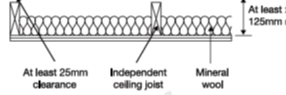
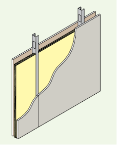
This acoustic solution is generally metal based and vary in thickness from 11 mm to 30 mm. They are mounted perpendicular to the joist span direction and can increase both airborne and impact sound insulation. Care should be taken to ensure that the ceiling board fixings into the resilient bar do not come into contact with the joists and reduce the potential performance.

Resilient noggin
This is a small section of resilient ceiling bar which is used to assist in bracing non load bearing partitions.

Rw
This is a single-number quantity (weighted) which characterises the airborne sound insulation of a building element from measurements undertaken in a laboratory, in accordance with BS EN ISO 717-1: 1997

Sound Insulation Testing
Sound Insulation Testing is required near the end of a development to show that the performance of the party wall and floor partitions meet the standards as stipulated in Building Regulations Approved Document E. The testing methods for airborne and impact sound insulation is in full accordance with the suggested methods presented in BS EN ISO 140-parts 4 & 7: 1998.

Stiffness
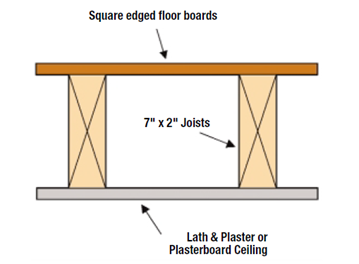
This is can improve low-frequency sound insulation, for example in floors, by reducing the potential for deflection or movement of the primary structure, therefore the correct spacing and depth of joists is important.

If you have a project that requires acoustic design and/or sound insulation testing please let us know. APT Sound Testing will ensure you will have direct contact with the allocated acoustician from the start of the process, through to the successful completion of the sound insulation testing. 

For more information about Sound Insulation Testing Terminology or with regard to acoustic services, please contact us at via our APT Sound Testing website or call us today on 01525 303905.

UKAS Accredited Air and Sound Testing Laboratory

UKAS Accredited Air and Sound Testing Laboratory

Why we are a UKAS Accredited Air and Sound Testing Laboratory

APT Sound Testing is UKAS accredited for both sound insulation testing and air tightness testing. Being a UKAS accredited laboratory for air and sound testing, provides an assurance of the competence, impartiality and integrity of the testing body. UKAS accredited testing reduces the need for testing company to be assessed by each of their customers.

UKAS’ involvement in international groups such as EAIAF and ILAC, provides for mutual recognition. This reduces the need for multiple assessments of suppliers, and as a consequence helps to reduce barriers for testing companies that have UKAS accreditation.

Most businesses – big or small within the industry they operate in, require some form of certification. This is the ultimate mark of quality and professionalism within their sector. With so many types of accreditation to choose from nowadays, it can be difficult to know what type would be best for your company. One place to start is by making sure that the testing consultancy you use is UKAS accredited. This is something you simply cannot afford to overlook.

Why we are a UKAS Accredited Air and Sound Testing Laboratory

What is UKAS accreditation?

UKAS stands for the United Kingdom Accreditation Service. It is the only government recognised national accreditation body in Britain. It has been designed to evaluate the competence of all organisations that supply services relating to certification, calibration, inspection, and testing. If a certification body meets their standards, they will then be accredited. If an organisation has reached this status, it means that they have the ability to deliver results while being reliable, impartial, and competent. Therefore, if you choose a UKAS accredited certification body, you can be certain of the highest levels of quality. APT Sound Testing is UKAS accredited for both sound insulation testing and air tightness testing, so you can be sure of the highest quality testing services and reportage at all times.

Why are not all companies UKAS accredited?

Unlike many other certification bodies, UKAS is a non-profit organisation, meaning their sole purpose is to ensure that companies are regulated properly and high standards are achieved at all times. This offers customers ultimate peace of mind. Other companies that don’t have UKAS certification, may have lower prices in some instances as they are not bound by the more stricter guidelines put in place by the United Kingdom Accreditation Service. If the company you are using is not UKAS accredited it may mean that you are taking a massive risk, as the quality of product testing and auditing quality may vary. If the company you are using for your air tightness and/or sound testing has not sought UKAS certification, it can be a good indicator that the quality may be lower.

Why we are a UKAS Accredited Air and Sound Testing Laboratory

Why it’s important to be UKAS accredited

There are also a lot of non-accredited air and sound testing companies that offer their service on a no certificate no fee basis; however, although this may seem great on the surface it usually means is that a certificate is barely ever refused. This does not say a lot for the quality of the testing company if they are simply allowing anyone to achieve their certification. It goes completely against the international standard that UKAS adheres to. Also, their accreditation isn’t worth much when you consider that they do not have to adhere to any regulatory constraints, and thus they offer little assurance in terms of accountability, impartiality, or integrity. Hats why it’s really important to use UKAS accredited testing laboratories like APT Sound testing for all your air tightness and  sound insulation testing.

How can I tell if an organisation is UKAS certified?

So, how can you tell if an organisation is UKAS certified? Well, all accredited businesses are allowed to use the Royal Crown symbol. Thus, you simply need to look out for this. Alternatively, you can head to the UKAS website at www.ukas.com , and you will find a list of all certified bodies under the ‘Accredited Bodies’ tab on the homepage. For peace of mind here is a direct link to APT sound testing’s UKAS accreditation.

Why we are a UKAS Accredited Air and Sound Testing Laboratory

We are a UKAS accredited company

Here at APT Sound Testing, we are happy to prove our UKAS certification. As a UKAS accredited laboratory we are committed to providing quality consultancy services to your business. If you want to know more about how we can help you with our UKAS accredited air and acoustic testing services, please contact us on 01525 303905 or email us at info@aptsoundtesting.co.uk  and we’ll be happy to talk you through our precompletion testing services or supply a free no obligation quote.

Precompletion Testing Services for Dwellings

Precompletion Testing Services for Dwellings

Our Pre-completion Testing Services for Dwellings

Whatever you’re testing or survey requirements for dwellings, APT Sound Testing are here to help you every step of the way with your pre completion Testing needs. Working in close partnership with our customers we guide them through the precompletion testing process, providing impartial advice from the initial design stage through to the precompletion testing at the end of the project. With over 20 years’ worth of experience under our belt, we ensure that clients always achieve the required result and that reports are completed within specific timeframes whilst maintaining the standards of a UKAS accredited testing laboratory (No. 4340).

We pride ourselves on delivering a proactive, cost-effective service and offer one point of contact throughout your contract. This customer-focused ethos has seen us partner with consultants, developers, contractors and self-builders on a wide range of their residential developments.

Sound Insulation Testing for Dwellings

Pre completion sound testing under Part E of Building Regulations has been a mandatory requirement since July 2003. All new build properties and conversions which were built after this date require 10% of each party wall/floor construction type to be tested. Sound Testing is to be carried out between pairs of rooms separated by party walls or floors.

Utilising our many years of acoustic design experience means that your project will be in safe hands from the initial design stage to the final precompletion testing of the project. If you require sound insulation testing on your project please contact us now. Our highly experienced team of engineers and consultants provide a friendly and cost-effective sound testing service, to achieve the requirements of Approved Document E throughout the UK. We are a UKAS accredited laboratory so providing our customers a first class service with quality reportage is a given.

For more information on our sound insulation testing service or to prepare your development, please download our sound test checklist.

Precompletion Testing Services for Dwellings

Air Tightness Testing to Dwellings

Air tightness testing to achieve satisfactory levels of air tightness became a legal requirement in 2006 in England and Wales, under Building Regulations Part L and ATTMA Technical Standard TS1, to help to reduce carbon emissions. Building Regulations Part L defines ‘air leakage’ as the uncontrolled flow of air through gaps and cracks in the fabric of a building. The general public recognise it as draughts.

When you lose energy through the building fabric this is known as the building emission rate. New projects/developments must meet specific requirements for air testing and emission rates. A common air leakage target for a standard dwelling is 5.0m3/hr/m2; however, for commercial buildings the target rate is often much lower approx. 3.0m3/hr/m2

If you require domestic air tightness testing please contact us now. Our highly experienced team of engineers and consultants provide a friendly and cost-effective air testing service, to achieve the requirements of Approved Document L throughout the UK. We are a UKAS accredited laboratory so providing our customers a first class service with quality reportage is a given.

For more information on our air tightness testing service or to prepare your development, please download our air testing checklist.

Precompletion Testing Services for Dwellings

Extract Vent Testing to Dwellings

The new Part F of Building Regulations requires standard intermittent extractor fans such as bathrooms and kitchens in new buildings, to have their air flow rates measured on site and the results submitted to the building control body prior to completion and handover.

We can undertake the extractor fan testing at the same time as the air and sound testing which helps to reduce coordination issues as well as offering a substantial cost saving. We also provide expert advice for helping customers to achieve compliance with approved document F for domestic extract fan testing.

If you require domestic extract vent testing please contact us now. Our highly experienced team of engineers and consultants provide a friendly and cost-effective extract vent testing service to achieve the requirements of Approved Document F throughout the UK. We are a UKAS accredited laboratory so providing our customers a first class service with quality reportage is a given.

For more information on our extract fan testing service or to prepare your development, please download our extract fan testing checklist.

Acoustic Design service for Dwellings

APT Sound Testing has many years’ experience of acoustic design, supported by our vast experience in construction design management and by utilising the data from thousands of sound insulation tests, which gives us a clear understanding of the positives and negatives of many different construction types. This gives us a clear understanding of the requirements necessary to pass your sound testing in line with The Building Regulations Approved Document E. We have undertaken hundreds of acoustic design and testing packages on many different types of projects, from the initial scheme stage to completion. We offer a no nonsense professional proactive service that ensures your company receives professional advice every step of the way, with a continual consideration of cost.

If you require acoustic design to your project please contact us now, we help clients with acoustic party wall & floor design to achieve the requirements of Approved Document E. Our highly experienced team of engineers and consultants provide a friendly and cost-effective design service. We are a UKAS accredited laboratory so providing our customers a first class service with quality reportage is a given.

For more information on our acoustic design service

SAP Calculations & EPC for Dwellings

SAP Assessments to show compliance with the Building Regulations (Approved Document L1A or Approved Document L1B) for domestic new build and converting an existing property into any number of dwellings. SAP Assessments are also sometimes called SAP Calculations, SAP Ratings or SAP Certificates. It is from these calculations that an EPC is produced. SAP stands for Standard Assessment Procedure and it is used to assess and compare the energy and environmental performance of dwellings.

It is worth noting that SAP assessments have been a legal requirement for all new-build, domestic properties in the UK under Part L of Building Regulations since 1995. Homes must achieve a ‘Pass’ on these calculations for the project to pass Building Regulations. Without this, a property will not be signed off by Building Control and may not legally be listed for rent or sale.

APT Sound Testing carries out SAP Calculations every day and by involving one of our trained consultants in the initial planning stages; we can help develop the project so that not only do you get the house you want, but that it meets all Building Regulation and environmental guidelines. Our highly experienced team of engineers and consultants provide a friendly and cost-effective service throughout your project.

For more information on our SAP Calculation service or to prepare your development, please download our SAP Calculation checklist.

Water Efficiency Calculations

Water efficiency calculations are required by the Government in the United Kingdom under Building Regulations Part G. All new dwellings and commercial developments require water calculations to help ensure that they have suitable water provisions to accommodate proposed activities. Additionally, water efficiency calculations also help to ensure that the maximum amount of water being used by a person within a property or development does not exceed a limit of 125 litres of water, per person each day.

If you need any advice for your water efficiency calculations, please contact us now. We have the expertise and experience in helping our clients attain the level of efficiency their project requires through our informative water calculation processes. Using our knowledge hydro dynamics we can attain acceptable water calculations on your project. We can take into account high pressure and low-pressure systems, as well as grey-water systems and rain-water type systems.

Contact Us Re: Precompletion Testing Services for Dwellings

Please contact us now to chat about your water calculation assessment requirements. Our friendly and experienced team of consultants are here to help you achieve your water efficiency calculations in compliance with Building Regulations Part G.

For more information on our water calculation assessment service or to prepare your development, please download our water calculation checklist.